

Slope or Gradient of a Straight Line
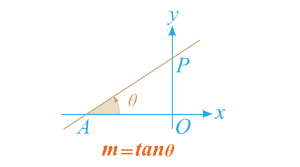
Slope or Gradient of a Straight Line
🔹 ∵ ∠XAP = θ, then m = tanθ
🔹 The slope of a line is the tangent of the angle which the part of the line above the x-axis makes with the positive direction of the x-axis.
Particular Cases:
🔹 θ is measured positively, i.e., in the anti-clockwise direction from 0° to 180°.
🔹 The slope of a line is positive if it makes an acute angle in the anti-clockwise direction with the x-axis.
🔹 The slope of the line is negative if the line makes an obtuse angle in the anti-clockwise direction with the x-axis.
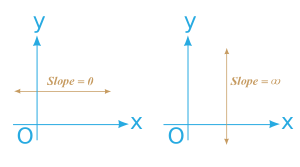
Parallel to the axes
🔹 The slope of a line is zero if the line is parallel to the x-axis. θ = 0° then, m = 0 (∵ tan 0° = 0)
🔹 The slope of a line parallel to the y-axis is not defined. θ = 90° then, m = ꝏ (∵ tan 90° = ꝏ).
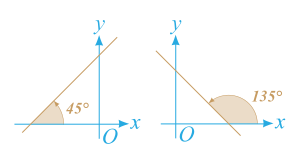
Slope of a line making equal angles with the axes
🔹 If θ = 45° then, m = 1 (∵ tan 45° = 1)
🔹 If θ = 135° then, m = -1 (∵ tan 135° = -1)
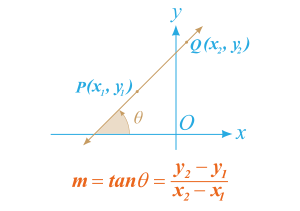
Slope of a line joining two points
🔹 Slope of a line joining two points (x1, y1) and (x2, y2)
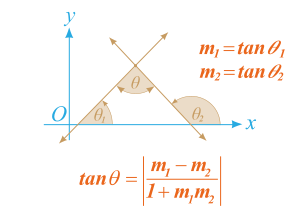
Angle Between two Straight Lines
🔹 The angle θ between two lines whose slopes m1 and m2
Particular Cases:
🔹 Two lines are parallel when, m1 = m2.
🔹 Two lines are perpendicular when, m1 m2 = -1.


