

Triangles and Types of Triangles
🎯 What will you learn in this lesson?
👉 Define a triangle and identify its sides, vertices and interior angles.
👉 Classify triangles by sides and by angles.
👉 Explain the properties of scalene, isosceles and equilateral triangles.
👉 Explain the properties of acute, right and obtuse triangles.
A triangle is a closed plane figure formed by joining three non-collinear points in pairs with three line segments. Non-collinear means that the three points do not lie on one straight line.
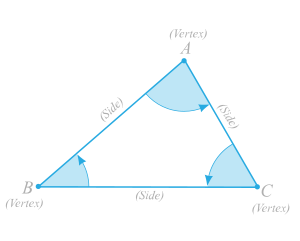
Triangle
△ABC
A triangle has three sides and three vertices.
The vertices of △ABC are A, B and C. Its sides are AB, BC and CA.
A point where two sides meet is called a vertex. At each vertex, the two sides form an interior angle on the inside of the triangle.
The interior angles of △ABC are ∠ABC, ∠BCA and ∠CAB. In plane geometry, their sum is 180°, or two right angles.
📚 ∠ABC + ∠BCA + ∠CAB = 180°
🔹 Types of Triangles by Sides
Three named types based on side lengths

Scalene Triangle
Isosceles Triangle
Equilateral Triangle
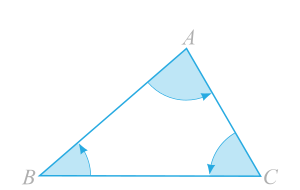
Scalene Triangle
AB ≠ BC, BC ≠ CA and CA ≠ AB
∠A ≠ ∠B, ∠B ≠ ∠C and ∠C ≠ ∠A
A scalene triangle has three unequal side lengths.
Its three interior angles are also unequal.
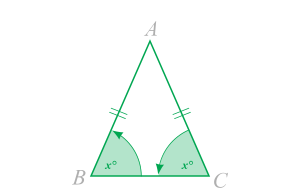
Isosceles Triangle
AB = AC and ∠ABC = ∠BCA
An isosceles triangle has at least two equal side lengths.
The angles opposite the equal sides are equal.
Taking BC as the base, ∠ABC and ∠BCA are the base angles.
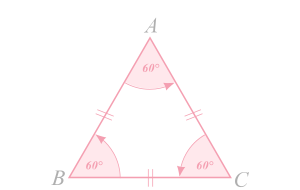
Equilateral Triangle
AB = BC = CA
∠A = ∠B = ∠C = 60°
An equilateral triangle has three equal side lengths and three equal interior angles.
Definition used in this lesson: “Isosceles” means at least two equal sides. Therefore, an equilateral triangle is also a special case of an isosceles triangle. We discuss equilateral triangles separately because of their additional properties.
🔹 Types of Triangles by Angles
A triangle cannot have more than one angle that is right or obtuse. If two angles were each at least 90°, their sum would be at least 180°, leaving no positive measure for the third angle.
In a right-angled triangle, the other two angles add up to 90°. They are acute and complementary.
The side opposite the right angle is called the hypotenuse. It is the longest side of the right-angled triangle.
Three types based on angle measures
Acute-angled Triangle
Right-angled Triangle
Obtuse-angled Triangle
Acute-angled Triangle
∠A < 90°, ∠B < 90°, ∠C < 90°
Every interior angle is less than 90°.
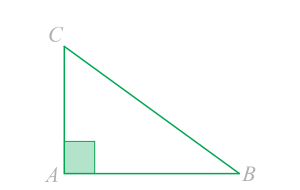
Right-angled Triangle
One interior angle is 90°.
The other two interior angles are acute and add up to 90°.
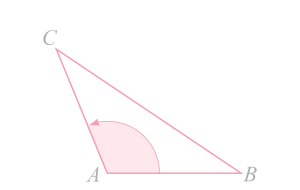
Obtuse-angled Triangle
One interior angle is greater than 90°.
The other two interior angles are acute.
📚 We use the ideas of similar and congruent triangles to compare two triangles. Similar triangles have equal corresponding angles and proportional corresponding sides. Congruent triangles have the same shape and size. You will study these ideas in later lessons.
👉 Two Ways to Describe the Same Triangle
A triangle can be described separately by its side lengths and by its angle measures.
For example, a triangle with angles 45°, 45° and 90° is right-angled. Since two angles are equal, the sides opposite them are also equal, so it is isosceles. It is therefore an isosceles right-angled triangle.
Every equilateral triangle is acute-angled because each angle is 60°. However, not every acute-angled triangle is equilateral.
✍ Simple Solved Examples
✏️ Example 1: Identify a triangle by its sides
Question: A triangle has side lengths 5 cm, 5 cm and 8 cm. What type is it by sides?
Solution: Two sides have equal lengths. Therefore, it is an isosceles triangle.
✏️ Example 2: Find the third angle
Question: Two angles of a triangle are 50° and 60°. Find the third angle and classify the triangle by angles.
Solution: Third angle = 180° − (50° + 60°) = 70°.
All three angles are less than 90°, so the triangle is acute-angled.
✏️ Example 3: Angles of an isosceles triangle
Question: In △ABC, AB = AC and ∠A = 40°. Find ∠B and ∠C.
Solution: Since AB = AC, the opposite angles are equal: ∠B = ∠C.
∠B + ∠C = 180° − 40° = 140°.
Therefore, ∠B = ∠C = 140° ÷ 2 = 70°.
✏️ Example 4: Angles of an equilateral triangle
Question: Why is each angle of an equilateral triangle 60°?
Solution: The three angles are equal because the three sides are equal. Their sum is 180°.
Therefore, each angle = 180° ÷ 3 = 60°.
🧠 Quick Revision
🔹 A triangle has three sides, three vertices and three interior angles.
🔹 In plane geometry, its interior angles add up to 180°.
🔹 A scalene triangle has three unequal side lengths.
🔹 An isosceles triangle has at least two equal sides; the angles opposite equal sides are equal.
🔹 An equilateral triangle has three equal sides, and each angle is 60°. Under our definition, it is also isosceles.
🔹 Every angle of an acute-angled triangle is less than 90°.
🔹 A right-angled triangle has one angle of 90°; the other two add up to 90°.
🔹 An obtuse-angled triangle has one angle greater than 90° and two acute angles.
🔹 A triangle cannot have two right angles, two obtuse angles, or one of each.
🔹 The same triangle can be classified by both sides and angles.


