

Equation of a Circle
A circle is the locus of a moving point in a plane that always remains at a constant distance from a fixed point in the same plane.
The fixed point is called the centre of the circle, and the constant distance is called its radius.
Suppose the centre of the circle is O and its radius is r. For any point P on the circle,
OP = r
When this geometric condition is expressed using coordinates, we obtain the equation of the circle.
👉 Equation of a Circle Centred at the Origin
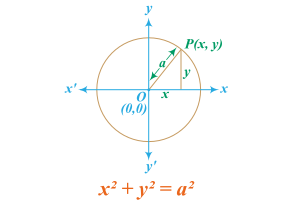
Suppose the centre of a circle in the Cartesian plane is the origin O(0, 0), and P(x, y) is any point on the circle. Let the radius of the circle be a.
By the Distance Formula,
OP = √(x² + y²)But OP = a.
Therefore,
√(x² + y²) = aSquaring both sides,
x² + y² = a²
This is the standard equation of a circle with centre at the origin and radius a.
Example
If a circle has centre (0, 0) and radius 5 units, its equation is
x² + y² = 5²Therefore,
x² + y² = 25
👉 Equation of a Circle with Centre (α, β)
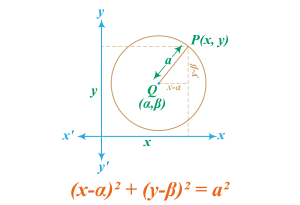
Suppose the centre of a circle is Q(α, β), P(x, y) is any point on the circle, and the radius is a.
Then,
QP = aUsing the Distance Formula,
√((x - α)² + (y - β)²) = aSquaring both sides,
(x - α)² + (y - β)² = a²
This is the standard form of a circle with centre (α, β) and radius a.
Remember
From the equation (x - α)² + (y - β)² = a², we can directly identify:
- Centre = (α, β)
- Radius = a
Example
(x - 3)² + (y + 2)² = 16Here,
- Centre = (3, -2)
- Radius = 4
because (y + 2) = (y - (-2)).
👉 General Equation of a Circle
The standard equation of a circle is
(x - α)² + (y - β)² = a²Expanding,
x² + y² - 2αx - 2βy + α² + β² - a² = 0This is commonly written as
x² + y² + 2gx + 2fy + c = 0
Comparing the two forms,
g = -α and f = -β
Therefore, the centre of the circle is
(-g, -f)
and its radius is
r = √(g² + f² - c)
For the equation to represent a real circle with positive radius,
g² + f² - c > 0must hold.
Example
Consider the circle
x² + y² - 6x + 4y - 3 = 0Here,
2g = -6 ⇒ g = -3 2f = 4 ⇒ f = 2and c = -3.
Therefore, the centre is
(-g, -f) = (3, -2)and the radius is
r = √(g² + f² - c) = √(9 + 4 + 3) = 4Thus, the circle has centre (3, -2) and radius 4 units.
👉 Finding the Centre and Radius by Completing the Square
If the general equation of a circle is given, it can also be converted into standard form using the completing the square method.
For example,
x² + y² - 6x + 4y - 3 = 0Then,
(x² - 6x) + (y² + 4y) = 3Completing the square,
(x - 3)² - 9 + (y + 2)² - 4 = 3Therefore,
(x - 3)² + (y + 2)² = 16
So the centre is (3, -2) and the radius is 4.
👉 Parametric Equations of a Circle
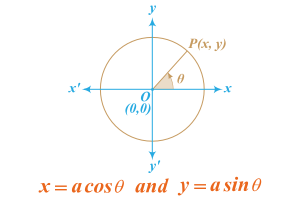
Suppose the origin O(0, 0) is the centre of a circle of radius a, and P(x, y) is a point on the circle. If OP makes an angle θ with the positive x-axis, then from trigonometric ratios,
cosθ = x/aand
sinθ = y/aTherefore,
x = a cosθ and y = a sinθ
These are the parametric equations of a circle centred at the origin.
If the centre of the circle is (α, β), the parametric equations are
x = α + a cosθ
y = β + a sinθ
👉 Equation of a Circle When the Endpoints of a Diameter Are Given
If the endpoints of a diameter of a circle are A(x₁, y₁) and B(x₂, y₂), then for any point P(x, y) on the circle, ∠APB = 90°.
Using this condition, the equation of the circle is
(x - x₁)(x - x₂) + (y - y₁)(y - y₂) = 0
Example
If the endpoints of a diameter are A(2, 0) and B(6, 0), then
(x - 2)(x - 6) + y² = 0That is,
x² - 8x + 12 + y² = 0Therefore,
x² + y² - 8x + 12 = 0
Here, the centre is (4, 0) and the radius is 2.
👉 Quick Formula Revision
| Type of Circle / Result | Equation / Formula |
|---|---|
| Centre (0, 0), radius a | x² + y² = a² |
| Centre (α, β), radius a | (x - α)² + (y - β)² = a² |
| General form | x² + y² + 2gx + 2fy + c = 0 |
| Centre from the general form | (-g, -f) |
| Radius from the general form | √(g² + f² - c) |
| Parametric form, centre (0,0) | x = a cosθ, y = a sinθ |
👉 Important Points
- In the equation of a circle, the coefficients of x² and y² are equal.
- The general equation of a circle does not contain an xy term.
- From the standard form, the centre and radius can be identified directly.
- From the general form, the centre is (-g, -f) and the radius is √(g² + f² - c).
- The parametric form is especially useful for representing the coordinates of a moving point on a circle.
Once these formulas are clearly understood, it becomes much easier to form equations of circles, determine their centres and radii, and solve many Class 11 Coordinate Geometry problems.


