

Basic Concepts of Geometry
🎯 What will you learn in this chapter?
👉 The difference between a point, line, line segment and ray
👉 How to identify straight lines and curves
👉 Collinear points and concurrent lines
👉 The main properties of lines, line segments and rays
👉 Point
A point represents an exact position or location. It has no length, width, height or thickness. When two lines, line segments or rays meet or cross, their common location is called a point of intersection.
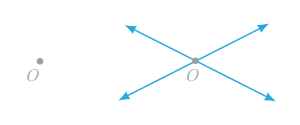
Point & Point of Intersection
A point represents an exact position and has no dimensions.
Main properties of a point
🔹 A point is one of the basic elements of geometry.
🔹 A point has no dimensions; it indicates only a position.
🔹 A point has no length, width, height or thickness.
🔹 In two-dimensional coordinate geometry, a point can be represented by (x, y).
🔹 In three-dimensional coordinate geometry, a point can be represented by (x, y, z).
📚 Points that lie on the same straight line are called collinear points.
Concurrent Lines
If two or more lines pass through the same point, they are called concurrent lines. Their common point is called the point of concurrence.
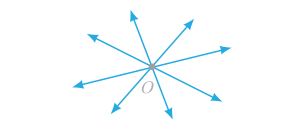
Concurrent Lines
Two or more lines passing through the same point.
👉 Line
In geometry, a line can be thought of as a continuous path made up of points. At the introductory level, we can distinguish between curves and straight lines.
Line

Curve
Straight Line
👉 Curve
A curve is a path that may bend or change direction. At a basic level, curves can be grouped into two common types: open curves and closed curves.
Curve
Open Curve
Closed Curve
🔹 Open Curve: A curve whose two ends do not meet is called an open curve.
🔹 Closed Curve: A curve whose two ends meet to form a closed shape is called a closed curve.
💡 In higher classes, you will study different curves such as circles, parabolas and ellipses in greater detail.
👉 Straight Line
Exactly one straight line can be drawn through any two distinct points. A straight line has no endpoints and extends infinitely in both directions. The line segment joining two points gives the shortest path between those points.

Straight Line
A straight path that extends infinitely in both directions.
Main properties of a straight line
🔹 A straight line is considered to have length but no width or thickness.
🔹 It extends infinitely in both directions, so it has no endpoints.
🔹 Two distinct points determine a unique straight line.
🔹 A straight line contains infinitely many points.
👉 Line Segment
A line segment is the part of a straight line between two fixed endpoints. Since both endpoints are fixed, the length of a line segment can be measured.

Line Segment
Part of a straight line with two fixed endpoints.
📚 The distance between two points is the length of the line segment joining them.
👉 Ray
A ray is the part of a straight line that starts from one fixed endpoint and extends infinitely in one direction.

Ray
A part of a line with one endpoint, extending infinitely in one direction.
🔹 A ray has one endpoint or starting point.
🔹 It extends infinitely in one direction.
🔹 A ray is sometimes also called a half-line.
Difference Between a Line, Line Segment and Ray
| Figure | End Points | Extension | Can Length Be Measured? |
|---|---|---|---|
| Straight Line | None | Extends infinitely in both directions | No |
| Line Segment | Two | Between two fixed points | Yes |
| Ray | One | Extends infinitely in one direction | No |
⚠️ Common misconceptions
🔹 A point may be drawn as a small dot, but a mathematical point has no actual size.
🔹 A straight line does not have two endpoints; it extends infinitely in both directions.
🔹 A line and a line segment are not the same. A line segment has two fixed endpoints.
🔹 A ray does not have a fixed length because it extends infinitely in one direction.
✅ Quick Revision
🔹 A point has no dimensions; it represents a position.
🔹 Collinear points lie on the same straight line.
🔹 Concurrent lines pass through the same point.
🔹 A straight line extends infinitely in both directions.
🔹 A line segment has two fixed endpoints and a measurable length.
🔹 A ray has one endpoint and extends infinitely in one direction.


