

👉 Different Forms of the Equation of a Straight Line
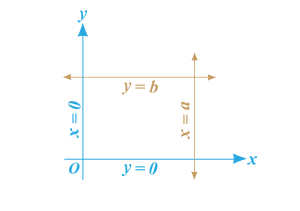
Equations of a Straight Line
🔹 The equation of the x-axis is y = 0, and the equation of the y-axis is x = 0.
🔹 A straight line parallel to the x-axis has the equation y = b, where b represents its perpendicular distance from the x-axis when the line lies at y=b.
🔹 A straight line parallel to the y-axis has the equation x = a, where a represents its perpendicular distance from the y-axis when the line lies at x=a.

Slope-Intercept Form of a Straight Line
y = mx + c
In this equation, m represents the slope of the straight line and c represents the intercept on the y-axis.
y = mx
This equation represents a straight line passing through the origin (0, 0), so c = 0.
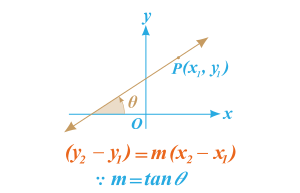
Equation of a Line with a Given Point and Slope
(y - y1) = m (x - x1)
This is the equation of a straight line passing through (x1, y1) with slope m = tan θ.
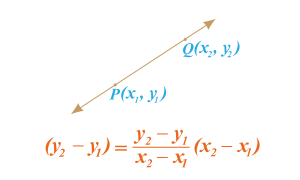
Equation of a Straight Line Through Two Points
This form represents the equation of the straight line passing through the two points (x1, y1) and (x2, y2), provided x1 ≠ x2.
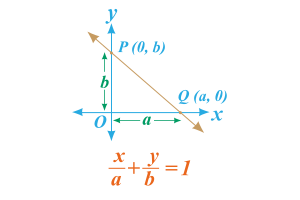
Intercept Form of a Straight Line
This form represents a straight line whose intercepts on the x-axis and y-axis are a and b respectively.
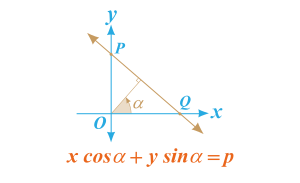
Normal Form of a Straight Line
x cosα + y sinα = p
This is the normal form of a straight line. Here p is the perpendicular distance from the origin to the line, and this perpendicular makes an angle α with the positive direction of the x-axis.
📚 The value of p is always taken as positive, while α may be an acute or an obtuse angle depending on the position of the line.
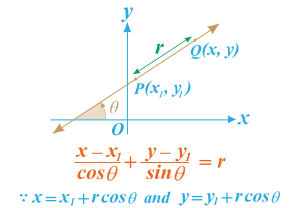
Symmetric Form of a Straight Line
In this equation, r is the directed distance from P(x1, y1) to Q(x, y) along the line, and the line makes an angle θ with the positive direction of the x-axis.
📚 x = x1 + r cosθ and y = y1 + r sinθ
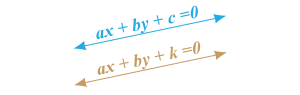
Equation of a Line Parallel to a Given Line
🔹 A line parallel to the given line ax + by + c = 0 can be written as ax + by + k = 0, where k is a constant.
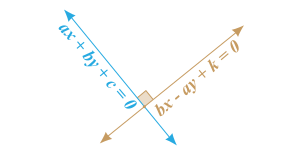
Equation of a Line Perpendicular to a Given Line
A line perpendicular to the given line ax + by + c = 0 can be written as bx - ay + k = 0, where k is a constant.
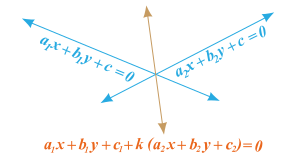
Equation of a Line Through the Intersection of Two Given Lines
If the two given lines are a1x + b1y + c1 = 0 and a2x + b2y + c2 = 0, then a line passing through their point of intersection can be written as
a1x + b1y + c1 + k (a2x + b2y + c2) = 0
where k is a constant.
🧠 Quick Formula Revision
| Topic | Formula / Result |
|---|---|
| Slope-Intercept Form | y = mx + c |
| Line through the origin | y = mx |
| Point-Slope Form | y − y₁ = m(x − x₁) |
| Two-Point Form | |
| Intercept Form | |
| Normal Form | x cosα + y sinα = p |
Parallel to the x-axis | y = b |
Parallel to the y-axis | x = a |
📚 Important Points
🔹 In y = mx + c, m is the slope of the line and c is its y-intercept.
🔹 A vertical line has an undefined slope, so it cannot be written in the form y = mx + c. A vertical line has the equation x = a.
🔹 Point-Slope Form is especially useful when one point on the line and the slope are known.
🔹 Before using the Two-Point Form, check that x₂ − x₁ ≠ 0. If x₁ = x₂, the line is vertical and its equation is x = x₁.
🔹 The lines ax + by + c = 0 and ax + by + k = 0 are parallel.
🔹 You can find a line passing through the intersection of two lines without explicitly calculating the intersection point by using L₁ + λL₂ = 0.
✏️ Solved Examples
Example 1: From a Point and Slope
Find the equation of the straight line passing through (2, 3) with slope 4.
y − 3 = 4(x − 2) ⇒ y = 4x − 5Therefore, the equation of the line is 4x − y − 5 = 0.
Example 2: From Two Points
Find the equation of the straight line passing through A(1, 2) and B(5, 10).
y − 2 = 2(x − 1) ⇒ 2x − y = 0Example 3: Parallel Line
Find the equation of the line parallel to 3x + 2y − 7 = 0 and passing through (2, 1).
A parallel line has the form 3x + 2y + k = 0. Substituting the point,
6 + 2 + k = 0 ⇒ k = −8Therefore, the required equation is 3x + 2y − 8 = 0.


