

Critical Angle and Total Internal Reflection
When light travels from a denser medium to a rarer medium, it bends away from the normal. If the angle of incidence is increased, the angle of refraction also increases.
At a particular angle of incidence, the refracted ray travels along the boundary between the two media. This angle of incidence is called the critical angle.
Critical Angle
The critical angle is the angle of incidence in the denser medium for which the angle of refraction in the rarer medium becomes 90°.
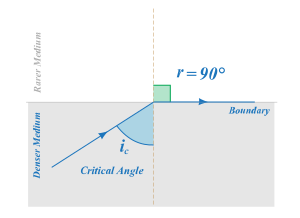
Critical Angle
At critical angle, the refracted ray travels along the surface separating the two media.
If the critical angle is C and the refractive index of the denser medium with respect to air is μ, then:
This formula is used when light travels from a denser medium to air.
Total Internal Reflection
When the angle of incidence in the denser medium is greater than the critical angle, light does not pass into the rarer medium. It is completely reflected back into the denser medium. This phenomenon is called total internal reflection.
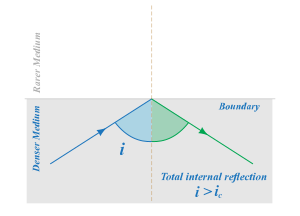
Total Internal Reflection
Light returns completely into the denser medium.
Conditions for Total Internal Reflection
⭐ Light must travel from a denser medium to a rarer medium.
⭐ The angle of incidence in the denser medium must be greater than the critical angle.
Difference Between Reflection and Total Internal Reflection
| Point | Ordinary Reflection | Total Internal Reflection |
|---|---|---|
| Where it occurs | At a reflecting surface | At the boundary of denser and rarer media |
| Light returned | Only a part of light may return | Almost all light returns |
| Condition | No critical angle condition | Angle of incidence must be greater than critical angle |
Examples of Total Internal Reflection
⭐ Sparkling of diamonds.
⭐ Mirage on hot roads.
⭐ Working of optical fibres.
⭐ Shining of air bubbles in water.
⭐ Total reflecting prisms used in periscopes and binoculars.
Important Points to Remember
⭐ Critical angle is possible only when light travels from denser to rarer medium.
⭐ At critical angle, the angle of refraction is 90°.
⭐ In total internal reflection, light is completely reflected back into the denser medium.
⭐ Total internal reflection needs two conditions: denser to rarer medium and angle of incidence greater than critical angle.
Common Mistakes
| Mistake | Correct Idea |
|---|---|
| Total internal reflection can occur from rarer to denser medium. | It occurs only from denser to rarer medium. |
| At critical angle, light returns completely. | At critical angle, the refracted ray travels along the boundary. |
| Critical angle is the angle of refraction. | Critical angle is the angle of incidence in the denser medium. |
Questions and Answers
Critical angle is the angle of incidence in the denser medium for which the angle of refraction in the rarer medium becomes 90°.
Total internal reflection is the complete reflection of light back into the denser medium when the angle of incidence is greater than the critical angle.
Light must travel from denser to rarer medium, and the angle of incidence must be greater than the critical angle.
For a denser medium with refractive index μ with respect to air, .


