

Trigonometrical Ratios
The study of the three angles, three sides, and their mutual relationships in a triangle is an important part of trigonometry. To understand these relationships clearly, trigonometrical ratios are defined.
In this lesson, we will learn the six trigonometrical ratios of a positive acute angle and their mutual relationships in a simple way.
Concept of Trigonometrical Ratios
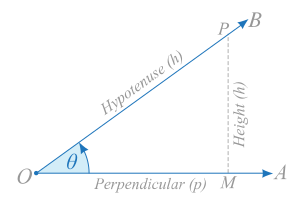
🔹 Trigonometrical Ratios
Suppose OB is a a ray that can rotate around its initial point while the initial point remains fixed.. It has rotated anticlockwise about the point O from the position OA to the position OB. As a result, ∠AOB is formed.
Let ∠AOB = θ, where θ is an acute angle.
θ is a Greek letter. It is pronounced as “theta”.Now take any point P on the ray OB. From P, draw PM perpendicular to OA. Then △POM is a right-angled triangle.
In △POM, OP is called the hypotenuse, PM, the side opposite to the angle θ, is called the perpendicular, and OM, the side adjacent to the angle θ, is called the base.
In short:
Hypotenuse = OP = h
Perpendicular = PM = p
Base = OM = b
Introduction to the Ratios
In a right-angled triangle, with respect to the angle θ, the ratio of the perpendicular to the hypotenuse is called sin θ.
Therefore,
∴ sin θ =
Similarly, the other five ratios can be explained.
The six trigonometrical ratios are:
| sin θ = ---- (i) | cosec θ = ---- (iv) |
| cos θ = ---- (ii) | sec θ = ---- (v) |
| tan θ = ---- (iii) | cot θ = ---- (vi) |
💡 Easy Way to Remember
A simple and common way to remember the first three ratios is:
Some People Have Curly Brown Hair Turn Permanently Black🔹 Some People Have → sin θ =
🔹 Curly Brown Hair → cos θ =
🔹 Turn Permanently Black → tan θ =
After that, the remaining three ratios are easy to find because they are the reciprocal ratios of the first three ratios.
🔹 Reciprocal of sin θ → cosec θ =
🔹 Reciprocal of cos θ → sec θ =
🔹 Reciprocal of tan θ → cot θ =
Reciprocal Relations
∵ sin θ = , and cosec θ =
∴
⇒
⇒
∵ cos θ = , and sec θ =
∴
⇒
⇒
∵ tan θ = , and cot θ =
∴
⇒
⇒
📚 Important Points
👉 sin θ, cos θ, tan θ, and the other trigonometrical ratios are ratios of two lengths. So, they have no unit.
👉 sin θ does not mean sin × θ. It means the ratio of the perpendicular and the hypotenuse with respect to the angle θ.
👉 The side opposite to the right angle is called the hypotenuse. The side opposite to the angle θ is called the perpendicular, and the side adjacent to the angle θ is called the base.
👉 The trigonometrical ratio of a fixed angle depends only on the value of that angle. Even if the size of the triangle changes, the ratio remains the same as long as the angle remains unchanged.
👉 In trigonometry, writing only sin, cos or tan is incomplete. They should be written with a particular angle, such as sin θ, cos θ, tan θ.
👉 sin² θ means (sin θ)². But sin θ² means sin(θ²). So, sin² θ and sin θ² are not the same.
👉 Similarly, (cos θ)⁵ = cos⁵ θ and (tan θ)⁷ = tan⁷ θ can be written.
From the Formula of a Right-Angled Triangle
We know that in a right-angled triangle, the sum of the square of the perpendicular and the square of the base is equal to the square of the hypotenuse.
That is, p² + b² = h²
Dividing both sides by h², we get:
∴
⇒
⇒ (∵ sin θ = and cos θ = )
Again, p² + b² = h²
Dividing both sides by b², we get:
∴
⇒
⇒
⇒ (∵ tan θ = and sec θ = )
⇒
And, p² + b² = h²
Dividing both sides by p², we get:
∴
⇒
⇒
⇒ (∵ cot θ = and cosec θ = )
⇒
📚 Quick Revision
✅ Hypotenuse = h, perpendicular = p, and base = b
⭐ sin θ =
⭐ cos θ =
⭐ tan θ =
⭐ cosec θ =
⭐ sec θ =
⭐ cot θ =
⭐ sin θ × cosec θ = 1
⭐ cos θ × sec θ = 1
⭐ tan θ × cot θ = 1
⭐ sin² θ + cos² θ = 1
⭐ 1 + tan² θ = sec² θ
⭐ 1 + cot² θ = cosec² θ


