

Reflection of Light
When a light ray travelling through a transparent medium falls on the boundary of another medium, a part of the light comes back into the first medium after changing its direction. This phenomenon is called reflection of light.
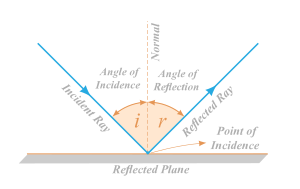
Reflection of Light
Light returns to the same medium after falling on a surface.
Important Terms Used in Reflection
🔹 Incident Ray: The ray of light that falls on the reflecting surface.
🔹 Reflected Ray: The ray of light that returns from the reflecting surface.
🔹 Normal: A line drawn perpendicular to the reflecting surface at the point of incidence.
🔹 Angle of Incidence: The angle between the incident ray and the normal.
🔹 Angle of Reflection: The angle between the reflected ray and the normal.
Laws of Reflection: Light follows two laws during reflection.
👉 The incident ray, the reflected ray and the normal at the point of incidence all lie in the same plane.
👉 The angle of incidence is always equal to the angle of reflection. So, i = r.
Reflection of light is mainly of two types

Regular Reflection
Diffuse Reflection
Regular Reflection: When parallel rays of light fall on a smooth and polished surface, the reflected rays also remain parallel. This is called regular reflection.
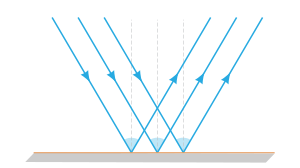
Regular Reflection
It occurs on smooth surfaces like a plane mirror.
Diffuse Reflection: When parallel rays of light fall on a rough surface, the reflected rays travel in different directions. This is called diffuse reflection or irregular reflection.
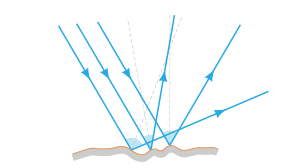
Diffuse Reflection
It occurs on rough surfaces like paper, wall and cloth.
| Point | Regular Reflection | Diffuse Reflection |
|---|---|---|
| Surface | Smooth and polished surface | Rough surface |
| Reflected rays | Remain parallel | Spread in different directions |
| Image | Clear image may be formed | Clear image is not formed |
| Example | Plane mirror | Book, wall, paper |
Image
When rays of light coming from an object meet or appear to meet after reflection or refraction, the point from which they actually meet or seem to come is called the image of the object.
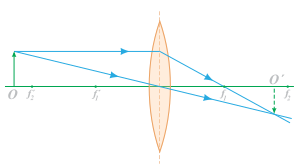
Real Image
A real image is formed by the actual meeting of light rays.
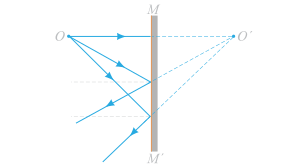
Virtual Image
A virtual image is formed by the apparent meeting of light rays.
Real Image: An image formed by the actual meeting of light rays is called a real image. It can be obtained on a screen.
Virtual Image: An image formed by the apparent meeting of light rays is called a virtual image. It cannot be obtained on a screen.
| Point | Real Image | Virtual Image |
|---|---|---|
| Formation | Actual meeting of rays | Apparent meeting of rays |
| Screen | Can be obtained on a screen | Cannot be obtained on a screen |
| Nature | Usually inverted | Usually erect |
| Example | Image on a cinema screen | Image in a plane mirror |
Common Mistakes
| Mistake | Correct Idea |
|---|---|
| Diffuse reflection does not follow the laws of reflection. | Diffuse reflection also follows the laws of reflection for each small part of the rough surface. |
| The angle is measured from the mirror surface. | The angle of incidence and angle of reflection are measured from the normal. |
| A virtual image can be taken on a screen. | A virtual image cannot be taken on a screen. |
Quick Revision
⭐ Reflection means the return of light into the same medium after falling on a surface.
⭐ The incident ray, reflected ray and normal lie in the same plane.
⭐ The angle of incidence is equal to the angle of reflection.
⭐ Smooth surfaces produce regular reflection.
⭐ Rough surfaces produce diffuse reflection.
⭐ Real images can be obtained on a screen.
⭐ Virtual images cannot be obtained on a screen.
Questions and Answers
When a light ray falls on a surface and returns to the same medium after changing its direction, it is called reflection of light.
There are two laws of reflection.
The angle of incidence is always equal to the angle of reflection.
Reflection from a smooth and polished surface, where reflected rays remain parallel, is called regular reflection.
Reflection from a rough surface, where reflected rays scatter in different directions, is called diffuse reflection.
A book has a rough surface. It produces diffuse reflection, so light reaches our eyes from many directions.
Yes. Both obey the laws of reflection. In diffuse reflection, each small part of the rough surface has its own normal.
An image formed by the actual meeting of light rays is called a real image.
An image formed by the apparent meeting of light rays is called a virtual image.
Try Yourself
-
Draw a diagram showing an incident ray, reflected ray and normal.
-
Write two differences between regular reflection and diffuse reflection.
-
Why is a plane mirror a good reflector?
-
Can diffuse reflection form a clear image? Give reason.


