

Curved Mirror
A mirror whose reflecting surface is curved is called a curved mirror.
A spherical mirror is a curved mirror whose reflecting surface is a part of a sphere.
Spherical mirrors are of two types

Concave Mirror
Convex Mirror
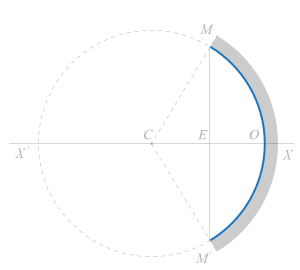
Concave and Convex Mirror
A concave mirror has reflecting surface inside. A convex mirror has reflecting surface outside.
Concave Mirror: A spherical mirror whose inner surface is reflecting is called a concave mirror. It is also called a converging mirror.
Convex Mirror: A spherical mirror whose outer surface is reflecting is called a convex mirror. It is also called a diverging mirror.
Concave Mirror
Reflecting surface is towards the centre of the sphere.
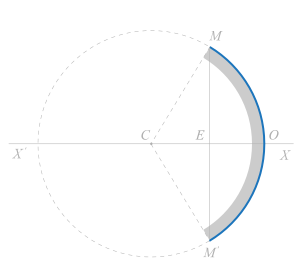
Convex Mirror
Reflecting surface is away from the centre of the sphere.
Pole: The middle point of the reflecting surface of a spherical mirror is called the pole. It is represented by P.
Centre of Curvature: The centre of the sphere of which the mirror is a part is called the centre of curvature. It is represented by C.
Radius of Curvature: The distance between the pole and the centre of curvature is called the radius of curvature. It is represented by R.
Principal Axis: The straight line passing through the pole and the centre of curvature is called the principal axis.
Aperture: The effective diameter of the reflecting surface of a spherical mirror is called its aperture.
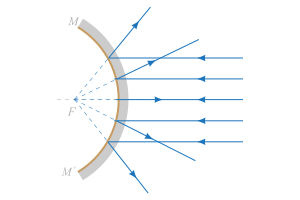
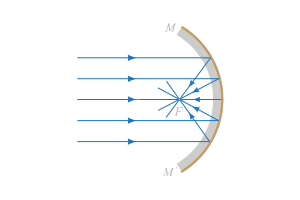
Principal Focus: When rays parallel to the principal axis fall on a spherical mirror, after reflection they meet at a point or appear to come from a point on the principal axis. This point is called the principal focus.
Focus of a Concave Mirror
Parallel rays meet at the focus after reflection.
Focus of a Convex Mirror
Parallel rays appear to come from the focus behind the mirror.
Focal Length: The distance between the pole and the principal focus is called the focal length. It is represented by f.
For a spherical mirror of small aperture:
Use of Concave Mirror
⭐ As a shaving mirror, because it can form an enlarged erect image when the face is close to it.
⭐ As a reflector in torches, searchlights and vehicle headlights.
⭐ By dentists to see a magnified image of teeth.
⭐ In solar cookers, because it can concentrate sunlight at its focus.
Use of Convex Mirror
⭐ As a rear-view mirror in vehicles, because it gives a wide field of view.
⭐ In shops and parking areas for security purposes.
⭐ On road bends to help drivers see vehicles coming from the other side.
Ray Diagram Rules for Spherical Mirrors
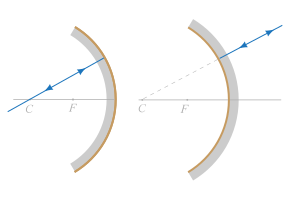
Rule 1
A ray parallel to the principal axis passes through the focus after reflection in a concave mirror.
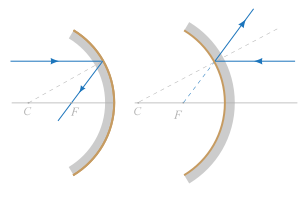
Rule 2
A ray passing through the focus becomes parallel to the principal axis after reflection.
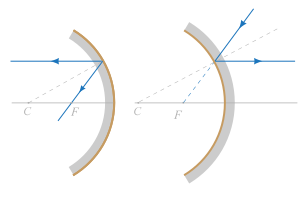
Rule 3
A ray passing through the centre of curvature returns along the same path.
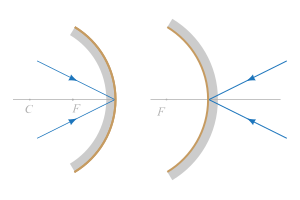
Rule 4
A ray incident at the pole reflects according to the laws of reflection.
For a convex mirror, the reflected rays appear to come from the focus or centre of curvature behind the mirror.
Common Mistakes
| Mistake | Correct Idea |
|---|---|
| Convex mirror is a converging mirror. | Convex mirror is a diverging mirror. |
| Concave mirror always forms a real image. | A concave mirror can form a real or virtual image depending on the object position. |
| Focus and centre of curvature are the same point. | Focus lies midway between the pole and the centre of curvature. |
Questions and Answers
A mirror whose reflecting surface is a part of a sphere is called a spherical mirror.
There are two types: concave mirror and convex mirror.
A spherical mirror whose inner surface is reflecting is called a concave mirror.
A spherical mirror whose outer surface is reflecting is called a convex mirror.
The middle point of the reflecting surface of a spherical mirror is called the pole.
The centre of the sphere of which the mirror is a part is called the centre of curvature.
The distance between the pole and the centre of curvature is called radius of curvature.
The straight line passing through the pole and centre of curvature is called the principal axis.
The point on the principal axis where parallel rays meet or appear to meet after reflection is called the principal focus.
The distance between the pole and the principal focus is called focal length.
It brings parallel rays together at the focus after reflection.
It makes parallel rays appear to spread out from a focus behind the mirror.


