

Measurement of Trigonometrical Angles
🎯 What will you learn by the end of this lesson?
👉 Trigonometrical angles, positive angles, and negative angles
👉 Difference between geometrical angles and trigonometrical angles
👉 Degree system and radian system
👉 Relation among arc length, radius, and angle
👉 A simple explanation of the formula
What is Trigonometry?
Trigonometry is an important branch of mathematics. It studies the sides and angles of triangles and the relationships between them. However, trigonometry is not limited only to triangles. It is also used in angle measurement, rotation, circular motion, waves, astronomy, physics, and many other areas.
In simple words, trigonometry is a method of measurement using angles and ratios.
Difference between Geometrical Angles and Trigonometrical Angles
In elementary geometry, angles are usually discussed from 0° to 360°. In trigonometry, however, an angle can be greater than 360° and it can also be negative. Therefore, trigonometrical angle measurement is broader than geometrical angle measurement.
| Point of comparison | Geometrical Angle | Trigonometrical Angle |
|---|---|---|
| Range | Usually measured from 0° to 360° | Can have any positive or negative value |
| Direction of rotation | The direction of rotation is usually not emphasized | Anticlockwise rotation is positive and clockwise rotation is negative |
| Use | Mostly used in shapes, constructions, and elementary geometry | Used in rotation, waves, circular motion, and higher mathematics |
Concept of a Trigonometrical Angle
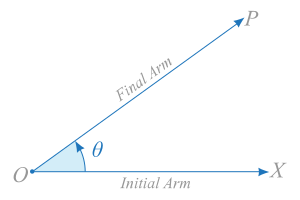
Trigonometrical Angle
Suppose a fixed ray OX is drawn from a point O. Another ray OP rotates about the point O and moves from the position OX to the position OP. The angle formed between the rays OX and OP is called a trigonometrical angle.
• The point O is called the vertex.
• The ray OX is called the initial arm.
• The ray OP is called the final arm.
• ∠XOP is the trigonometrical angle formed by the rotation.
Positive and Negative Angles
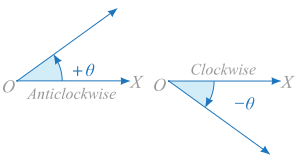
Positive and Negative Angles
In trigonometry, the direction in which an angle is formed is very important.
⭐ If the rotating ray moves in the anticlockwise direction, the angle formed is called a positive angle.
⭐ If the rotating ray moves in the clockwise direction, the angle formed is called a negative angle.
📚 Remember:
⭐ Anticlockwise rotation = Positive angle
⭐ Clockwise rotation = Negative angle
Systems of Measuring Angles
There are different systems for measuring angles in trigonometry. At school level, the degree system and the radian system are used most often.
🔸 Sexagesimal system or degree system (Degree Measure)
🔸 Circular system or radian system (Radian Measure)
🔸 Centesimal system or grade system (Grade Measure)
The grade system is used less often. In this lesson, the first two systems are discussed in detail.
Sexagesimal System or Degree System
In this system, one right angle is divided into 90 equal parts. Each part is called one degree.
⭐ One right angle = 90°
⭐ 1° = 60 minutes = 60′
⭐ 1′ = 60 seconds = 60″
📚 Example: 30° 20′ 15″ means 30 degrees, 20 minutes, and 15 seconds.
Circular System or Radian System
In the circular system, the unit of angle measurement is the radian. The radian system is used more often in higher mathematics, physics, and calculus because it is natural and convenient for circular motion and trigonometric functions.
What is one radian?
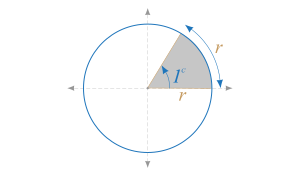
One Radian Angle
In any circle, an arc whose length is equal to the radius of the circle subtends an angle of one radian at the centre.
That is, if the radius of a circle is r, and an arc of length r subtends an angle at the centre, then that central angle is called one radian.
📚 Modern notation: The unit radian is usually written as rad. For example: 1 rad, 2 rad, θ rad.
π, Circumference, and Radian
The ratio of the circumference of a circle to its diameter is always constant. This constant is denoted by π.
⭐ = π
⭐ If the radius is r, then the diameter = 2r
⭐ Therefore, the circumference of the circle = 2πr
📚 π is an irrational number. It cannot be expressed exactly as a ratio of two integers.
⭐ Common approximate value of π =
⭐ A better approximate value of π =
⭐ π ≈ 3.14159
Relation between Degree and Radian
The angle of a complete circle is 360°. The circumference of the same complete circle is 2πr. Therefore, the central angle of a complete circle is 2π radians.
• 360° = 2π radians
• 180° = π radians
• 90° = radians
Therefore, if the degree measure of an angle is D and its radian measure is R, then
| Degree | Radian |
|---|---|
| 0° | 0 |
| 30° | |
| 45° | |
| 60° | |
| 90° | |
| 180° | π |
Relation among Arc, Radius, and Angle
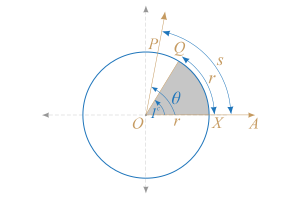
Relation among Arc, Radius, and Angle
In the same circle, the ratio of two arcs is equal to the ratio of the central angles subtended by them. From this idea, we get an important formula of the radian system.
∴
⇒
⇒
⇒
⭐ If the radius of a circle is r, the length of the arc opposite to the central angle is s, and the radian measure of the angle is θ, then
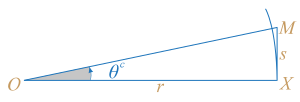
Formula for Measuring the Height of a Distant Object
⭐ When the value of r is very large and the value of θ is small, the arc length s and the height MX are approximately equal. In this case, we can use this formula to measure the height of a distant object.
📚 Important: In this formula, θ must be in radians. If the angle is given in degrees, it must be converted into radians first.
Examples
🔸 Express 60° in radians.
We know that 180° = π radians.
Therefore, 60° = = radians.
Answer: 60° =radians
🔸 Express radians in degrees.
We know that π radians = 180°.
Therefore, π/4 radians = 180°/4 = 45°.
Answer: π/4 radians = 45°
🔸 If s = 10 cm and r = 5 cm, find θ.
Formula:
Here, s = 10 cm and r = 5 cm.
Therefore, θ = 10/5 = 2 radians.
Answer: θ = 2 radians
Quick Revision
🔹 Trigonometry studies angles, sides of triangles, and ratios.
🔹 Anticlockwise rotation forms a positive angle.
🔹 Clockwise rotation forms a negative angle.
🔹 In the degree system, 1 right angle = 90°.
🔹 In the radian system, an arc equal to the radius subtends an angle of 1 radian at the centre.
🔹 π radians = 180°.
🔹 The radian measure of an angle is .
Short Questions and Answers
Question: Can a trigonometrical angle be negative?
Answer: Yes. An angle formed by clockwise rotation is called a negative angle.
Question: Why is radian measure important?
Answer: Radian measure is the most natural and convenient system in circular motion, calculus, and higher mathematics.
Question: How many radians are there in 180°?
Answer: 180° = π radians.
Question: In the formula , in which unit is θ expressed?
Answer: θ is expressed in radians.
Practice
🔸 Express 30° in radians.
🔸 Express π/6 radians in degrees.
🔸 In a circle, if r = 7 cm and s = 14 cm, find θ.
🔸 Write the difference between positive and negative angles.
🔸 Write the definition of one radian.


