

Refraction of Light
When light passes obliquely from one transparent medium to another, its speed changes. Due to this change in speed, the light ray bends at the boundary between the two media. This bending of light is called refraction of light.
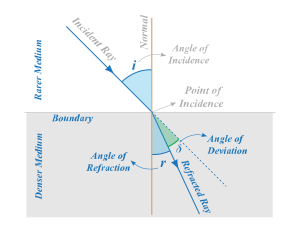
Refraction of Light
Light bends when it passes from one medium to another at an angle.
Refraction
Incident Ray: The ray that falls on the boundary between two media.
Refracted Ray: The ray that enters the second medium after bending.
Normal: A line drawn perpendicular to the boundary at the point of incidence.
Angle of Incidence: The angle between the incident ray and the normal.
Angle of Refraction: The angle between the refracted ray and the normal.
Rarer Medium: A medium in which light travels faster is called an optically rarer medium.
Denser Medium: A medium in which light travels slower is called an optically denser medium.
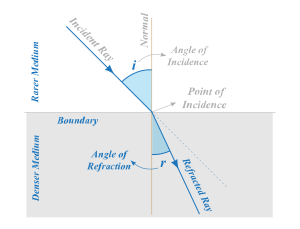
Rarer to Denser Medium
Light bends towards the normal.
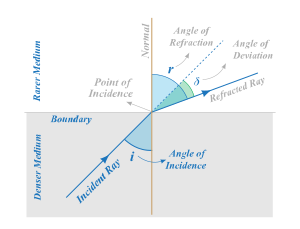
Denser to Rarer Medium
Light bends away from the normal.
Laws of Refraction
👉 The incident ray, the refracted ray and the normal at the point of incidence all lie in the same plane.
👉 For a given pair of media and a given colour of light, the ratio of the sine of the angle of incidence to the sine of the angle of refraction is constant.
This is called Snell's law.
Snell's Law
For a given pair of media, sin i / sin r remains constant.
For light going from medium a to medium b:
Here, is the refractive index of medium b with respect to medium a.
Refractive Index and Speed of Light
The refractive index of a medium tells us how much the medium slows down light.
If the speed of light in vacuum is c and the speed of light in a medium is v, then the absolute refractive index is:
Since light travels slower in any material medium than in vacuum, the refractive index of a material medium is generally greater than 1.
For two media a and b:
Here, va is the speed of light in medium a, and vb is the speed of light in medium b.
Cauchy's Formula
The refractive index of a transparent medium depends on the wavelength of light. According to Cauchy's formula:
For school-level use, we often write the simpler form:
Here, A, B and C are constants for the medium, and is the wavelength of light.
Examples of Refraction in Daily Life
⭐ A pencil partly dipped in water appears bent.
⭐ The bottom of a swimming pool appears raised.
⭐ Stars appear to twinkle due to atmospheric refraction.
⭐ A coin inside water appears to be at a higher position.
⭐ A lens forms images by refraction of light.
Path of Light in Rarer and Denser Media
| Light travels from | Direction of bending | Reason |
|---|---|---|
| Rarer to denser medium | Towards the normal | Speed decreases |
| Denser to rarer medium | Away from the normal | Speed increases |
| Normally on the boundary | No bending | Direction remains unchanged |
Important Points to Remember
⭐ Refraction is caused by change in speed of light.
⭐ Light bends towards the normal when it goes from a rarer medium to a denser medium.
⭐ Light bends away from the normal when it goes from a denser medium to a rarer medium.
⭐ The frequency of light does not change during refraction.
⭐ Snell's law gives as a constant for a given pair of media.
⭐ Refractive index has no unit.
Common Mistakes
| Mistake | Correct Idea |
|---|---|
| Light bends because its frequency changes. | Light bends because its speed changes. Frequency remains unchanged. |
| Light always bends towards the normal. | It bends towards or away from the normal depending on the media. |
| Refractive index has a unit. | Refractive index is a ratio, so it has no unit. |
Questions and Answers
The change in direction of light when it passes obliquely from one transparent medium to another is called refraction of light.
It bends towards the normal.
It bends away from the normal.
The incident ray, refracted ray and normal at the point of incidence all lie in the same plane.
For a given pair of media, is constant.
Refractive index is a ratio that compares the speed of light in two media.
The ratio of the speed of light in vacuum to the speed of light in a medium is called absolute refractive index.
The refractive index of one medium with respect to another medium is called relative refractive index.
Refraction does not occur when light falls normally on the boundary between two media.


