

Basic Concepts of Light
Light is a form of energy. It is emitted by a source of light and produces the sensation of sight in our eyes.
According to modern physics, light has both particle nature and wave nature.
The particles of light are called photons.
Light is a transverse electromagnetic wave. In vacuum, its speed is maximum, about . The speed of light changes when the medium changes.
Radiations with wavelength from about 400 nm to 800 nm can produce vision in the human eye. This range is called visible light.
When light passes from one medium to another, its speed and wavelength change, but its frequency remains unchanged.
Two main branches of optics

Geometrical Optics
Physical Optics
Geometrical Optics: In geometrical optics, light is studied by considering it as rays. Reflection and refraction are mainly explained in this branch.
Physical Optics: In physical optics, the wave nature of light is studied. Interference, diffraction and polarization are examples of physical optics.
Geometrical Optics
Source of Light: A body that gives out its own light is called a source of light.
Non-luminous Object: A body that has no light of its own but is visible by reflecting light from another source is called a non-luminous object.
📚 The Sun, an electric bulb and a candle are sources of light. The Moon, a book, a table and a human body are non-luminous objects because they do not produce their own light.
Point Source of Light: When a source of light is represented as a geometrical point, it is called a point source of light.
Optical Medium: A medium through which light can travel is called an optical medium.
Homogeneous Medium: A transparent medium in which light travels with the same speed in all directions is called a homogeneous medium.
Non-homogeneous Medium: A medium in which light does not travel with the same speed in all directions is called a non-homogeneous medium.
Transparent Medium: A medium through which light can pass easily is called a transparent medium.
Translucent Medium: A medium through which light can pass only partly is called a translucent medium.
Opaque Medium: A medium through which light cannot pass is called an opaque medium.
Transparent, Translucent and Opaque Mediums
| Medium | Meaning | Examples |
|---|---|---|
| Transparent | Light passes through easily. | Glass, clear water, air |
| Translucent | Light passes through partly. | Frosted glass, oiled paper |
| Opaque | Light cannot pass through. | Wood, iron, wall |
In a homogeneous transparent medium, light travels in a straight line.
Ray of Light: The straight line drawn to show the path of light is called a ray of light.

Ray of Light
A ray shows the direction of propagation of light.
Beam of Light: A group of light rays travelling together is called a beam of light.

Parallel Beam
Rays remain parallel and do not meet.
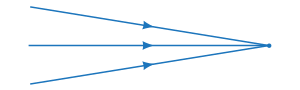
Convergent Beam
Rays move towards one point.
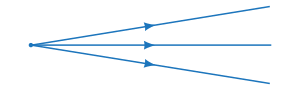
Divergent Beam
Rays spread out from one point.
Parallel Beam: A beam in which the rays travel parallel to one another is called a parallel beam.
Convergent Beam: A beam in which the rays meet at a point is called a convergent beam.
Divergent Beam: A beam in which the rays spread out from a point is called a divergent beam.
Important Points to Remember
⭐ Light is a form of energy.
⭐ Light produces the sensation of vision.
⭐ Light has both particle nature and wave nature.
⭐ The particles of light are called photons.
⭐ The speed of light in vacuum is about 3 × 10⁸ m/s.
⭐ The wavelength of visible light is about 400 nm to 800 nm.
⭐ When light enters another medium, its speed and wavelength change, but its frequency remains unchanged.
⭐ The study of light is called optics.
⭐ A ray of light shows the direction in which light travels.
⭐ A beam of light is a group of rays.
⭐ Light beams are of three types: parallel, convergent and divergent.
Common Mistakes
| Mistake | Correct Idea |
|---|---|
| The Moon is a source of light. | The Moon is not a source of light. It reflects sunlight. |
| Light always travels with the same speed. | Light has different speeds in different media. |
| Ray and beam are the same. | A ray is a single path of light. A beam is a group of rays. |
| Frequency changes when light enters another medium. | Frequency remains unchanged. Speed and wavelength change. |
Concept Questions
Why can we see a book in daylight?
Why is the Moon called a non-luminous object?
What happens to the speed of light when it enters glass from air?
What is the difference between a ray and a beam of light?
Why is sunlight reaching Earth treated as almost parallel rays?
Quick Questions and Answers
Light is a form of energy that produces the sensation of vision in our eyes.
The speed of light in vacuum is about 3 × 10⁸ m/s.
A medium through which light can travel is called an optical medium.
A straight line used to show the path of light is called a ray of light.
There are three types of light beams: parallel, convergent and divergent.


