

Prism and Lens
Prism
A prism is a transparent refracting medium bounded by plane surfaces. A common glass prism has a triangular cross-section.
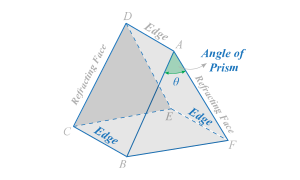
Prism
A prism bends light by refraction at its two refracting surfaces.
Refracting Face: The faces of a prism through which light enters and comes out are called refracting faces.
Refracting Edge: The line where two refracting faces meet is called the refracting edge.
Angle of Prism: The angle between the two refracting faces of a prism is called the angle of prism. It is represented by A.
Angle of Deviation: The angle between the direction of the incident ray and the emergent ray is called the angle of deviation. It is represented by δ.
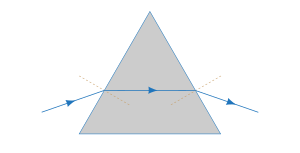
Angle of Prism and Angle of Deviation
A prism changes the direction of a light ray.
Spectrum of Prism: When white light falls obliquely on a prism, it splits into seven colours due to refraction. The band of colours obtained is called the spectrum.
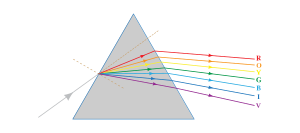
Spectrum of Prism
White light splits into violet, indigo, blue, green, yellow, orange and red.
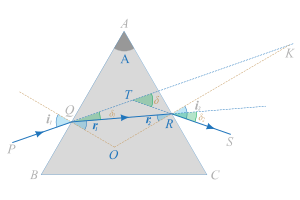
Refraction of Light Rays in a Prism
A light ray bends at both refracting faces of a prism.
For a prism, if i1 is the angle of incidence, i2 is the angle of emergence, A is the angle of prism and δ is the angle of deviation, then:
When deviation is minimum
When the angle of deviation is minimum, the angle of incidence and angle of emergence are equal.
Also, the two angles of refraction inside the prism are equal.
Lens
A lens is a transparent refracting medium bounded by two spherical surfaces, or by one spherical and one plane surface.
Lenses are of two types

Convex Lens
Concave Lens
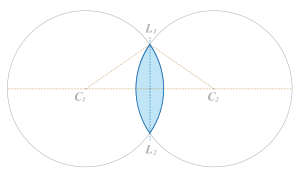
Convex Lens
A convex lens is thicker at the middle and thinner at the edges.
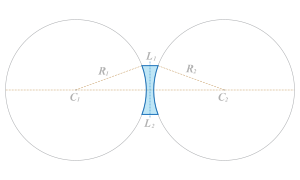
Concave Lens
A concave lens is thinner at the middle and thicker at the edges.
Important Terms Related to Lens
🔹 Centres of Curvature: The centres of the two spheres of which the lens surfaces are parts. They are represented by C1 and C2.
🔹 Radii of Curvature: The radii of the two spherical surfaces. They are represented by R1 and R2.
🔹 Principal Axis: The straight line passing through C1 and C2.
🔹 Aperture: The effective diameter of the lens.
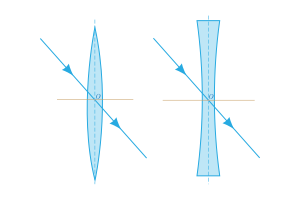
Optical Centre
For a thin lens, the optical centre is a point on the principal axis through which a light ray passes without deviation.
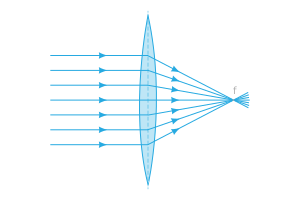
Focus of a Convex Lens
Parallel rays meet at the focus after refraction.
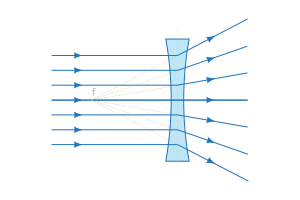
Focus of a Concave Lens
Parallel rays appear to diverge from the focus after refraction.
👉 Focus of a Lens: When rays parallel to the principal axis fall on a lens, after refraction they meet at a point or appear to come from a point on the principal axis. This point is called the principal focus.
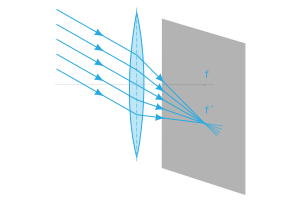
Focal Plane and Secondary Focus of a Convex Lens
Different parallel beams meet at different points on the focal plane.
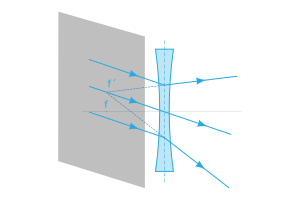
Focal Plane and Secondary Focus of a Concave Lens
Different beams appear to come from different points on the focal plane.
👉 Focal Plane: The plane passing through the principal focus and perpendicular to the principal axis is called the focal plane.
👉 Secondary Focus: A point on the focal plane where a parallel beam, not parallel to the principal axis, meets or appears to meet after refraction is called a secondary focus.
The principal focus lies on the principal axis, but secondary foci can lie at different points on the focal plane.
Difference Between Convex and Concave Lens
| Point | Convex Lens | Concave Lens |
|---|---|---|
| Shape | Thicker at the middle, thinner at the edges | Thinner at the middle, thicker at the edges |
| Nature | Converging lens | Diverging lens |
| Parallel rays | Meet at the focus | Appear to diverge from the focus |
| Uses | Magnifying glass, camera, eye lens | Spectacles for myopia, door eye hole |


