

Congruence of Triangles
🎯 What will you learn in this lesson?
👉 Recognise congruent triangles and their corresponding parts.
👉 Use SSS, SAS, ASA, AAS and RHS correctly.
👉 Write corresponding vertices in the correct order.
👉 Apply CPCT after establishing congruence.
👉 Explain why AAA and SSA do not generally establish congruence.
👉 Solve simple numerical and proof-based questions.
👉 What Are Congruent Triangles?
Two triangles are congruent if they have exactly the same shape and size. One can fit exactly over the other after moving, rotating or turning it over, without stretching it.
The symbol for congruence is ≅. For example, △ABC ≅ △PQR.
The order of the letters specifies the correspondence:
A ↔ P, B ↔ Q, C ↔ RTherefore, the corresponding sides satisfy AB = PQ, BC = QR, CA = RP, and the corresponding angles satisfy ∠A = ∠P, ∠B = ∠Q, ∠C = ∠R.
📚 What Is CPCT?
CPCT stands for Corresponding Parts of Congruent Triangles. Once two triangles are known or proved to be congruent, their corresponding sides and angles are equal.
For example, if △ABC ≅ △PQR, then by CPCT:
AB = PQ, BC = QR, AC = PR ∠A = ∠P, ∠B = ∠Q, ∠C = ∠R🔹 Criteria for Congruence of Triangles
We will study five commonly used criteria: SSS, SAS, ASA, AAS and RHS. AAS can be derived from ASA using the triangle angle sum. These criteria establish that two triangles have the same shape and size; equal area alone does not establish congruence.
⭐ SSS: Side-Side-Side
If three pairs of corresponding sides are equal, the two triangles are congruent.
AB = EF; BC = FG; CA = GE △ABC ≅ △EFG (SSS)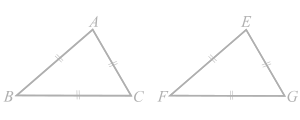
SSS: Side-Side-Side
AB = EF; BC = FG; CA = GE
| Given | AB = EF |
| Given | BC = FG |
| Given | CA = GE |
| Therefore | △ABC ≅ △EFG (SSS) |
⭐ SAS: Side-Angle-Side
If two pairs of corresponding sides and the included angle between them are equal, the two triangles are congruent.
AB = EF; ∠BAC = ∠FEG; AC = EG △ABC ≅ △EFG (SAS)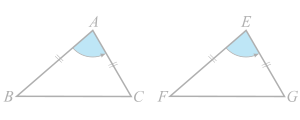
SAS: Side-Angle-Side
AB = EF; ∠BAC = ∠FEG; AC = EG
| Given | AB = EF |
| Given | ∠BAC = ∠FEG |
| Given | AC = EG |
| Therefore | △ABC ≅ △EFG (SAS) |
In SAS, the equal angle must be the included angle between the two specified sides.
⭐ ASA: Angle-Side-Angle
If two pairs of corresponding angles and the included side between them are equal, the two triangles are congruent. In this example, AB and EF are the included sides.
∠BAC = ∠FEG; AB = EF; ∠ABC = ∠EFG △ABC ≅ △EFG (ASA)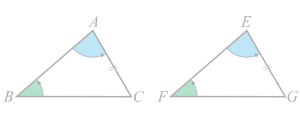
ASA: Angle-Side-Angle
∠BAC = ∠FEG; AB = EF; ∠ABC = ∠EFG
| Given | ∠BAC = ∠FEG |
| Given | AB = EF |
| Given | ∠ABC = ∠EFG |
| Therefore | △ABC ≅ △EFG (ASA) |
⭐ AAS: Angle-Angle-Side
If two pairs of corresponding angles and a corresponding non-included side are equal, the two triangles are congruent. Here AC and PR are not the sides between the given angles A, B and P, Q.
∠A = ∠P; ∠B = ∠Q; AC = PR △ABC ≅ △PQR (AAS)| Given | ∠A = ∠P |
| Given | ∠B = ∠Q |
| Given | AC = PR |
| Therefore | △ABC ≅ △PQR (AAS) |
Since ∠A = ∠P and ∠B = ∠Q, the angle sum of 180° gives ∠C = ∠R. We can then use ∠A = ∠P, AC = PR and ∠C = ∠R to apply ASA. This proves the AAS result.
⭐ RHS: Right angle-Hypotenuse-Side
Two right-angled triangles are congruent if their hypotenuses and one pair of corresponding legs are equal. A leg is a side other than the hypotenuse.
∠A = ∠E = 90°; BC = FG (hypotenuses); AC = EG (legs) △ABC ≅ △EFG (RHS)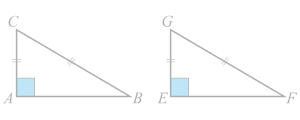
RHS: Right angle-Hypotenuse-Side
∠A = ∠E = 90°; BC = FG (hypotenuses); AC = EG (legs)
| Given | ∠A = ∠E = 90° |
| Given | BC = FG (hypotenuses) |
| Given | AC = EG (legs) |
| Therefore | △ABC ≅ △EFG (RHS) |
⚠️ Which Information Is Not Enough?
Why Is AAA Not a Congruence Criterion?
If three pairs of corresponding angles are equal, the triangles are similar. They have the same shape and proportional corresponding sides, but their side lengths need not be equal.
For example, equilateral triangles with side lengths 3 cm and 6 cm both have three angles of 60°, yet they are not congruent. Thus, AAA alone does not guarantee congruence.
Why Is SSA Not a General Congruence Criterion?
Two side lengths and a non-included angle do not always determine a unique triangle. In some cases, two different triangles satisfy the same data. Therefore, SSA is not a general congruence criterion.
Special case: If both triangles are right-angled and the equal sides are the hypotenuses and one corresponding pair of legs, RHS applies and the triangles are congruent.
✍️ Solved Examples
✏️ Example 1: Identify the criterion
In △ABC and △PQR, AB = PQ, BC = QR and CA = RP. Three pairs of corresponding sides are equal. Therefore, △ABC ≅ △PQR by SSS.
✏️ Example 2: Use SAS
In △ABC and △DEF, AB = DE, AC = DF and ∠A = ∠D. The equal angles are included between the given equal sides. Therefore, △ABC ≅ △DEF by SAS.
✏️ Example 3: Correspondence and CPCT
If △ABC ≅ △PQR and BC = 7 cm, find QR. The vertex order gives B ↔ Q and C ↔ R, so BC corresponds to QR. By CPCT, QR = BC = 7 cm.
✏️ Example 4: Use RHS
Two right-angled triangles each have a hypotenuse of 10 cm and a corresponding leg of 6 cm. Both have a right angle, equal hypotenuses and an equal pair of corresponding legs. They are congruent by RHS.
✏️ Example 5: Is AAA enough?
Two triangles each have angles 40°, 60°, 80°. Must they be congruent? No. Their corresponding angles are equal, but their side lengths may differ. AAA establishes similarity, not necessarily congruence.
✏️ Example 6: Identify AAS
In △ABC and △PQR, ∠A = ∠P, ∠B = ∠Q and AC = PR. AC and PR are not the sides included between the given angle pairs. Therefore, △ABC ≅ △PQR by AAS.
✏️ Example 7: Prove two angles equal
In △ABC, AB = AC and D is the midpoint of BC. Prove that ∠BAD = ∠DAC.
For △ABD and △ACD:
- AB = AC, given.
- BD = CD, because D is the midpoint of BC.
- AD = AD, the common side.
Therefore, △ABD ≅ △ACD by SSS. By CPCT, ∠BAD = ∠DAC. Hence AD bisects ∠BAC.
🧩 Practice Questions
✍️ 1. In △ABC and △PQR, AB = PQ, BC = QR and AC = PR. Which congruence criterion applies?
✍️ 2. In △ABC and △DEF, AB = DE, AC = DF and ∠A = ∠D. Which criterion applies?
✍️ 3. Two pairs of corresponding angles and the sides included between them are equal. Which criterion applies?
✍️ 4. Two right-angled triangles have equal hypotenuses and one equal pair of corresponding legs. Which criterion applies?
✍️ 5. If △ABC ≅ △PQR and AB = 5.4 cm, find PQ.
✍️ 6. If △XYZ ≅ △LMN, which angle corresponds to ∠Y?
✍️ 7. Do three equal pairs of corresponding angles guarantee congruence? Explain.
✍️ 8. Which is not generally sufficient to establish congruence: SSS, SAS, ASA, SSA or RHS?
✍️ 9. In △ABC and △PQR, ∠A = ∠P, ∠B = ∠Q and AC = PR. Which criterion applies?
✍️ 10. If △ABC ≅ △PQR and ∠C = 72°, find ∠R.
1. SSS
2. SAS
3. ASA
4. RHS
5. PQ = 5.4 cm
6. ∠M corresponds to ∠Y.
7. No. AAA establishes similarity, but the sizes may differ.
8. SSA
9. AAS
10. ∠R = 72°
🎯 Match the Columns
⚠️ Common Misconceptions
🔹 Any equal angle works in SAS. No. It must be the included angle between the two given sides.
🔹 ASA and AAS describe the same data. Both establish congruence, but ASA uses the included side and AAS a non-included side.
🔹 AAA establishes congruence. It establishes the same shape, but not necessarily the same size.
🔹 RHS applies to any triangle. It applies only to right-angled triangles.
🔹 Vertex order does not matter. The order determines corresponding vertices, sides and angles.
🔹 CPCT can be used without identifying corresponding parts. First establish congruence and match the parts correctly.
🧠 Quick Revision
🔹 Congruent triangles have the same shape and size.
🔹 The congruence symbol is ≅.
🔹 SSS: three equal pairs of corresponding sides.
🔹 SAS: two equal pairs of sides and their equal included angles.
🔹 ASA: two equal pairs of angles and their equal included sides.
🔹 AAS: two equal pairs of angles and one equal pair of non-included corresponding sides.
🔹 RHS: right-angled triangles with equal hypotenuses and one equal pair of corresponding legs.
🔹 After establishing congruence, use CPCT to equate corresponding parts.
🔹 AAA does not guarantee congruence.
🔹 SSA is not a general congruence criterion.
🔹 Write vertices in the correct corresponding order.


