

Triangle Theorems
🎯 What will you learn on this page?
👉 Understand the isosceles triangle theorem and its converse.
👉 Relate an exterior angle to the two remote interior angles.
👉 Prove that the interior angles of a triangle add up to 180°.
👉 Compare sides by their opposite angles and angles by their opposite sides.
👉 Use the triangle inequality to decide whether three given lengths can form a triangle.
👉 Apply the theorems to simple numerical and proof-based problems.
1. Equal Sides Have Equal Opposite Angles
⭐ If two sides of a triangle are equal, the angles opposite those sides are equal.
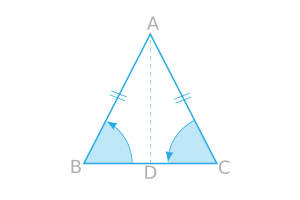
📚 If AB = AC in △ABC, then ∠ABC = ∠ACB.
| Given : | In △ABC, AB = AC. |
| To prove : | ∠ABC = ∠ACB. |
| Construction : | Draw AD as the bisector of ∠BAC, meeting BC at D. |
| Proof : | In △ABD and △ACD, |
| AB = AC (given) | |
| ∠BAD = ∠CAD (AD bisects ∠BAC) | |
| AD = AD (common side) | |
| ∴ | △ABD ≅ △ACD (SAS) |
| ∴ | ∠ABD = ∠ACD (CPCT) |
| Hence, | ∠ABC = ∠ACB. (Proved) |
2. Equal Angles Have Equal Opposite Sides
⭐ If two angles of a triangle are equal, the sides opposite those angles are equal.
This is the converse of the isosceles triangle theorem.
📚 If ∠ABC = ∠ACB in △ABC, then AB = AC.
| Given : | In △ABC, ∠ABC = ∠ACB. |
| To prove : | AB = AC. |
| Construction : | Draw AD as the bisector of ∠BAC, meeting BC at D. |
| Proof : | In △ABD and △ACD, |
| ∠BAD = ∠CAD (by construction) | |
| AD = AD (common side) | |
| ∠ABD = ∠ACD (given) | |
| ∴ | △ABD ≅ △ACD (ASA) |
| ∴ | AB = AC (CPCT). (Proved) |
3. Exterior Angle Theorem
⭐ An exterior angle of a triangle is equal to the sum of its two remote interior angles.
📚 If side BC of △ABC is extended to D, then ∠ACD = ∠ABC + ∠BAC.
| Given : | Side BC of △ABC is extended to D. |
| To prove : | ∠ACD = ∠ABC + ∠BAC. |
| Construction : | Through C, draw CP parallel to AB. |
| Proof : | AB ∥ CP and BD is a transversal. |
| ∠PCD = ∠ABC (corresponding angles) — (i) | |
| AB ∥ CP and AC is a transversal. | |
| ∠ACP = ∠BAC (alternate interior angles) — (ii) | |
| Adding (i) and (ii), | |
| ∠PCD + ∠ACP = ∠ABC + ∠BAC | |
| ∴ | ∠ACD = ∠ABC + ∠BAC. (Proved) |
📚 Useful consequence: an exterior angle of a triangle is greater than either of its remote interior angles.
4. Angle-Sum Theorem of a Triangle
⭐ The sum of the three interior angles of every triangle is 180°.
📚 In △ABC, ∠ABC + ∠BAC + ∠ACB = 180°.
| Given : | △ABC is any triangle. |
| To prove : | ∠ABC + ∠BAC + ∠ACB = 180°. |
| Construction : | Through A, draw EF parallel to BC. |
| Proof : | BC ∥ EF and AB is a transversal. |
| ∠CBA = ∠EAB (alternate interior angles) — (i) | |
| BC ∥ EF and AC is a transversal. | |
| ∠BCA = ∠CAF (alternate interior angles) — (ii) | |
| Add ∠BAC to both sides of (i) and (ii). | |
| ∠CBA + ∠BCA + ∠BAC = ∠EAB + ∠CAF + ∠BAC | |
| The three angles on the right form a straight angle on EF. | |
| ∴ | ∠ABC + ∠BAC + ∠ACB = 180°. (Proved) |
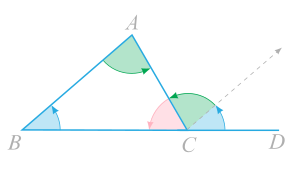
| Given : | Side BC of △ABC is extended to D. |
| Proof : | ∠ACD = ∠ABC + ∠BAC (exterior-angle theorem) |
| Add ∠ACB to both sides. | |
| ∠ACD + ∠ACB = ∠ABC + ∠BAC + ∠ACB | |
| ∠ACD + ∠ACB = 180° (linear pair) | |
| ∴ | ∠ABC + ∠BAC + ∠ACB = 180°. (Proved) |
5. The Larger Side Has the Larger Opposite Angle
⭐ If two sides of a triangle are unequal, the angle opposite the longer side is greater than the angle opposite the shorter side.
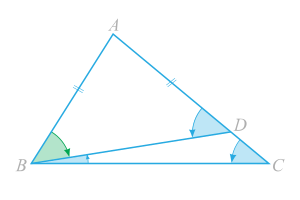
📚 If AC > AB in △ABC, then ∠ABC > ∠ACB.
| Given : | In △ABC, AC > AB. |
| To prove : | ∠ABC > ∠ACB. |
| Construction : | On AC, take AD = AB and join B to D. |
| Proof : | In △ABD, AB = AD. |
| ∴ | ∠ABD = ∠ADB. |
| In △DCB, ∠ADB is an exterior angle. | |
| ∠ADB = ∠DCB + ∠DBC | |
| ∴ | ∠ADB > ∠DCB = ∠ACB. |
| But ∠ADB = ∠ABD and ∠ABC > ∠ABD. | |
| Hence, | ∠ABC > ∠ACB. (Proved) |
6. The Larger Angle Has the Larger Opposite Side
⭐ If two angles of a triangle are unequal, the side opposite the larger angle is longer than the side opposite the smaller angle.
This is the converse of the previous theorem.
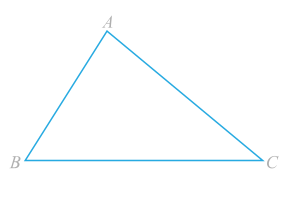
📚 If ∠ABC > ∠ACB in △ABC, then AC > AB.
| Given : | In △ABC, ∠ABC > ∠ACB. |
| To prove : | AC > AB. |
| Proof : | Suppose AC is not greater than AB. Then either AC = AB or AC < AB. |
If AC = AB, then ∠ABC = ∠ACB, contradicting the given condition. | |
If AC < AB, then the angle opposite AB would be greater, so ∠ACB > ∠ABC. This also contradicts the given condition. | |
| ∴ | AC > AB. (Proved) |
7. Triangle Inequality Theorem
⭐ The sum of the lengths of any two sides of a triangle is greater than the length of the third side.
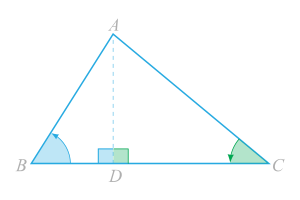
📚 In △ABC: AB + AC > BC, AB + BC > AC and AC + BC > AB.
| Given : | In △ABC, suppose BC is the longest side. |
| To prove : | AB + AC > BC. |
| Construction : | Draw AD perpendicular to BC. |
| Proof : | In △ADB, ∠ADB = 90° and ∠BAD < 90°. |
| ∴ | ∠ADB > ∠BAD, so AB > BD. — (i) |
| Similarly, in △ADC, ∠ADC > ∠DAC, so AC > DC. — (ii) | |
| Adding (i) and (ii), | |
| AB + AC > BD + DC | |
| Therefore, | AB + AC > BC. (Proved) |
📚 Using the Triangle Inequality
Three lengths can form a triangle only if the sum of every pair of sides is greater than the third side.
For example:
5 cm, 7 cm, 9 cm5 + 7 > 9, 7 + 9 > 5, and 9 + 5 > 7.
Therefore, these lengths can form a triangle.
But for 3 cm, 4 cm, 8 cm,
3 + 4 = 7 < 8.
Therefore, these lengths cannot form a triangle.
✏️ Solved Examples
✍️ Example 1: Angles of an Isosceles Triangle
In △ABC, AB = AC and ∠A = 40°. Find ∠B and ∠C.
Since AB = AC,
∠B = ∠C.
Also,
∠A + ∠B + ∠C = 180° 40° + ∠B + ∠C = 180° ∠B + ∠C = 140°Since the two angles are equal,
∠B = ∠C = 70°.
✍️ Example 2: Find an Exterior Angle
The two remote interior angles of a triangle are 48° and 67°. Find the exterior angle.
Exterior angle = 48° + 67° = 115°Therefore, the exterior angle is 115°.
✍️ Example 3: Find the Third Angle
Two angles of a triangle are 56° and 73°.
Third angle = 180° - (56° + 73°) = 51°✍️ Example 4: Compare the Sides
In △PQR,
∠P = 75°, ∠Q = 65°, and ∠R = 40°.
The largest angle is ∠P, so the opposite side QR is the longest.
The smallest angle is ∠R, so the opposite side PQ is the shortest.
Therefore,
QR > PR > PQ.
✍️ Example 5: Can These Sides Form a Triangle?
Can lengths 6 cm, 8 cm, 14 cm form a triangle?
6 + 8 = 14The sum must be greater than the third side, not equal to it.
Therefore, these lengths cannot form a triangle.
✍️ Example 6: An Equation Using an Exterior Angle
An exterior angle is 120°. Its two remote interior angles are (x + 10)° and (2x + 20)°.
By the exterior-angle theorem,
(x + 10) + (2x + 20) = 120 3x + 30 = 120 3x = 90 x = 30Therefore, the two remote interior angles are 40° and 80°.
🧩 Practice Questions
✍️ 1. In △ABC, AB = AC and ∠B = 58°. Find ∠C and ∠A.
✍️ 2. An exterior angle of a triangle is 125° and one remote interior angle is 55°. Find the other remote interior angle.
✍️ 3. Two angles of a triangle are 42° and 79°. Find the third angle.
✍️ 4. In △ABC, AC > AB. Compare ∠B and ∠C.
✍️ 5. In △PQR, ∠P > ∠Q. Compare QR and PR.
✍️ 6. Check whether lengths 5 cm, 6 cm, 10 cm can form a triangle.
✍️ 7. Check whether lengths 4 cm, 7 cm, 12 cm can form a triangle.
✍️ 8. In △ABC, ∠A = 80°, ∠B = 60°, and ∠C = 40°. Arrange the sides from longest to shortest.
✍️ 9. The vertex angle of an isosceles triangle is 36°. Find each base angle.
✍️ 10. An exterior angle is 132°, and its remote interior angles are (x + 12)° and (2x + 6)°. Find x.
1. ∠C = 58°, ∠A = 64°
2. 70°
3. 59°
4. ∠B > ∠C
5. QR > PR
6. Yes; 5 + 6 > 10
7. No; 4 + 7 < 12
8. BC > AC > AB
9. 72°, 72°
10. x = 38
⚠️ Common Misconceptions
🔹 If the sum of two sides equals the third side, a triangle can still be formed.
No. The sum must be greater than the third side.
🔹 The larger side lies opposite the smaller angle.
No. The larger side lies opposite the larger angle.
🔹 An exterior angle equals only one remote interior angle.
No. It equals the sum of the two remote interior angles.
🔹 An isosceles triangle only has equal sides.
Incomplete. The angles opposite the equal sides are also equal.
🔹 If a theorem is true, its converse must automatically be true.
Not in general. A converse must be established separately. The converse results used on this page are proved separately.
✅ Quick Revision
🔹 AB = AC ⇒ ∠B = ∠C
🔹 ∠B = ∠C ⇒ AB = AC
🔹 Exterior angle = sum of the two remote interior angles.
🔹 The three interior angles of a triangle add up to 180°.
🔹 The larger side lies opposite the larger angle.
🔹 The larger angle lies opposite the larger side.
🔹 The sum of any two sides is greater than the third side.
🔹 In theorem-based problems, clearly write the given facts, the theorem used, and the conclusion.


