

Area and Perimeter of Quadrilaterals
🎯 What will you learn by the end of this lesson?
👉 Identify quadrilaterals and their different types.
👉 Understand the difference between area and perimeter.
👉 Use simple methods to remember important quadrilateral formulas.
👉 Find the area of squares, rectangles, parallelograms, rhombuses, trapeziums and kites.
👉 Choose the correct formula while solving problems.
What is a Quadrilateral?
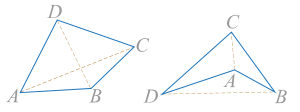
Quadrilateral
A plane figure closed by four sides is called a quadrilateral. In both figures above, ABCD is a quadrilateral.
A quadrilateral has four angles, four vertices, four sides and two diagonals. In the figures above, AC and BD are the diagonals.
In the Class 7 chapter on quadrilaterals, we learned the general properties of quadrilaterals. Here, we will learn how to calculate the perimeter and area of some special types of quadrilaterals.
Examples include squares, rectangles, parallelograms, rhombuses and trapeziums.
Perimeter
Perimeter is the total length around a shape.
Perimeter = AB + BC + CD + DA
The unit of perimeter is a unit of length, such as cm or m.
Area
Area is the amount of space enclosed inside a plane figure.
Area = region enclosed by ABCD.
Area is generally measured in square units such as cm², m², etc.
Square
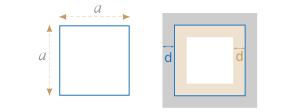
All sides of a square are equal
If the length of each side = a units
🔸 Perimeter = 4 × side length = 4a units
🔸 Diagonal = √2 × side length = √2a units
🔸 Area = (side length)2 = a2 sq. units
📚 Area of a square = × (diagonal)2 sq. units
🔸 If a path of width d units runs along the inside boundary of a square of side a, then the area of the path = 4d × (a − d) sq. units.
💡 Explanation of the formula above
Area of the path = (area of the square) − (area of the inner square excluding the path)
= {a2 − (a − 2d)2} sq. units
= {a2 − (a2 − 4ad + 4d2)} sq. units
= {a2 − a2 + 4ad − 4d2} sq. units
= (4ad − 4d2) sq. units
= 4d × (a − d) sq. units
🔸 If a path of width d units runs around the outside boundary of the square, then the area of the path = 4d × (a + d) sq. units.
💡 Explanation of the formula above
Area of the path = (area of the larger square including the path) − (area of the original square)
= {(a + 2d)2 − a2} sq. units
= {(a2 + 4ad + 4d2) − a2} sq. units
= {a2 + 4ad + 4d2 − a2} sq. units
= (4ad + 4d2) sq. units
= 4d × (a + d) sq. units
🔹 1. If the side of a square is 9 cm, find its area and perimeter.
🔹 2. The diagonal of a square field is 2√2 metres. Find the area of the square.
🔹 3. The area of a square field is 169 square metres. Find the length of its diagonal.
🔹 4. The area of a square garden is 225 square metres. Find the cost of fencing the garden at ₹3.50 per metre.
🔹 5. The sum of the areas of two square gardens is 325 square metres. If the side of one garden is 2/3 of the side of the other, find the sum of their perimeters.
🔹 6. If each side of a square is reduced by 2 cm, its area decreases by 60 cm². Find the perimeter of the original square.
Rectangle
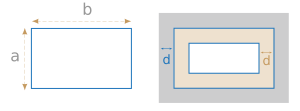
Opposite sides of a rectangle are equal
If length = a units and breadth = b units
🔸 Perimeter = 2 × (length + breadth) = 2(a + b) units
🔸 Area = length × breadth = ab sq. units
🔸 Diagonal units
🔸 If a path of width d units runs along the inside boundary of the rectangle, then the area of the path = 2d × (a + b − 2d) sq. units.
💡 Explanation of the formula above
Area of the path = (area of the rectangle) − (area of the inner rectangle excluding the path)
= ab − {(a − 2d)(b − 2d)} sq. units
= ab − {ab − 2d(a + b) + 4d2} sq. units
= ab − ab + 2d(a + b) − 4d2 sq. units
= 2d(a + b) − 4d2 sq. units
= 2d × (a + b − 2d) sq. units
🔸 If a path of width d units runs around the outside boundary of the rectangle, then the area of the path = 2d × (a + b + 2d) sq. units.
💡 Explanation of the formula above
Area of the path = (area of the larger rectangle including the path) − (area of the original rectangle)
= {(a + 2d)(b + 2d) − ab} sq. units
= {ab + 2d(a + b) + 4d2} − ab sq. units
= ab + 2d(a + b) + 4d2 − ab sq. units
= 2d(a + b) + 4d2 sq. units
= 2d × (a + b + 2d) sq. units
🔹 1. A rectangle has length 18 cm and breadth 11 cm. Find its area.
🔹 2. The diagonal and one side of a rectangle are 13 cm and 12 cm respectively. Find the area of the rectangle.
🔹 3. The ratio of the length to the breadth of a rectangle is 8:5. If its area is 360 square metres, find its perimeter.
🔹 4. The diagonal of a square is equal to the diagonal of a rectangle whose length is twice its breadth. Find the ratio of the area of the square to the area of the rectangle.
Parallelogram
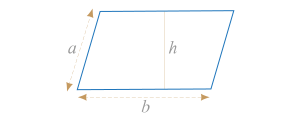
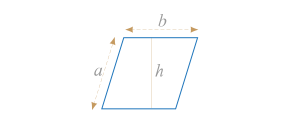
Opposite sides of a parallelogram are equal
If the side lengths are a and b units, and height = h
🔸 Perimeter = 2 × (a + b) = 2(a + b) units
🔸 Area = base × height = bh sq. units
Rhombus
All sides of a rhombus are equal
If side length = a units and height = h
🔸 Perimeter = 4 × side length = 4a units
🔸 Area = side × corresponding height = ah sq. units
Trapezium
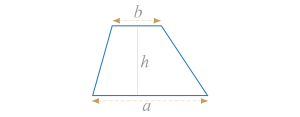
A trapezium has one pair of parallel sides
If the parallel sides are a and b units and the perpendicular height = h
🔸 Area = 1/2 (a + b)h sq. units


