

Circle Circumference, Area and Sectors
🎯 What will you learn in this lesson?
👉 Understand the relationship between diameter, radius and π.
👉 Calculate the circumference and area of a circle.
👉 Distinguish semicircular arc length from semicircle perimeter.
👉 Calculate the areas of circular and semicircular rings.
👉 Use the central angle to find a sector's arc length, area and perimeter.
👉 Understand incircles and circumcircles of squares and equilateral triangles.
👉 Use the correct formulas and units in problems.
How much fencing is needed around a circular garden? Calculate its Circumference. To find how much ground can be covered with grass, calculate its Area. For a portion shaped like a slice of pizza, use the formulas for a Sector.
We will study circles, semicircles, rings and sectors, solve simple problems, and explore their relationships with squares and equilateral triangles.
👉 Circle
A circle is the set of all points in a plane at a fixed positive distance from a fixed point. The fixed point is the centre, and the distance is the radius.
A line segment passing through the centre with both endpoints on the circle is a diameter. Its length is twice the radius.
Note: Circumference is the length of the circular boundary. The area of a circle means the area of the plane region enclosed by that boundary.
For every circle, circumferencediameter = a constant.
This constant is π (pi), an irrational number with a non-terminating, non-repeating decimal expansion.
For calculations, use or π ≈ 3.14 as specified in the question. 227 and 3.14 are approximations, not exact values of π.
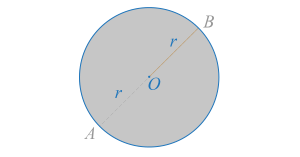
Circle
Let the diameter = AB = d and radius = OB = r.
🔹 Radius = × Diameter (∴ )
🔹 Circumference = π × Diameter = πd = 2πr (∵ d = 2r)
🔹 Area of circle = π × (Radius)2 = πr2
👉 Semicircle
A diameter divides the region inside a circle into 2 equal semicircular regions. Each is bounded by a semicircular arc and a diameter.
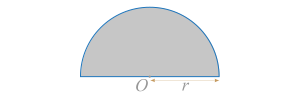
Semicircle
🔹 Semicircle area = × Circle area = πr2
🔹 Semicircular arc length, or half the circle's circumference = πr
🔹 Semicircle perimeter = Semicircular arc length + Diameter = πr + 2r = r(π + 2)
👉 Circular Ring or Annulus
A circular ring is the region between 2 concentric circles of different radii. The outer radius is greater than the inner radius: R > r > 0.
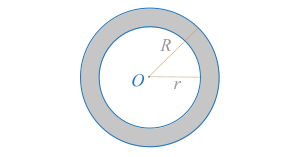
Circular ring
Let the outer radius = R and inner radius = r.
🔹 Ring width = R − r
🔹 Ring area = Outer circle area − Inner circle area = πR2 − πr2 = π(R + r)(R − r)
👉 Semicircular Ring
A line through the centre divides a circular ring into 2 equal semicircular rings. Each boundary consists of 2 semicircular arcs and 2 straight segments.
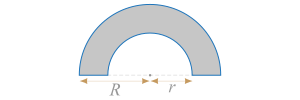
Semicircular ring
Let the outer radius = R and inner radius = r.
🔹 Width = R − r
🔹 Semicircular ring area = .
🔹 Semicircular ring perimeter = Outer semicircular arc length + Inner semicircular arc length + 2 × Width
🔹 Semicircular ring perimeter = πR + πr + 2(R − r) = π(R + r) + 2(R − r)
👉 Sector of a Circle
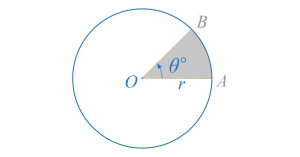
Sector of a circle
A sector is a region bounded by 2 radii and an arc joining their endpoints. Depending on the chosen arc, it may be a minor or major sector; a 180° sector is a semicircle.
Let the centre be O, radius r and central angle θ°. Denote the corresponding arc length by l.
Arc and chord are different: An arc is part of the curved circumference; a chord is the straight segment joining its endpoints. Use the arc length in the following formulas.
⭐ When the Central Angle Is in Degrees
A full circle subtends 360° at its centre. A sector of angle θ° is therefore of the full circle.
🔹 Arc length:
🔹 Sector area:
🔹 When the arc length is known:
🔹 Sector perimeter = Arc length + 2 radii:
This perimeter formula applies to sectors with angles greater than 0° and less than 360°. Do not add 2 radii to the circumference of a full circle.
⭐ Extra Insight: Angles in Radians
If the same angle has degree measure θ and radian measure φ:
Then:
Remember: In l = rφ, the angle must be in radians. Do not substitute a degree value directly.
👉 Square Inscribed in a Circle
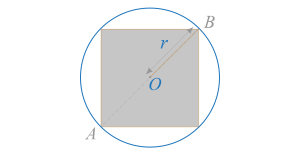
Square inscribed in a circle
All 4 vertices of an inscribed square lie on the circle.
🔹 Diagonal of the inscribed square = Circle diameter = 2r.
🔹 Square area = = = 2r2
🔹 Square perimeter = 4 × √2 × r = 4 √2 r
👉 Square Circumscribing a Circle
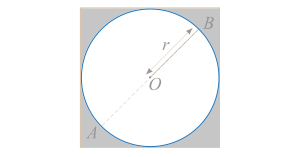
Square circumscribing a circle
For a square whose 4 sides touch a circle lying inside it, Side of square = Circle diameter = 2r.
🔹 Circumscribed square area = (2r)2 = 4r2
🔹 Circumscribed square perimeter = 4 × 2r = 8r
👉 Incircle of a Square
The circle inside a square that touches all 4 sides is its incircle.
Let the side of the square = a.
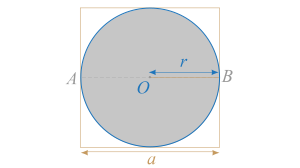
Incircle of a square
🔹 Inradius r =
🔹 Circumference = πa
🔹 Area =
👉 Circumcircle of a Square
The circle passing through all 4 vertices of a square is its circumcircle. The side of the square is again a.
Circumcircle of a square
🔹 Circumcircle diameter = Square diagonal = a × √2
🔹 Circumcircle area = =
🔹 Circumcircle circumference = 2π × = πa × √2 = √2πa
👉 Incircle of an Equilateral Triangle
Let the inradius of equilateral triangle ABC be = r.
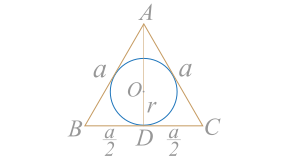
Incircle of an equilateral triangle
In an equilateral triangle, the incentre, circumcentre and centroid coincide. The centroid divides a median in the ratio 2 : 1 from the vertex. Each altitude is also a median, so for height h, the inradius is r = h/3.
🔹 Triangle height AD = h = 3r.
🔹 Triangle side = a =
🔹 Triangle area =
🔹 Triangle perimeter
👉 Circumcircle of an Equilateral Triangle
The distance from the circumcentre to a vertex is of the height. Thus, using R = 2h/3 and r = h/3:
🔹 Circumradius of the equilateral triangle R = 2r.
🔹 Circumcircle area = πR2 = 4πr2
👉 Simple Solved Examples
Calculation rule: Where 22/7 is used for π, the numerical answers are based on that approximation. Use the value specified in the question; otherwise, you may leave an exact answer in terms of π.
✏️ Example 1: Circumference and Area of a Circle
A circle has radius 7 cm. Find its circumference and area. Use .
Solution:
Circumference = 2π × 7 = 14π cm.
cm.
Area = π × 7² = 49π cm².
cm².
Answer: Circumference ≈ 44 cm and area ≈ 154 cm².
✏️ Example 2: Area from Diameter
A circle has diameter 10 cm. Find its area.
Solution: Radius = 10 ÷ 2 = 5 cm.
Area = π × 5² = 25π cm².
Answer: 25π cm². Using π ≈ 3.14, the area is approximately 78.5 cm².
Note: Substitute the radius 5, not the diameter 10, in the area formula.
✏️ Example 3: Area and Perimeter of a Semicircle
A semicircle has radius 7 cm. Find its area and perimeter. Use .
Solution:
Area = cm².
Semicircular arc length = 7π ≈ 22 cm.
Perimeter = Arc length + Diameter = 7π + 14 ≈ 36 cm.
Answer: Area ≈ 77 cm² and perimeter ≈ 36 cm. The curved part alone is approximately 22 cm long.
✏️ Example 4: Area of a Circular Ring
Two concentric circles have outer radius 7 cm and inner radius 3 cm. Find the ring's width and area.
Solution: Width = 7 − 3 = 4 cm.
Area = π(7² − 3²) = π(49 − 9) = 40π cm².
Answer: Width = 4 cm, area = 40π cm².
Remember: The area is not π(R − r)²; the correct formula is π(R² − r²).
✏️ Example 5: Area and Perimeter of a Semicircular Ring
A semicircular ring has outer radius 5 cm and inner radius 3 cm. Find its area and perimeter.
Solution:
Area = cm².
Perimeter = π(5 + 3) + 2(5 − 3) = 8π + 4 cm.
Answer: Area = 8π cm², perimeter = (8π + 4) cm.
✏️ Example 6: Arc Length, Area and Perimeter of a Sector
A circle has radius 14 cm. For a sector with central angle 90°, find the arc length, area and perimeter. Use .
Solution: The sector is 90/360 = 1/4 of the full circle.
Arc length:
cm.
Area:
cm².
Perimeter = l + 2r = 7π + 28 ≈ 50 cm.
Answer: Arc length ≈ 22 cm, area ≈ 154 cm², perimeter ≈ 50 cm.
✏️ Example 7: Inscribed and Circumscribed Squares
A circle has radius 5 cm. Find the areas of its inscribed square and the square circumscribing it.
Solution:
Inscribed square area = 2r² = 2 × 5² = 50 cm².
Circumscribed square area = 4r² = 4 × 5² = 100 cm².
Answer: The inner square has area 50 cm², and the outer square has area 100 cm².
✏️ Example 8: Incircle and Circumcircle of an Equilateral Triangle
An equilateral triangle has inradius 2 cm. Find its height, side length and circumradius.
Solution:
Height = 3r = 3 × 2 = 6 cm.
Side = cm.
Circumradius = R = 2r = 4 cm.
Answer: Height = 6 cm, side = cm, circumradius = 4 cm.
🧠 Important Points to Remember
⭐ Diameter and radius: d = 2r. Use the radius in the area formula.
⭐ Units: Express circumference, arc length and perimeter in cm or m; express area in cm² or m².
⭐ Same units: Convert all lengths to the same unit before substitution.
⭐ Value of π: 22/7 and 3.14 are approximations. Leave π in your answer when an exact value is required.
⭐ Semicircle perimeter: Add the diameter to the curved length.
⭐ Ring area: Subtract the inner circle's area from the outer circle's area.
⭐ Sector perimeter: Add 2 radii to the arc length. Arc length alone is not the perimeter.
⭐ Degrees and radians: θ is the degree measure and φ the radian measure. Do not interchange their numerical values.
⭐ Equilateral triangle: R = 2r holds for an equilateral triangle. Do not assume this equality for every triangle.
✍️ Try It Yourself
Give exact answers in terms of π; decimal values are not required.
🔹 1. A circle has radius 3 cm. Find its circumference and area.
🔹 2. A semicircle has radius 4 cm. Find its area and perimeter.
🔹 3. A circular ring has outer radius 6 cm and inner radius 4 cm. Find its width and area.
🔹 4. A sector has radius 6 cm and central angle 60°. Find its arc length, area and perimeter.
🔹 5. A square has side 8 cm. Find its incircle's radius and area.
🔹 6. An equilateral triangle has inradius 3 cm. Find its circumcircle's radius and area.
Check Your Answers
🔸 1. Circumference 6π cm; area 9π cm².
🔸 2. Area 8π cm²; perimeter (4π + 8) cm.
🔸 3. Width 2 cm; area 20π cm².
🔸 4. Arc length 2π cm; area 6π cm²; perimeter (2π + 12) cm.
🔸 5. Radius 4 cm; area 16π cm².
🔸 6. Circumradius 6 cm; area 36π cm².
💡 Quick Revision
⭐ Circle circumference = 2πr
⭐ Circle area = πr²
⭐ Semicircle perimeter = πr + 2r
⭐ Ring area = π(R + r)(R − r)
⭐ Sector arc length = × 2πr
⭐ Sector area = × πr²
⭐ Inscribed square area = 2r²
⭐ Circumscribed square area = 4r²
⭐ Sector perimeter = l + 2r (central angle greater than 0° and less than 360°).
⭐ For an equilateral triangle, circumradius R = 2r, where r is the inradius.


