

Perimeter and Area of a Triangle
How much fencing is needed around a triangular garden? To find out, we need its Perimeter. To know how much ground can be covered with grass, we need its Area.
In this lesson, we will learn about triangle perimeter, area from base and height, Heron's formula, and formulas for equilateral and isosceles triangles.
👉 General Formulas for the Perimeter and Area of a Triangle
⭐ Perimeter
The perimeter of a triangle is the sum of the lengths of its 3 sides.
If the side lengths are a, b, c:
Units: cm, m, etc.
⭐ Base and Height
Any side of a triangle can be chosen as its base. The perpendicular distance from the opposite vertex to that side or its extension is the corresponding height.
Remember: The altitude is always perpendicular to the chosen base. An arbitrary sloping side cannot be used as the height.
⭐ Area
If the base has length b and the corresponding height is h:
Thus, Area = × Base × Height.
This formula applies to all types of triangles.
Units: cm², m², etc.
✏️ Example 1: Area from Base and Height
A triangle has a base of 8 cm and a corresponding height of 5 cm. Find its area.
Solution:
Answer: The area is 20 cm².
In general, the base and height alone do not determine a triangle's perimeter. The lengths of the other sides or additional information are needed.
👉 Scalene Triangle
A triangle whose 3 sides have different lengths is called a scalene triangle.
That is, AB ≠ BC, BC ≠ CA and CA ≠ AB.
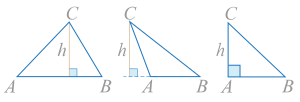
Base and corresponding height of a triangle
A scalene triangle can be acute-angled, obtuse-angled or right-angled.
- In an acute-angled triangle, all 3 altitudes lie inside the triangle.
- In an obtuse-angled triangle, the altitudes from the 2 acute-angle vertices meet extensions of the opposite sides and lie outside the triangle. The altitude from the obtuse-angle vertex lies inside.
- In a right-angled triangle, if one perpendicular side is the base, the other is the corresponding height.
If AB is the base and h is its corresponding height:
👉 Heron's Formula
When all 3 side lengths are known, Heron's formula gives the area without first calculating the height.
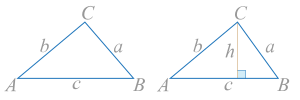
Area of a triangle using Heron's formula
Side lengths a, b, c and semiperimeter s
If the side lengths are a, b, c:
Perimeter:
Semiperimeter:
Area:
Remember: Heron's formula applies to all types of triangles, including isosceles and equilateral triangles.
The given lengths must form a triangle: each length must be positive, and the sum of any 2 side lengths must be greater than the third.
✏️ Example 2: Area Using Heron's Formula
A triangle has side lengths of 5 cm, 5 cm and 6 cm. Find its perimeter and area.
Solution:
Perimeter = 5 + 5 + 6 = 16 cm.
Semiperimeter:
Using Heron's formula:
Answer: Perimeter = 16 cm and area = 12 cm².
Heron's formula works even though this triangle is isosceles.
👉 Finding the Height of a Triangle from Its Area
If a triangle has area A and the chosen base has length b:
If all 3 sides are known, first calculate the area using Heron's formula. Then use the chosen base to find its corresponding height.
For example, if side c is chosen as the base:
Here, we have equated 2 expressions for the area of the same triangle.
✏️ Example 3: Height from Area
A triangle has an area of 30 cm² and a base of 10 cm. What is the corresponding height?
Solution:
Answer: The height is 6 cm.
👉 Equilateral Triangle
A triangle with all 3 sides equal is called an equilateral triangle.
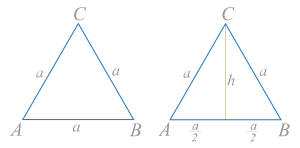
Height and area of an equilateral triangle
Let AB = BC = CA = a.
Perimeter:
Height:
Area:
📚 How Are the Height and Area Formulas Derived?
The perpendicular from a vertex of an equilateral triangle to the opposite side divides that side into 2 equal parts.
By Pythagoras' theorem:
Therefore:
Now, using the base-height formula:
✏️ Example 4: Perimeter, Height and Area of an Equilateral Triangle
Each side of an equilateral triangle is 4 cm long. Find its perimeter, height and area.
Solution:
Perimeter = 3 × 4 = 12 cm.
Height:
Area:
Answer: Perimeter = 12 cm, height = cm, and area = cm².
📚 Extra Insight: Distances from an Interior Point to the Sides
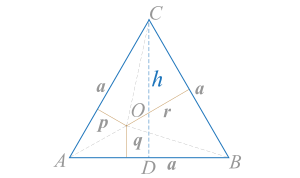
Perpendicular distances from an interior point to the sides of an equilateral triangle
Inside an equilateral triangle ABC, choose any point O.
Let the perpendicular distances from O to AB, BC, CA be p, q, r, respectively. Let each side have length a and the triangle have height h.
Joining OA, OB, OC divides the original triangle into 3 smaller triangles.
Sum of the areas of the 3 smaller triangles = Area of the original triangle.
Thus:
Dividing both sides by , which is positive:
Thus, the sum of the perpendicular distances from any interior point to the sides of an equilateral triangle equals its height.
For example, if the height is 9 cm and 2 perpendicular distances are 2 cm and 3 cm, the remaining distance is 9 − 2 − 3 = 4 cm.
👉 Isosceles Triangle
A triangle with at least 2 equal sides is called an isosceles triangle. With this definition, an equilateral triangle is also a special type of isosceles triangle.
Here, each of the 2 equal sides has length a, and the base has length b.
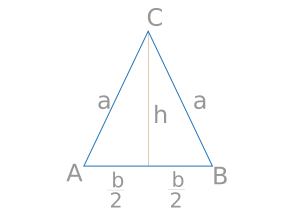
Perimeter, height and area of an isosceles triangle
Let AB = AC = a and BC = b.
Perimeter:
Height corresponding to the base:
Area:
Here, a and b must be positive, and b must be less than 2a.
Check the units: Height is expressed in linear units and area in square units.
📚 How Is the Height Formula Derived?
The perpendicular from the vertex where the equal sides meet bisects the base. Each half has length .
By Pythagoras' theorem:
Rearranging this equation and taking the positive square root gives the height formula.
✏️ Example 5: Perimeter, Height and Area of an Isosceles Triangle
The equal sides of an isosceles triangle are each 5 cm long, and its base is 6 cm. Find its perimeter, height and area.
Solution:
Perimeter = 2 × 5 + 6 = 16 cm.
The altitude to the base divides it into 2 equal parts. Each part is 6 ÷ 2 = 3 cm.
Thus:
Area:
Answer: Perimeter = 16 cm, height = 4 cm, and area = 12 cm².
In Example 2, we found the area of this same triangle using Heron's formula. Both methods give the same answer.
👉 Area of a Right-Angled Triangle
In a right-angled triangle, if one perpendicular side is chosen as the base, the other is the corresponding height.
If the perpendicular sides have lengths p and q:
Note: If the hypotenuse is chosen as the base, use the perpendicular height from the right-angle vertex to the hypotenuse.
✏️ Example 6: Perimeter and Area of a Right-Angled Triangle
A right-angled triangle has perpendicular sides of 3 cm and 4 cm, and a hypotenuse of 5 cm. Find its perimeter and area.
Solution:
Perimeter = 3 + 4 + 5 = 12 cm.
Area:
Answer: Perimeter = 12 cm and area = 6 cm².
👉 Which Formula Should You Use?
| Given information | Formula to use |
|---|---|
| Side lengths a, b, c; find the perimeter | P = a + b + c |
| Base b and corresponding height h | |
| All 3 side lengths; find the area | Heron's formula |
| Side length a of an equilateral triangle | |
| Equal side length a and base b of an isosceles triangle | |
| Perpendicular sides p, q of a right-angled triangle | |
| Area A and base b; find the height |
🧠 Important Points to Remember
⭐ Perimeter is the total length of the boundary; area measures the plane region enclosed by it.
⭐ Express all lengths in the same unit before substituting into a formula.
⭐ Perimeter and height are measured in cm or m; area is measured in cm² or m².
⭐ Use the perpendicular height corresponding to the chosen base in the area formula.
⭐ In Heron's formula, s is the semiperimeter, not the full perimeter.
⭐ Not every set of 3 positive lengths forms a triangle. For example, 2 cm, 3 cm and 5 cm do not form a triangle because 2 + 3 = 5.
⭐ The height of an equilateral triangle is not equal to its side length.
⭐ In an isosceles triangle, the perpendicular from the vertex where the equal sides meet bisects the base.
✍️ Try It Yourself
🔹 1. A triangle has side lengths of 4 cm, 5 cm and 6 cm. Find its perimeter.
🔹 2. A triangle has a base of 12 cm and a corresponding height of 7 cm. Find its area.
🔹 3. A triangle has side lengths of 13 cm, 14 cm and 15 cm. Find its area using Heron's formula.
🔹 4. Each side of an equilateral triangle is 6 cm long. Find its perimeter and area.
🔹 5. Each equal side of an isosceles triangle is 10 cm long, and its base is 12 cm. Find its height and area.
🔹 6. A triangle has an area of 36 cm² and a base of 9 cm. Find its corresponding height.
Check Your Answers
🔸 1. Perimeter = 15 cm.
🔸 2. Area = 42 cm².
🔸 3. Semiperimeter = 21 cm; area = 84 cm².
🔸 4. Perimeter = 18 cm; area = cm².
🔸 5. Height = 8 cm; area = 48 cm².
🔸 6. Height = 8 cm.
💡 Quick Revision
🔹 Perimeter: P = a + b + c.
🔹 General area formula: .
🔹 Semiperimeter: .
🔹 Heron's formula: .
🔹 Equilateral triangle area: .
🔹 Isosceles triangle area: .
🔹 Height from area: .


