

Theorems on Central and Inscribed Angles
A chord or arc of a circle can subtend angles at the centre and at points on the circumference. These angles satisfy certain fixed relationships. Understanding them makes it easier to prove geometrical results, find unknown angles and identify points that lie on the same circle.
This page explains four important circle angle theorems and their applications step by step.
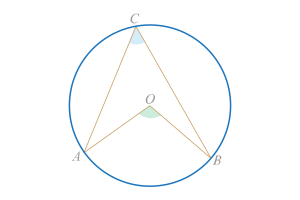
Central and inscribed angles of a circle
📚 Some essential ideas
👉 Central angle: An angle with its vertex at the centre and its arms along two radii, such as ∠AOB.
👉 Inscribed angle: An angle whose vertex lies on the circle and whose sides pass through two other points on it, such as ∠ACB.
👉 Angles subtended by the same arc: The inscribed angle ∠ACB intercepts the arc AB not containing C. Compare it with the central angle that corresponds to that exact arc. Sharing the endpoints A and B alone is not enough: we must choose the correct minor, straight or reflex central angle.
👉 Same segment: Points on the circle on the same side of a chord are said to lie in the same segment. The vertices must be different from the chord's endpoints.
⭐ The angle subtended by an arc at the centre is twice the angle subtended by it at the circumference
| Given: | In a circle with centre O, an arc AB subtends the central angle ∠AOB and the inscribed angle ∠ACB. The intercepted arc does not contain C. |
| To prove: | ∠AOB = 2∠ACB, using the central angle corresponding to that arc. |
| Construction: | Join CO and extend it beyond O to D. |
| Proof: | In △AOC, OA = OC. [Radii of the same circle] |
| ∴ | ∠OAC = ∠ACO. [Base angles of an isosceles triangle] |
| Also, | Since CO is extended to D, the exterior angle of △AOC is ∠AOD = ∠OAC + ∠ACO. |
| ∴ | ∠AOD = 2∠ACO. ...(i) |
| Similarly, | In △BOC, OB = OC, so ∠OBC = ∠BCO. |
| Hence, | ∠BOD = ∠OBC + ∠BCO = 2∠BCO. ...(ii) |
| Now, | If O lies inside ∠ACB, then the central angle through the intercepted arc is ∠AOB = ∠AOD + ∠DOB, and ∠ACB = ∠ACO + ∠OCB. |
| ∴ | From (i) and (ii), ∠AOB = 2∠ACO + 2∠OCB = 2(∠ACO + ∠OCB). |
| ∴ | ∠AOB = 2∠ACB. [Proved for this configuration] |
📚 Other positions of the centre
If O lies on one arm of ∠ACB, that arm passes through a diameter. Apply the exterior-angle argument to the single non-degenerate isosceles triangle to obtain the same result.
If O lies outside the angle, subtract the smaller angle from the larger instead of adding. For example, if ∠ACO is larger than ∠BCO, then
∠ACB = ∠ACO - ∠BCO,
and the corresponding central angle is
∠AOB = ∠AOD - ∠BOD = 2(∠ACO - ∠BCO) = 2∠ACB.
Thus the theorem holds for a minor arc, semicircular arc or major arc. For a major intercepted arc, the corresponding central angle is reflex, meaning greater than 180° and less than 360°.
📚 What the theorem means
For the same intercepted arc,
Central angle = 2 × Inscribed angle.
Equivalently,
Inscribed angle = 1/2 × Central angle.
💡 Simple example
If the central angle subtended by an arc is 100°, the inscribed angle subtended by that same arc is
100° ÷ 2 = 50°.
⭐ Angles in the same segment of a circle are equal
| Given: | C and D lie on a circle with centre O, in the same segment determined by chord AB. The angles ∠ACB and ∠ADB intercept the same arc AB, which contains neither vertex. |
| To prove: | ∠ACB = ∠ADB. |
| Construction: | Join OA and OB. |
| Proof: | For the intercepted arc, the central-angle theorem gives ∠AOB = 2∠ACB. ...(i) |
| Also, | For that same arc, ∠AOB = 2∠ADB. ...(ii) |
| ∴ | From (i) and (ii), 2∠ACB = 2∠ADB. |
| Therefore, | ∠ACB = ∠ADB. [Proved] |
📚 A simple interpretation
The chord AB subtends equal inscribed angles at all points on the circle in the same segment.
💡 Simple example
If C and D lie in the same segment determined by AB and ∠ACB = 42°, then
∠ADB = 42°.
⭐ If a segment subtends equal angles at two points on the same side, the four points are concyclic
This is an important converse of the angles-in-the-same-segment theorem. Concyclic points lie on one circle.
| Given: | Distinct points C and D lie on the same side of the line AB, and ∠ACB = ∠ADB. The four points are distinct. |
| To prove: | A, B, C, D are concyclic. |
| Proof idea: | On a specified side of a fixed chord, a fixed inscribed angle determines a unique circular arc. The proof below establishes this using the central-angle theorem and congruent right triangles. |
📚 Proof using the centres of the circles
Let ∠ACB = ∠ADB = α. Draw the circumcircles of △ABC and △ABD, with centres O₁ and O₂. Let M be the midpoint of AB.
Both centres lie on the perpendicular bisector of AB. We will show that they are the same point.
👉 If α < 90°, the intercepted arc has central angle 2α < 180°. Thus each vertex is on the major arc, on the same side of AB as its circle's centre.
👉 If α > 90°, the intercepted arc has reflex central angle 2α > 180°. Each vertex is on the minor arc, on the opposite side of AB from its circle's centre.
In either case, since C and D are on the same side of AB, the centres O₁ and O₂ are on the same side of AB.
The smaller central angle subtended by AB is the same in both circles: it is 2α when α < 90° and 360° - 2α when α > 90°. In each isosceles triangle formed by the centre and A, B, the line from the centre to the midpoint M bisects that smaller central angle.
Therefore, in the right triangles △AO₁M and △AO₂M:
- ∠AMO₁ = ∠AMO₂ = 90°.
- ∠AO₁M = ∠AO₂M.
- AM is common.
The triangles are congruent by AAS, so MO₁ = MO₂. The centres lie on the same ray of the perpendicular bisector and at the same distance from M; hence O₁ = O₂.
If α = 90°, the central angle in each circle is 180°, so AB is a diameter of both circles and both centres are M.
Thus, in every case, the circles have the same centre and the same radius, the distance from that centre to A. They are the same circle. Hence A, B, C, D are concyclic. [Proved]
📚 A quick way to identify concyclic points
If C and D lie on the same side of AB and
∠ACB = ∠ADB,
then
A, B, C, D are concyclic.
⭐ The angle in a semicircle is a right angle
| Given: | AB is a diameter of a circle with centre O. Point C lies on the circle and is different from A and B. |
| To prove: | ∠ACB = 90°. |
| Proof: | Since AB is a diameter, the central angle ∠AOB = 180°. |
| Also, | ∠AOB and ∠ACB are subtended by the same semicircular arc AB, the one not containing C. |
| ∴ | By the central-angle theorem, ∠AOB = 2∠ACB. |
| ∴ | 180° = 2∠ACB. |
| Therefore, | ∠ACB = 90°. The angle in a semicircle is a right angle. [Proved] |
📚 An alternative proof
Join OC. Since OA = OC and OB = OC, both △AOC and △BOC are isosceles.
Let
∠OAC = ∠OCA = x and ∠OBC = ∠OCB = y.
Then,
∠ACB = x + y.
In △ABC,
∠BAC + ∠ABC + ∠ACB = 180°.
Since O lies on AB, this becomes
x + y + (x + y) = 180°.
Therefore,
2(x + y) = 180°,
so
∠ACB = x + y = 90°.
✏️ Finding a central angle from an inscribed angle
If the inscribed angle subtended by an arc is 35°, then
Central angle = 2 × 35° = 70°.
Thus the corresponding central angle is 70°.
✏️ Finding an inscribed angle from a central angle
If the central angle subtended by an arc is 124°, then
Inscribed angle = 124° ÷ 2 = 62°.
✏️ Finding an unknown angle in the same segment
Suppose C and D lie in the same segment determined by AB, and ∠ACB = 48°.
By the same-segment theorem,
∠ADB = ∠ACB = 48°.
✏️ Checking whether four points are concyclic
Suppose C and D lie on the same side of AB and
∠ACB = 58°, ∠ADB = 58°.
Therefore,
∠ACB = ∠ADB.
By the converse theorem, A, B, C, D are concyclic.
✏️ Identifying a right triangle with a diameter as its hypotenuse
Suppose AB is a diameter and C is another point on the circle.
By the angle-in-a-semicircle theorem,
∠ACB = 90°.
Thus △ABC is a right triangle and AB is its hypotenuse.
This result helps us recognise right triangles drawn inside circles.
🧠 The four theorems at a glance
| Topic | Main result |
|---|---|
| Central and inscribed angles | Central angle = 2 × Inscribed angle, for the same arc |
| Angles in the same segment | Inscribed angles in the same segment subtended by the same chord are equal |
| Condition for concyclic points | ∠ACB = ∠ADB ⇒ A, B, C, D are concyclic [C and D on the same side of AB] |
| Angle in a semicircle | 90° |
⚠️ Common mistakes
👉 Incorrect: Any central angle is twice any inscribed angle.
Correct: Both angles must be subtended by the same arc.
👉 Incorrect: All inscribed angles subtended by the same chord are equal.
Correct: Their vertices must lie in the same segment, on the same side of the chord. Angles on opposite sides of the chord are supplementary.
👉 Incorrect: ∠ACB = ∠ADB always proves that four points are concyclic, regardless of their positions.
Correct: For this form of the converse, check that C and D lie on the same side of AB.
👉 Incorrect: Any chord can be used in the angle-in-a-semicircle theorem.
Correct: The chord must be a diameter.
👉 Incorrect: From ∠AOB = 2∠ACB, writing ∠ACB = 2∠AOB.
Correct: ∠ACB = 1/2 × ∠AOB.
👉 Incorrect: Always using the smaller central angle, even for a major intercepted arc.
Correct: Use the central angle corresponding to the intercepted arc. For a major arc, use the reflex central angle.
🧠 Key points to remember
👉 The central angle is twice the inscribed angle subtended by the same arc.
👉 Inscribed angles subtended by the same chord in the same segment are equal.
👉 If a segment subtends equal angles at two distinct points on the same side, all four points are concyclic.
👉 The central angle corresponding to a semicircle is 180°.
👉 The angle in a semicircle is 90°.
👉 A triangle formed by the endpoints of a diameter and another point on the circle is right-angled, with the diameter as its hypotenuse.
👉 Divide the central angle by 2 to find the inscribed angle on the same arc.
👉 Multiply the inscribed angle by 2 to find the central angle on the same arc.
👉 Before applying a theorem, clearly identify which chord or arc subtends each angle.


