

🎯 What will you learn in this lesson?
👉 Understand the definition of a parallelogram.
👉 Learn the properties of opposite sides and opposite angles.
👉 Understand how the diagonals of a parallelogram behave.
👉 Prove the main properties using congruent triangles.
👉 Use different tests to prove that a quadrilateral is a parallelogram.
A parallelogram is a special quadrilateral in which both pairs of opposite sides are parallel.
So, for parallelogram ABCD,
AB ∥ DC and AD ∥ BC.
Properties of a Parallelogram
⭐ A diagonal of a parallelogram divides it into two congruent triangles. Hence, its opposite sides and opposite angles are equal.
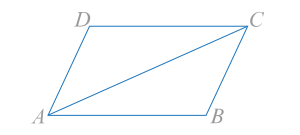
ABCD is a parallelogram, so AB ∥ DC and AD ∥ BC
| Given: | ABCD is a parallelogram and AC is a diagonal. |
| To prove: | (1) △ABC ≅ △CDA, (2) AB = DC and BC = AD, (3) ∠ABC = ∠ADC and ∠BAD = ∠BCD. |
| Proof: | Since AD ∥ BC and AC is a transversal, ∠ACB = ∠CAD. ...(i) |
| Since AB ∥ DC and AC is a transversal, ∠BAC = ∠ACD. ...(ii) | |
| Also, AC is common to both triangles. | |
| Therefore, △ABC ≅ △CDA [ASA congruence]. | |
| Hence, AB = DC and BC = AD [corresponding sides of congruent triangles]. | |
| Also, ∠ABC = ∠ADC, and by adding the equal parts in (i) and (ii), ∠BAD = ∠BCD. | |
| Thus the opposite sides and opposite angles of a parallelogram are equal. |
⭐ The diagonals of a parallelogram bisect each other.
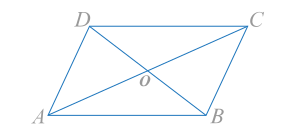
The diagonals AC and BD of parallelogram ABCD intersect at O
| Given: | Diagonals AC and BD of parallelogram ABCD intersect at O. |
| To prove: | AO = OC and BO = OD. |
| Proof: | Since AD ∥ BC, ∠OAD = ∠OCB. |
| ∠AOD = ∠BOC [vertically opposite angles]. | |
| AD = BC [opposite sides of a parallelogram]. | |
| Therefore, △AOD ≅ △COB [AAS/ASA congruence]. | |
| Hence, AO = OC and DO = BO. | |
| Therefore, the diagonals of a parallelogram bisect each other. |
⭐ If both pairs of opposite sides of a quadrilateral are equal, then it is a parallelogram.
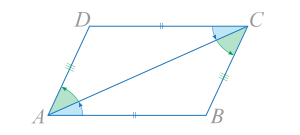
In quadrilateral ABCD, AB = DC and AD = BC
| Given: | In quadrilateral ABCD, AB = DC and AD = BC. |
| To prove: | ABCD is a parallelogram. |
| Construction: | Join B and D. |
| Proof: | In △ABD and △CDB, AB = DC, AD = BC and BD is common. |
| Therefore, △ABD ≅ △CDB [SSS congruence]. | |
| So, ∠ADB = ∠CBD. Hence AD ∥ BC. | |
| Also, ∠ABD = ∠CDB. Hence AB ∥ DC. | |
| Both pairs of opposite sides are parallel, so ABCD is a parallelogram. |
⭐ If both pairs of opposite angles of a quadrilateral are equal, then it is a parallelogram.
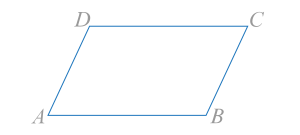
In quadrilateral ABCD, ∠BAD = ∠BCD and ∠ABC = ∠ADC
| Given: | ∠BAD = ∠BCD and ∠ABC = ∠ADC. |
| To prove: | ABCD is a parallelogram. |
| Proof: | The sum of the four angles of a quadrilateral is 360°. |
| ∠BAD + ∠ABC + ∠BCD + ∠ADC = 360°. | |
| Using the given equalities, 2(∠BAD + ∠ABC) = 360°. | |
| Therefore, ∠BAD + ∠ABC = 180°. | |
| Hence AD ∥ BC, because the interior angles on the same side of transversal AB are supplementary. | |
| Similarly, AB ∥ DC. | |
| Therefore, ABCD is a parallelogram. |
⭐ If one pair of opposite sides of a quadrilateral is equal and parallel, then it is a parallelogram.
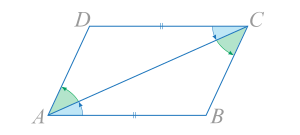
In quadrilateral ABCD, AB = DC and AB ∥ DC
| Given: | AB = DC and AB ∥ DC. |
| To prove: | ABCD is a parallelogram. |
| Construction: | Draw diagonal AC. |
| Proof: | Since AB ∥ DC and AC is a transversal, ∠BAC = ∠ACD. |
| In △ABC and △CDA, AB = DC, ∠BAC = ∠ACD and AC is common. | |
| Therefore, △ABC ≅ △CDA [SAS congruence]. | |
| Thus ∠ACB = ∠DAC, so BC ∥ AD. | |
| Now AB ∥ DC and BC ∥ AD. Therefore, ABCD is a parallelogram. |
⭐ If the diagonals of a quadrilateral bisect each other, then the quadrilateral is a parallelogram.
The diagonals AC and BD of quadrilateral ABCD bisect each other at O
| Given: | AO = OC and BO = OD. |
| To prove: | ABCD is a parallelogram. |
| Proof: | In △AOD and △COB, AO = OC and OD = OB. |
| Also, ∠AOD = ∠COB [vertically opposite angles]. | |
| Therefore, △AOD ≅ △COB [SAS congruence]. | |
| Hence, AD = BC and ∠OAD = ∠OCB. | |
| Since ∠OAD and ∠OCB are alternate interior angles, AD ∥ BC. | |
| Thus one pair of opposite sides is equal and parallel. Therefore, ABCD is a parallelogram. |
✏️ Solved examples
Example 1
In parallelogram ABCD, AB = 8 cm and BC = 5 cm. Find DC and AD.
Solution: Opposite sides of a parallelogram are equal.
DC = AB = 8 cm and AD = BC = 5 cm.
Example 2
In parallelogram PQRS, ∠P = 68°. Find the other three angles.
Solution: Opposite angles are equal and adjacent angles are supplementary.
∠R = 68° ∠Q = ∠S = 180° - 68° = 112°Example 3
The diagonals AC and BD of parallelogram ABCD meet at O. If AO = 6.5 cm and BO = 4 cm, find AC and BD.
Solution: The diagonals bisect each other.
AC = 2 × AO = 13 cm BD = 2 × BO = 8 cm📝 Practice questions
- In parallelogram ABCD, AB = 12 cm and AD = 7 cm. Find DC and BC.
- One angle of a parallelogram is 125°. Find the other three angles.
- The diagonals of a parallelogram meet at O. If AC = 18 cm and BD = 14 cm, find AO, OC, BO and OD.
- In quadrilateral PQRS, PQ = RS and QR = PS. What can you conclude? Give the theorem used.
- In quadrilateral ABCD, AB ∥ DC and AB = DC. Prove that ABCD is a parallelogram.
- The diagonals of quadrilateral WXYZ bisect each other. Is WXYZ necessarily a parallelogram? Explain.
✅ Answers
1. DC = 12 cm, BC = 7 cm.
2. The angles are 125°, 55°, 125° and 55°.
3. AO = OC = 9 cm; BO = OD = 7 cm.
4. PQRS is a parallelogram because both pairs of opposite sides are equal.
5. A quadrilateral with one pair of opposite sides equal and parallel is a parallelogram.
6. Yes. A quadrilateral whose diagonals bisect each other is a parallelogram.
📚 Important points to remember
👉 Opposite sides of a parallelogram are equal and parallel.
👉 Opposite angles of a parallelogram are equal.
👉 Adjacent angles of a parallelogram add up to 180°.
👉 The diagonals of a parallelogram bisect each other.
👉 A diagonal divides a parallelogram into two congruent triangles.
👉 To prove that a quadrilateral is a parallelogram, you may use any one of these tests: both pairs of opposite sides equal, both pairs of opposite angles equal, one pair of opposite sides equal and parallel, or diagonals bisecting each other.


