

Similarity and Similar Triangle Theorems
We often see figures with the same shape but different sizes. For example, enlarging or reducing a photograph by scaling its length and width in the same ratio, without cropping it, gives figures with the same shape but different sizes. Such figures are called similar.
The aim of this chapter is to understand when two figures, especially two triangles, are similar and which ratios and geometric relationships follow from similarity.
📚 Basic ideas about similar figures
👉 Congruent figures are always similar.
👉 Similar figures need not be congruent.
👉 All squares are similar to one another.
👉 All circles are similar to one another.
👉 All equilateral triangles are similar to one another.
👉 A square and a rhombus are not always similar because their corresponding angles need not be equal.
📚 The similarity symbol
For similar triangles, use ~ rather than the congruence symbol ≅. For example, △ABC ~ △DEF.
The order of the letters matters: A ↔ D, B ↔ E, C ↔ F are corresponding vertices.
📚 Conditions for similar polygons
Two polygons with the same number of sides are similar if their corresponding angles are equal and their corresponding sides are proportional.
If ABCD and A'B'C'D' are similar quadrilaterals, then:
∠A = ∠A', ∠B = ∠B', ∠C = ∠C', ∠D = ∠D'📚 Similar triangles
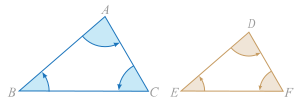
Similar triangles
Similar triangles have equal corresponding angles and proportional corresponding sides. If △ABC ~ △DEF, then:
∠A = ∠D, ∠B = ∠E, ∠C = ∠F📚 Dividing a line segment in a given ratio
Let P lie between A and B on AB. It divides AB internally in the ratio AP : PB.
👉 If P is the midpoint of AB,
👉 If P is closer to A than to B,
👉 If P is closer to B than to A,
A point on an extension of AB divides the segment externally. In the following proofs of BPT and its converse, the dividing points lie inside the two sides.
⭐ Thales’ theorem or the Basic Proportionality Theorem
Here denotes the area of △XYZ.
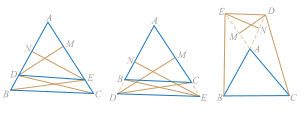
Basic Proportionality Theorem
| Given: | In △ABC, DE ∥ BC. The line meets AB and AC at interior points D and E respectively. |
| To prove: | |
| Construction: | Join B to E and C to D. Draw DM ⟂ AC and EN ⟂ AB. |
| Proof: | Taking AD and DB as the bases of △ADE and △BDE, both triangles have the same corresponding height EN because the bases lie on the same line AB. |
| Therefore: | |
| And: | |
| Therefore: | ...(i) |
| Again: | △ADE and △DEC have bases AE and EC and the same height DM. |
| Therefore: | ...(ii) |
| But: | △BDE and △DEC stand on the same base DE and lie between the same parallels DE and BC. Hence their areas are equal. |
| Conclusion: | From (i) and (ii), . [Proved] |
📚 Two useful consequences of BPT
Let D and E be interior points of AB and AC respectively, with DE ∥ BC. From , adding 1 to both sides gives:
Taking reciprocals in the original proportion, adding 1, and then taking reciprocals again gives:
These three proportions express the same relationship in different forms. Choose the form that suits the given information.
⭐ Converse of the Basic Proportionality Theorem
Converse of BPT
| Given: | D and E are interior points of AB and AC in △ABC, and . |
| To prove: | DE ∥ BC |
| Construction: | Join B to E and C to D. Draw DM ⟂ AC and EN ⟂ AB. |
| Proof: | |
| And: | [Using the area relationships in the preceding proof.] |
| Since: | [Given] |
| Therefore: | Area of △BDE = area of △DEC. |
| Again: | The triangles have the same base DE and lie on the same side of DE. Equal areas imply equal perpendicular distances of B and C from DE. Thus B and C lie on a line parallel to DE. |
| Conclusion: | DE ∥ BC [Proved] |
📚 Remembering BPT and its converse
Here D and E are interior points of AB and AC respectively.
👉 Parallelism gives a proportion: DE ∥ BC ⇒
👉 A proportion gives parallelism: ⇒ DE ∥ BC
⭐ Equiangular triangles have proportional corresponding sides
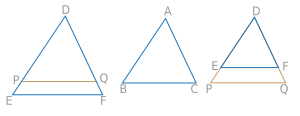
Corresponding vertices: A and D, B and E, C and F
| Given: | ∠A = ∠D, ∠B = ∠E, ∠C = ∠F |
| To prove: | |
| Special case: | If AB = DE, the given angle equalities imply △ABC ≅ △DEF by ASA congruence. Every corresponding side ratio is then 1. Otherwise, interchange the triangle names if necessary so that AB < DE. |
| Construction: | Choose P inside DE so that DP = AB. Through P draw a line parallel to EF, meeting DF at Q. Then Q also lies inside DF. |
| Proof: | ∠DPQ = ∠DEF = ∠ABC by corresponding angles and the given condition. Also, ∠PDQ = ∠BAC and DP = AB. |
| Therefore: | △DPQ ≅ △ABC by ASA congruence. Thus DQ = AC and PQ = BC . |
| Now: | Since PQ ∥ EF, a consequence of BPT gives . Therefore ...(i). |
| Similarly: | Apply the same construction and argument at corresponding vertices B and E. Replace (A, B, C) by (B, C, A) and (D, E, F) by (E, F, D). This gives ...(ii). |
| Conclusion: | From (i) and (ii), . [Proved] |
📚 Result: AAA or AA similarity criterion
If corresponding angles of two triangles are equal, the triangles are similar. Two pairs of equal corresponding angles suffice: the third pair must also be equal. This is the AA similarity criterion.
∠A = ∠D, ∠B = ∠E ⇒ △ABC ~ △DEF⭐ Proportional corresponding sides imply equal corresponding angles
Corresponding vertices: A and D, B and E, C and F
| Given: | |
| To prove: | △ABC ~ △DEF |
| Special case: | If AB = DE, the given ratios give BC = EF and AC = DF. By SSS congruence the triangles are congruent and hence similar. Otherwise, interchange their names if necessary to take AB < DE. |
| Construction: | Choose P inside DE so that DP = AB. Through P draw a line parallel to EF, meeting DF at Q. Then Q also lies inside DF. |
| Proof: | Since PQ ∥ EF, corresponding angles are equal. By the AA criterion already proved, △DPQ ~ △DEF. Thus . |
| Comparing: | Substituting DP = AB and comparing with the given ratios gives PQ = BC and DQ = AC. |
| Therefore: | DP = AB, PQ = BC, DQ = AC, so △DPQ ≅ △ABC by SSS congruence. |
| Conclusion: | ∠A = ∠D, ∠B = ∠DPQ = ∠E, ∠C = ∠DQP = ∠F. Therefore △ABC ~ △DEF . [Proved] |
📚 Result: SSS similarity criterion
Two triangles are similar if their three pairs of corresponding sides are proportional.
⇒ △ABC ~ △DEF⭐ Equal included angles and proportional containing sides imply similarity
Corresponding vertices: A and D, B and E, C and F
| Given: | ∠A = ∠D and |
| To prove: | △ABC ~ △DEF |
| Special case: | If AB = DE, the given ratio gives AC = DF. The included angles are equal, so SAS congruence gives △ABC ≅ △DEF; hence they are similar. Otherwise, interchange names if necessary to take AB < DE. |
| Construction: | Choose P inside DE so that DP = AB. Through P draw a line parallel to EF, meeting DF at Q. Then Q also lies inside DF. |
| Proof: | Since PQ ∥ EF, BPT gives . |
| Comparing: | Using DP = AB and the given , we obtain DQ = AC. |
| Therefore: | DP = AB, DQ = AC and the included ∠PDQ = ∠BAC. Hence △DPQ ≅ △ABC by SAS congruence. |
| Again: | Parallelism gives ∠DPQ = ∠E, ∠DQP = ∠F. Congruence gives ∠B = ∠DPQ, ∠C = ∠DQP. |
| Conclusion: | ∠A = ∠D, ∠B = ∠E, ∠C = ∠F. By AA, △ABC ~ △DEF. [Proved] |
📚 Result: SAS similarity criterion
Two triangles are similar if one pair of corresponding angles is equal and the two pairs of sides containing these angles are proportional.
🔹 ∠A = ∠D, ⇒ △ABC ~ △DEF
📚 When are two triangles similar?
The theorems above give three main criteria:
👉 AA/AAA: Two pairs of equal corresponding angles suffice; the third pair is then equal.
👉 SSS: All three pairs of corresponding sides are proportional.
👉 SAS: One pair of corresponding angles is equal, and the sides containing these angles are proportional.
Any one of these criteria, correctly satisfied, proves similarity.
⭐ Similarity of triangles formed by the altitude to the hypotenuse
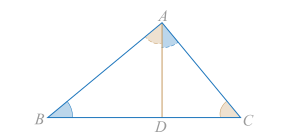
Altitude to the hypotenuse
A perpendicular drawn from the right-angle vertex to the hypotenuse divides the triangle into two smaller triangles. Both are similar to the original triangle and to each other.
| Given: | △ABC is right-angled with ∠A = 90°. Draw AD ⟂ BC from A to hypotenuse BC. |
| To prove: | (i) △DBA ~ △ABC, (ii) △DAC ~ △ABC, (iii) △DBA ~ △DAC |
| Proof: | In △DBA and △ABC, |
| Since: | ∠BDA = ∠BAC = 90° |
| And: | ∠ABD = ∠CBA |
| Therefore: | ∠BAD = ∠BCA [Remaining angles.] |
| Therefore: | △DBA ~ △ABC [AA; (i) proved.] |
| Again: | In △DAC and △ABC, |
| Since: | ∠ADC = ∠BAC = 90° |
| And: | ∠ACD = ∠BCA |
| Therefore: | ∠CAD = ∠CBA [Remaining angles.] |
| Therefore: | △DAC ~ △ABC [AA; (ii) proved.] |
| Now: | △DBA ~ △ABC |
| And: | △DAC ~ △ABC |
| Conclusion: | △DBA ~ △DAC [(iii) proved.] |
📚 Three important consequences
Ratios of corresponding sides give:
Cross-multiplying,
⭐ AB² = BC × BD
⭐ AD² = BD × CD
⭐ AC² = BC × CD
The second relation says that altitude AD is the geometric mean of the two hypotenuse segments BD and CD.
⚠️ Common mistakes
❌ Assuming similar figures must be congruent.
✔✔ Congruent figures are similar, but similar figures may differ in size.
❌ Checking only angles for similar polygons.
✔✔ For polygons with the same number of sides, corresponding angles must be equal and corresponding sides proportional.
❌ Rejecting an equivalent BPT proportion.
✔✔ gives AD × EC = AE × DB. Thus is also correct. All lengths here are positive.
❌ Ignoring the order of vertices in similarity notation.
✔✔ Write corresponding vertices in the same order. In △ABC ~ △DEF, A ↔ D, B ↔ E, C ↔ F.
❌ Using any two side ratios for SAS.
✔✔ The proportional sides must be the sides containing the equal angles.
❌ Using BPT and its converse in the same direction.
✔✔ BPT obtains a ratio from parallelism; its converse establishes parallelism from a ratio.
🧠 Key points to remember
In the BPT formulas below, D and E are interior points of AB and AC respectively.
👉 Similar figures have the same shape; their sizes may be equal or different.
👉 Congruent figures are always similar, but the converse need not hold.
👉 Similar polygons have equal corresponding angles and proportional corresponding sides.
👉 DE ∥ BC ⇒ [BPT]
👉 ⇒ DE ∥ BC [Converse of BPT]
👉 AA/AAA: Equal corresponding angles establish similarity.
👉 SSS: Three pairs of proportional corresponding sides establish similarity.
👉 SAS: Equal included angles and proportional containing sides establish similarity.
👉 The altitude to the hypotenuse produces three mutually similar triangles, including the original.
👉 AB² = BC × BD, AD² = BD × CD, AC² = BC × CD


