

Theorems on Perpendicular and Oblique Segments
From a point outside a straight line, we can draw many line segments to different points on the line. These segments do not all have the same length. The perpendicular segment is the shortest. Also, among two oblique segments, the one whose foot lies farther from the foot of the perpendicular is longer.
Let us understand and prove these two important results step by step.
📚 What are perpendicular and oblique segments?
Let AB be a straight line and O be a point outside it. Draw OP perpendicular to AB.
👉 If OP ⟂ AB, then OP is called a perpendicular segment.
👉 Join O to any other point Q on AB. Then OQ is called an oblique segment.
👉 P is called the foot of the perpendicular.
⭐ Of all segments drawn from an external point to a line, the perpendicular is the shortest
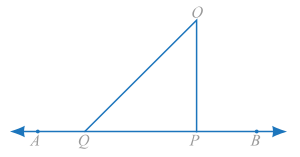
The perpendicular is the shortest
OP ⟂ AB
| Given: | Let AB be a straight line and O a point outside it. OP is perpendicular to AB, that is, OP ⟂ AB. |
| To prove: | For any other point Q on AB, the segment OP is shorter than OQ, that is, OP < OQ. |
| Construction: | Take any point Q on AB other than P and join OQ. |
| Proof: | In △OPQ, ∠OPQ = 90°. [Since OP ⟂ AB and both P and Q lie on AB] |
| ∴ | ∠OQP < 90°. [The other two angles of a right triangle are acute] |
| ∴ | ∠OPQ > ∠OQP. |
| ∴ | OQ > OP. [The side opposite the larger angle of a triangle is longer] |
| But, | Q is any point on AB other than P. |
| ∴ | OP < OQ for every possible position of Q on AB. |
| ∴ | Among all line segments drawn from O to AB, OP has the least length. [Proved] |
📚 Important result: Distance of a point from a line
The theorem above shows that among all segments drawn from a point to a line, the perpendicular is the shortest.
👉 Therefore, the distance of a point from a line is the length of the perpendicular segment drawn from the point to the line.
So, in the figure above, the distance of O from AB is OP.
⭐ The farther the foot of an oblique segment is from the perpendicular foot, the longer the oblique segment
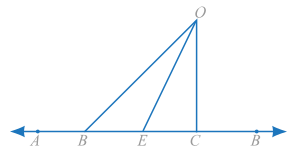
Length of an oblique segment
OE < OD
Let OC be perpendicular to line AB from the external point O. Let OD and OE be two oblique segments. In the proof below, C, E, D lie on the same side in the order C-E-D, so CD > CE.
| Given: | AB is a straight line and O is an external point. OC ⟂ AB.OD and OE are oblique segments. C, E, D lie on the same side on the same line and CD > CE. |
| To prove: | OD > OE. |
| Proof: | In △OCE, ∠OCE = 90°. [Since OC ⟂ AB] |
| ∴ | ∠OEC < 90°. [The other two angles of a right triangle are acute] |
| Again, | EC and ED are opposite rays. |
| ∴ | ∠OEC + ∠OED = 180°. |
| ∴ | ∠OED > 90°. [Since ∠OEC < 90°] |
| Again, | In △OCD, ∠OCD = 90°. [Since OC ⟂ AB] |
| ∴ | ∠ODC < 90°. |
From point D, both E and C lie in the same direction, so DE and DC are the same ray. | |
| ∴ | ∠ODE = ∠ODC < 90°. |
| Therefore, | In △OED, ∠OED > ∠ODE. |
| ∴ | OD > OE. [The side opposite the larger angle of a triangle is longer] [Proved] |
📚 General meaning
The angle-based proof above assumes that D and E lie on the same side of C. However, the result is more general. No matter on which side of C the two points lie, if D is farther from the perpendicular foot C than E, then OD > OE.
If you know the Pythagoras theorem, the result becomes very easy to see:
OD² = OC² + CD²and
OE² = OC² + CE²Since CD > CE, we have CD² > CE².
Therefore, OC² + CD² > OC² + CE².
So, OD² > OE² and hence OD > OE.
💡 Simple example 1
Let OP be perpendicular from an external point O to line AB, and let OQ be an oblique segment. If OP = 5 cm, what can we say about the length of OQ?
By the first theorem,
OP < OQTherefore,
5 < OQ.
So OQ must be longer than 5 cm.
💡 Simple example 2
Let OC ⟂ AB, CD = 8 cm and CE = 5 cm. If OD and OE are oblique segments, which one is longer?
Since,
CD > CE,
by the second theorem,
OD > OE.
Thus, OD is longer because its foot D is farther from the perpendicular foot C.
💡 Numerical example using Pythagoras theorem
Suppose OC ⟂ AB, OC = 6 cm and CD = 8 cm. Find OD.
In right triangle OCD,
OD² = OC² + CD² = 6² + 8² = 36 + 64 = 100Therefore,
OD = 10 cm.
This also shows that the oblique segment OD is longer than the perpendicular OC.
📚 Two more direct conclusions
⭐ If the feet of two oblique segments are equally far from the foot of the perpendicular, then the two oblique segments are equal in length.
⭐ From the same external point, as the foot of an oblique segment moves farther away from the foot of the perpendicular, the oblique segment becomes longer.
✏️ Practice questions
🔹 1. OP is perpendicular to line AB and OQ is an oblique segment. If OP = 7 cm, can OQ = 6.5 cm? Give a reason.
🔹 2. OC ⟂ AB. If CD = 4 cm and CE = 9 cm, compare OD and OE.
🔹 3. The distance of a point P from a line l is 5 cm. What is the length of the perpendicular from P to l?
🔹 4. OC ⟂ AB, OC = 9 cm and CD = 12 cm. Find OD using the Pythagoras theorem.
🔹 5. Two oblique segments OX and OY are drawn from the same external point. Their feet X and Y are equally far from the foot C of the perpendicular. Compare OX and OY.
🔹 6. Explain in one sentence why the shortest route from a point to a straight line is perpendicular to the line.
1. No. A perpendicular is shorter than every oblique segment from the same external point, so OQ > 7 cm.
2. Since CE > CD, OE > OD.
3. 5 cm.
4. OD² = 9² + 12² = 81 + 144 = 225, so OD = 15 cm.
5. OX = OY।
6. Because the perpendicular segment has the least length among all segments joining the point to the line.
⚠️ Common mistakes
👉 Wrong: Writing ∠OED < 90°.
👉 Correct: If the order is C-E-D, then ∠OED > 90° because it is supplementary to the acute angle ∠OEC.
👉 Wrong: Assuming ∠ODE > 90°.
👉 Correct: ∠ODE = ∠ODC < 90°.
👉 In a triangle, the larger side lies opposite the larger angle. Do not compare sides merely because they are adjacent to an angle.
👉 To find the distance of a point from a line, use the perpendicular length, not an oblique segment.
📚 Important points to remember
👉 Among all segments drawn from an external point to a straight line, the perpendicular is the shortest.
👉 Distance of a point from a line = length of the perpendicular from the point to the line.
👉 Every oblique segment drawn from the same external point to the line is longer than the perpendicular.
👉 The farther the foot of an oblique segment is from the foot of the perpendicular, the longer the oblique segment is.
👉 If CD > CE, then OD > OE.
👉 In a triangle, the side opposite the larger angle is longer, and the side opposite the smaller angle is shorter.


