

Circle Theorems
This page proves three important circle theorems step by step. Before you begin, make sure you understand centre, radius, chord, perpendicular and perpendicular bisector.
Quick recall
- All radii of the same circle are equal.
- Both endpoints of a chord lie on the circle.
- A perpendicular bisector divides a segment into two equal parts and is perpendicular to it.
- Corresponding sides and angles of congruent triangles are equal.
⭐ Exactly one circle can be drawn through three non-collinear points
This proof is included to help you understand the idea. Check your own syllabus to see whether you need to reproduce it in an examination.
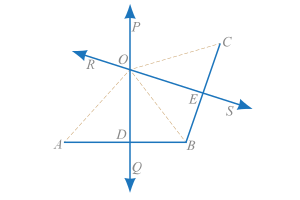
The unique circle through three non-collinear points
| Given: | A, B, C are three given non-collinear points. |
| To prove: | Exactly one circle can be drawn through A, B, C. |
| Construction: | Join AB and BC. Draw their perpendicular bisectors PQ and RS, meeting at O. Let D and E be the midpoints of AB and BC, respectively. Join OA, OB and OC. |
| Why they intersect: | Since A, B, C are non-collinear, the lines AB and BC intersect and are not parallel. Their perpendicular bisectors are therefore not parallel and meet at exactly one point O. |
| Proof: | First suppose O is different from D. In △OAD and △OBD: |
AD = DB. [D is the midpoint of AB] | |
∠ODA = ∠ODB = 90°. [PQ ⟂ AB] | |
OD is common. | |
| ∴ | △OAD ≅ △OBD. [SAS congruence] |
| ∴ | OA = OB. [Corresponding sides of congruent triangles] |
| Special case: | If O = D, then OA = OB follows directly because D is the midpoint of AB; no triangle-congruence argument is needed. |
| Similarly, | Since O lies on the perpendicular bisector of BC, △OBE ≅ △OCE by SAS when O ≠ E. Hence OB = OC. If O = E, the same equality follows directly from BE = EC. |
| ∴ | OA = OB = OC. |
| Therefore, | A, B, C are all at the same distance from O. A circle with centre O and radius OA passes through all three points. |
| ∴ | A circle through the three non-collinear points exists. |
| Uniqueness: | The centre of any circle through A, B, C must be equidistant from A and B, and from B and C. It must therefore lie on both perpendicular bisectors PQ and RS. |
| ∴ | Since these bisectors have only one intersection, the centre must be O. |
| Also, | The radius must be OA, which is fixed. A fixed centre and a fixed radius determine exactly one circle. |
| ∴ | Exactly one circle passes through the three non-collinear points A, B, C. [Proved] |
What have we learned?
The intersection of the perpendicular bisectors of two sides of △ABC is equidistant from all three vertices.
This point is the circumcentre of the triangle and the centre of its circumcircle, the circle through A, B, C.
⭐ The perpendicular from the centre to a chord that is not a diameter bisects the chord
| Given: | AB is a chord, not a diameter, of a circle with centre O. The perpendicular from O meets AB at D, so OD ⟂ AB. |
| To prove: | AD = DB. |
| Construction: | Join OA and OB. |
| Proof: | Since OD ⟂ AB, △OAD and △OBD are right triangles. |
| Now, | OA = OB. [Radii of the same circle; these are the hypotenuses] |
OD = OD. [Common side] | |
∠ODA = ∠ODB = 90°. | |
| ∴ | △OAD ≅ △OBD. [RHS congruence] |
| ∴ | AD = DB. [Corresponding sides of congruent triangles] |
| Therefore, | D is the midpoint of AB. |
| ∴ | The perpendicular from the centre to a chord that is not a diameter bisects the chord. [Proved] |
Applying the theorem
If AB = 18 cm and OD ⟂ AB, then
AD = DB = 18 ÷ 2 = 9 cm.
Thus, locating the foot of the perpendicular from the centre also locates the midpoint of the chord.
⭐ The line joining the centre to the midpoint of a chord that is not a diameter is perpendicular to the chord
This is the converse of the previous theorem.
| Given: | AB is a chord, not a diameter, of a circle with centre O. Its midpoint is D, so AD = DB. Join OD. |
| To prove: | OD ⟂ AB. |
| Construction: | Join OA and OB. |
| Proof: | In △OAD and △OBD: |
OA = OB. [Radii of the same circle] | |
AD = DB. [Given] | |
OD = OD. [Common side] | |
| ∴ | △OAD ≅ △OBD. [SSS congruence] |
| ∴ | ∠ODA = ∠ODB. [Corresponding angles of congruent triangles] |
| Now, | A, D, B lie on a straight line, with D between A and B. Thus ∠ODA and ∠ODB form a linear pair. |
| Hence, | ∠ODA + ∠ODB = 180°. |
| Since, | The angles are equal, each equals 180° ÷ 2 = 90°. |
| ∴ | ∠ODA = ∠ODB = 90°. |
| ∴ | OD ⟂ AB. [Proved] |
⭐ Understanding the two chord theorems together
| Perpendicular from the centre to the chord | ⇒ Passes through the midpoint of the chord. |
| Line joining the centre to the chord's midpoint | ⇒ Is perpendicular to the chord. |
For a chord that is not a diameter, the perpendicular from the centre and the line joining the centre to the chord's midpoint are the same line.
The “not a diameter” condition ensures that O and D are distinct. For a diameter, its midpoint is the centre itself, so joining these two coincident points does not define a line.
⭐ Simple worked examples
Example 1: Finding the two parts of a chord
AB is a chord, not a diameter, and AB = 20 cm. From the centre O, OD is drawn perpendicular to AB.
By the theorem,
AD = DB.
Therefore,
AD = DB = 20 ÷ 2 = 10 cm.
Answer: AD = DB = 10 cm.
Example 2: How can we prove that a line is perpendicular to a chord?
D is the midpoint of a chord AB that is not a diameter, and O is the centre of the circle.
Since,
AD = DB,
and OD joins the centre to the midpoint, the converse theorem gives
OD ⟂ AB.
Answer: OD is perpendicular to AB.
⚠️ Common mistakes and how to avoid them
🔸 “Non-collinear” is essential in the three-point circle theorem. No circle of finite radius passes through three distinct points on a straight line.
🔸 In the converse chord theorem, equal angles alone do not complete the proof of perpendicularity. The angles also form a linear pair, so their sum is 180°. Since they are equal, each is 90°.
🔸 Do not confuse RHS and SSS congruence. First identify the information given. Use RHS when the triangles are known to be right-angled with equal hypotenuses and one equal corresponding side. Use SSS when all three corresponding sides are equal.
🔸 Keep the non-diameter condition when joining the centre to a chord's midpoint. Otherwise the two points coincide and OD does not define a line.
📚 Key points to remember
🔹 Exactly one circle passes through three given non-collinear points.
🔹 To locate its centre, find the intersection of the perpendicular bisectors of two segments joining those points.
🔹 The perpendicular bisectors of a triangle's sides meet at its circumcentre.
🔹 The perpendicular from the centre to a chord that is not a diameter bisects the chord.
🔹 The line joining the centre to the midpoint of a chord that is not a diameter is perpendicular to the chord.
🔹 The two chord theorems are converses of each other.
Quick revision
In the chord statements below, O is the centre, AB is not a diameter, and D lies on AB.
| Three non-collinear points | Determine exactly one circle. |
| OD ⟂ AB | ⇒ AD = DB |
| AD = DB | ⇒ OD ⟂ AB |
Review the basic concepts first
If you are unsure about chords, diameters, arcs, segments or sectors, read Basic Concepts of a Circle before studying these proofs.


