

Transversal and Midpoint Theorem
The Midpoint Theorem gives an important relation between the sides of a triangle and a line joining two midpoints. It is useful in geometry proofs, in finding unknown lengths, and later in problems involving similar triangles.
⭐ The line segment joining the midpoints of two sides of a triangle is parallel to the third side and is half of it.
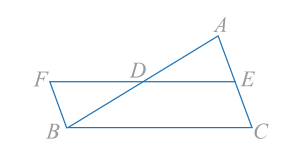
In △ABC, D is the midpoint of AB and E is the midpoint of AC; DE || BC
| Given: | In △ABC, D is the midpoint of AB and E is the midpoint of AC. Therefore AD = DB and AE = EC. D and E are joined. |
| To prove: | DE || BC and DE = BC |
| Construction: | Produce DE to F such that DE = DF. Join B and F. |
| Proof: | In △ADE and △BDF, |
AD = DB [Given] | |
∠ADE = ∠BDF [Vertically opposite angles] | |
DE = DF [By construction] | |
| ∴ | △ADE ≅ △BDF [SAS congruence] |
| ∴ | AE = BF [Corresponding sides of congruent triangles] |
| But, | AE = EC [Given] |
| ∴ | BF = EC |
| Also, | ∠DAE = ∠DBF [Corresponding angles of congruent triangles] |
| ∴ | BF || AE [A pair of alternate angles is equal] |
| Hence, | BF || EC |
| In quadrilateral BCEF, BF || EC and BF = EC. | |
| ∴ | BCEF is a parallelogram. |
| ∴ | FE || BC |
| Therefore, | DE || BC [Proved] |
| Also, | BC = EF = DE + DF = DE + DE [Since DE = DF] |
| ∴ | BC = 2DE |
| ∴ | DE = BC [Proved] |
⭐ Converse of the Midpoint Theorem
A line drawn through the midpoint of one side of a triangle, parallel to another side, bisects the third side. The segment inside the triangle is also half the length of the side to which it is parallel.
In △ABC, D is the midpoint of AB and DE || BC; then AE = EC
| Given: | In △ABC, D is the midpoint of AB. Through D, DE is drawn parallel to BC, meeting AC at E. |
| To prove: | (1) AE = EC and (2) DE = BC |
| Construction: | Produce DE to F such that DE = DF. Join B and F. |
| Proof: | In △ADE and △BDF, |
AD = DB [D is the midpoint of AB] | |
∠ADE = ∠BDF [Vertically opposite angles] | |
DE = DF [By construction] | |
| ∴ | △ADE ≅ △BDF [SAS] |
| ∴ | AE = BF |
| Also, | ∠DAE = ∠DBF |
| ∴ | AE || BF |
| Hence, | EC || BF |
| Also, | DE || BC [Given] |
| Thus, | FE || BC |
| Therefore, both pairs of opposite sides of BCEF are parallel. | |
| ∴ | BCEF is a parallelogram. |
| ∴ | EC = BF and BC = EF |
| But, | AE = BF |
| ∴ | AE = EC [(1) Proved] |
| Again, | BC = EF = DE + DF = DE + DE |
| ∴ | BC = 2DE |
| ∴ | DE = BC [(2) Proved] |
⭐ Theorem on Parallel Lines and Transversals
If three or more parallel lines cut equal intercepts on one transversal, then they cut equal intercepts on any other transversal.
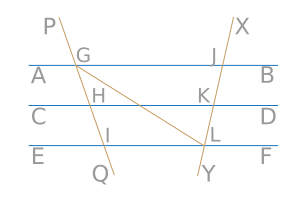
AB, CD and EF are three parallel lines cut by two transversals
| Given: | AB, CD and EF are parallel lines. On transversal PQ they cut equal intercepts GH and HI, so GH = HI. On another transversal XY they cut intercepts JK and KL. |
| To prove: | JK = KL |
| Construction: | Join G and L. Let GL meet CD at T. |
| Proof: | In △GIL, H is the midpoint of GI because GH = HI. |
| Also, | HT || IL [Parallel lines] |
| ∴ | By the converse of the Midpoint Theorem, T is the midpoint of GL. |
| Now, | In △GLJ, T is the midpoint of GL and TK || GJ. |
| ∴ | By the converse of the Midpoint Theorem, K is the midpoint of JL. |
| ∴ | JK = KL [Proved] |
✍️ Solved Examples
Example 1
In △ABC, D and E are the midpoints of AB and AC respectively. If BC = 18 cm, find DE.
Solution: By the Midpoint Theorem,
Therefore, DE = 9 cm.
Example 2
In △PQR, X is the midpoint of PQ. Through X, XY is drawn parallel to QR and meets PR at Y. If PY = 7.5 cm, find YR.
Solution: By the converse of the Midpoint Theorem, Y is the midpoint of PR. Therefore,
PY = YR = 7.5 cmSo, YR = 7.5 cm.
Example 3
Three parallel lines cut two transversals. On the first transversal, two consecutive intercepts are 6 cm and 6 cm. On the second transversal, the first corresponding intercept is 9 cm. Find the second corresponding intercept.
Solution: Since the parallel lines make equal intercepts on the first transversal, they also make equal intercepts on the second transversal.
Therefore, the second intercept is 9 cm.
📝 Practice Questions
🔹 1. In △ABC, D and E are the midpoints of AB and AC. If BC = 26 cm, find DE.
🔹 2. In △XYZ, P and Q are the midpoints of XY and XZ. If PQ = 8 cm, find YZ.
🔹 3. In △ABC, D is the midpoint of AB and DE || BC. If AE = 6.4 cm, find EC.
🔹 4. The segment joining the midpoints of two sides of a triangle is 11 cm long. Find the length of the third side.
🔹 5. Three parallel lines cut two consecutive intercepts of 5 cm and 5 cm on one transversal. On another transversal, the first intercept is 7.2 cm. Find the second intercept.
🔹 6. In △PQR, M is the midpoint of PQ and MN || QR. If QR = 20 cm and PR = 18 cm, find MN and NR.
1. 13 cm
2. 16 cm
3. 6.4 cm
4. 22 cm
5. 7.2 cm
6. MN = 10 cm, NR = 9 cm
📚 Important Points to Remember
👉 A midpoint divides a line segment into two equal parts.
👉 The segment joining the midpoints of two sides of a triangle is parallel to the third side.
👉 Its length is half the length of the third side.
👉 A line through the midpoint of one side of a triangle, parallel to another side, bisects the third side.
👉 If parallel lines cut equal intercepts on one transversal, they cut equal intercepts on another transversal as well.
👉 When a problem gives both a midpoint and a parallel line, check whether the Midpoint Theorem or its converse can be used.


