

Theorems on Tangents to a Circle
A tangent is a straight line that meets a circle at exactly one point. There are important relationships between a tangent, the radius, the centre and the point of contact. These help us construct tangents, calculate angles, prove equal lengths and locate the centres of touching circles.
This page explains three main tangent theorems and their important applications step by step.
📚 What are a tangent and a point of contact?
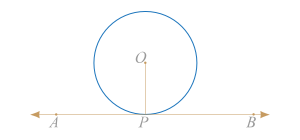
Tangent and point of contact
Suppose the line AB touches a circle with centre O only at P.
👉 AB is the tangent to the circle.
👉 P is the point of contact.
👉 OP is the radius through the point of contact.
👉 A point outside the circle is called an external point.
⭐ A tangent is perpendicular to the radius through the point of contact
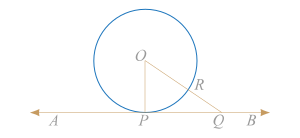
The tangent is perpendicular to the radius at the point of contact
| Given: | AB is a tangent at P to a circle with centre O, and OP is the radius through P. |
| To prove: | OP ⟂ AB. |
| Construction: | Choose any point Q on AB other than P. Join OQ, meeting the circle at R. |
| Proof: | Since Q is a point on the tangent other than its point of contact, it lies outside the circle. Therefore R lies between O and Q. |
| ∴ | OR < OQ. [R lies between O and Q] |
| Also, | OR = OP. [Radii of the same circle] |
| ∴ | OP < OQ. |
| Now, | Q is any point on AB other than P. Thus OP is the shortest segment from O to the line AB. |
| ∴ | The shortest distance from a point to a line is the perpendicular distance. Hence OP ⟂ AB. [Proved] |
📚 What the theorem means
The angle between a tangent and the radius at the point of contact is always a right angle:
∠OPA = ∠OPB = 90°.
This is a key starting point for many geometrical proofs involving tangents.
⭐ Converse: A line perpendicular to a radius at its endpoint on the circle is a tangent
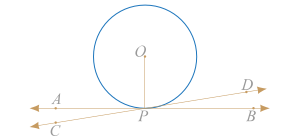
Converse of the tangent–radius theorem
| Given: | OP is a radius of a circle with centre O, and the line AB through P is perpendicular to OP. |
| To prove: | AB is a tangent to the circle at P. |
| Construction: | Consider the tangent CD at P. |
| Proof: | By the tangent–radius theorem, OP ⟂ CD, so ∠OPD = 90°. |
| Also, | By the given condition, OP ⟂ AB, so ∠OPB = 90°. |
| ∴ | ∠OPD = ∠OPB. |
| Therefore, | CD and AB are the same line: through a given point on a line, only one perpendicular line can be drawn. |
| ∴ | AB is the tangent at P to the circle with centre O. [Proved] |
✏️ Exactly one tangent can be drawn at a given point on a circle
Let P be a given point on a circle and OP its radius.
The tangent at P must be perpendicular to OP. Only one perpendicular line can be drawn to OP through P.
Therefore, there is exactly one tangent at P.
✏️ The perpendicular to a tangent at the point of contact passes through the centre
Suppose AB is a tangent at P. Draw PC perpendicular to AB at P.
The radius OP is also perpendicular to the tangent. Thus,
OP ⟂ AB and PC ⟂ AB.
Only one perpendicular to AB passes through P, so the lines PC and PO coincide.
Hence, the perpendicular line to a tangent at its point of contact passes through the centre.
✏️ Finding an angle using a tangent and a line through the centre
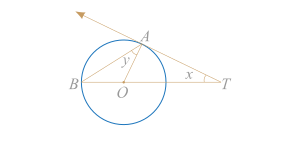
Finding an angle using the tangent–radius theorem
Let AT be a tangent at A to a circle with centre O. Points B, O, T lie on the same straight line in that order, and OA and OB are radii. Suppose,
∠ATO = x° and ∠OAB = ∠OBA = y°.
Prove that x = 90 - 2y.
| Since, | AT is the tangent at A and OA is the radius through A, ∠OAT = 90°. |
| ∴ | In △AOT, ∠AOT = 90° - x°. ...(i) |
| Also, | OA = OB, as they are radii of the same circle. Therefore ∠OAB = ∠OBA = y°. |
| Now, | Since OT extends BO, the exterior angle of △AOB is ∠AOT = ∠OAB + ∠OBA = 2y°. ...(ii) |
| ∴ | From (i) and (ii), 2y° = 90° - x°. |
| Therefore, | x° = 90° - 2y°, giving x = 90 - 2y. |
💡 Example
If y = 25, so that each base angle is 25°, then
x = 90 - 2 × 25 = 40.
Therefore, ∠ATO = 40°.
✏️ Two tangents can be drawn to a circle from an external point
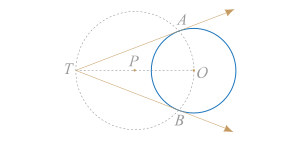
Constructing two tangents from an external point
Let T be outside a circle with centre O. We will show how to draw two tangents from T.
| Construction: | Join TO. Draw a circle with TO as diameter. It intersects the given circle at A and B. Join TA, TB, OA and OB. |
| Proof: | In the circle with diameter TO, both ∠OAT and ∠OBT are angles in a semicircle. |
| ∴ | ∠OAT = ∠OBT = 90°. |
| Hence, | OA ⟂ AT and OB ⟂ BT. |
| Also, | OA and OB are radii through A and B, respectively. |
| ∴ | By the converse theorem, TA and TB are tangents to the given circle at A and B. |
| Therefore, | Two tangents can be drawn from the external point T to the circle. [Proved] |
⭐ Tangents from the same external point have equal lengths and subtend equal angles at the centre
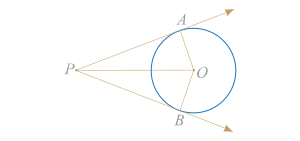
Equal tangent segments from the same external point
| Given: | PA and PB are tangents from an external point P to a circle with centre O. Their points of contact are A and B. Join OA, OB and OP. |
| To prove: | (i) PA = PB and (ii) ∠POA = ∠POB. |
| Proof: | The radii through the points of contact are perpendicular to the tangents: OA ⟂ PA and OB ⟂ PB. |
| ∴ | ∠OAP = ∠OBP = 90°. |
| Now, | In the right triangles △PAO and △PBO, OP is the common hypotenuse and OA = OB. [Radii of the same circle] |
| ∴ | △PAO ≅ △PBO. [RHS congruence] |
| ∴ | PA = PB. [Corresponding sides of congruent triangles; (i) proved] |
| And, | ∠POA = ∠POB. [Corresponding angles of congruent triangles; (ii) proved] |
📚 Another important result
The same congruence also gives,
∠APO = ∠OPB.
Thus, OP bisects both the non-reflex central angle ∠AOB and the angle ∠APB between the tangent segments.
✏️ Simple example
Two tangents PA and PB are drawn from an external point P. If PA = 7 cm, then
PB = 7 cm.
Also, if ∠POA = 35°, then
∠POB = 35°.
⭐ The point of contact of two touching circles lies on the line joining their centres
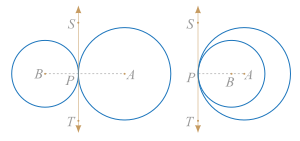
Centres and point of contact of two touching circles
This theorem applies to both external tangency and internal tangency.
| Given: | Two circles with centres A and B touch at P. |
| To prove: | A, P and B are collinear. |
| Construction: | Join AP and BP. Draw the common tangent ST at P. |
| Proof: | For the circle with centre A, ST is the tangent at P and AP is the radius through P. Thus AP ⟂ ST. |
| Also, | For the circle with centre B, BP is the radius through the point of contact. Thus BP ⟂ ST. |
| Therefore, | Both AP and BP are perpendicular to ST at the same point P. Only one perpendicular can be drawn to a line at a given point. |
| ∴ | AP and BP lie on the same straight line. Hence A, P and B are collinear. [Proved] |
📚 Distance between the centres of touching circles
Let the radii be r₁ and r₂.
👉 For external tangency, the point of contact P lies between the centres. Therefore,
AB = AP + PB = r₁ + r₂.
👉 For internal tangency, both centres lie on the same side of the point of contact. If the larger radius is R and the smaller radius is r, then
AB = R - r.
⚠️ Common mistakes
👉 Incorrect: A tangent is perpendicular to any radius.
Correct: It is perpendicular to the radius through the point of contact.
👉 Incorrect: A tangent can be drawn from a point inside a circle.
Correct: No tangent can be drawn from an interior point. There is one tangent at a point on the circle and two tangents from an external point.
👉 Incorrect: Tangent segments from the same external point may have different lengths.
Correct: The two tangent segments from the same external point to the same circle have equal lengths.
👉 Incorrect: Concluding PA = PB directly from OA = OB in the equal-tangents proof.
Correct: First establish that the two right triangles are congruent by RHS.
👉 Incorrect: The point of contact always lies between the centres of two touching circles.
Correct: It lies between the centres for external tangency. For internal tangency, the centres lie on the same side of the point of contact. In both cases, all three points are collinear.
🧠 Key points to remember
👉 The radius through the point of contact is perpendicular to the tangent.
👉 A line perpendicular to a radius at its endpoint on the circle is a tangent.
👉 Exactly one tangent can be drawn at a given point on a circle.
👉 Exactly two tangents can be drawn from an external point to a circle.
👉 Tangent segments from the same external point are equal: PA = PB.
👉 The line joining the external point and the centre bisects the non-reflex central angle between the radii to the contact points and the angle between the tangent segments.
👉 The centres and point of contact of two touching circles are collinear.
👉 For external tangency, the distance between centres equals the sum of the radii.
👉 For internal tangency, the distance between centres equals the difference of the radii.


