

Area Theorems of Parallelograms and Triangles (Theorems of Areas)
The main ideas behind these area theorems are base, height and parallel lines. Figures lying on the same base and between the same parallel lines have the same perpendicular height. This creates useful relationships between their areas.
🔎 Important theorems at a glance
👉 Parallelograms on the same base and between the same parallels are equal in area.
👉 If a triangle and a parallelogram are on the same base and between the same parallels, the area of the triangle is half the area of the parallelogram.
👉 Triangles on the same base and between the same parallels are equal in area.
👉 If two triangles of equal area lie on the same base and on the same side of it, the line joining their third vertices is parallel to the common base.
⭐ Parallelograms on the same base and between the same parallel lines are equal in area.
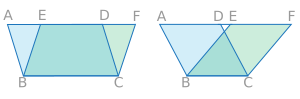
Parallelograms ABCD and EBCF lie on the same base BC and between the same parallel lines BC and AF
| Given: | Parallelograms ABCD and EBCF lie on the same base BC and between the same parallel lines BC and AF. |
| To prove: | Area of parallelogram ABCD = area of parallelogram EBCF. |
| Proof: | AB ∥ DC and AF is a transversal. [Since ABCD is a parallelogram] |
| Therefore, | ∠BAE = corresponding ∠CDF. ...(i) |
| Again, | EB ∥ FC and AF is a transversal. [Since EBCF is a parallelogram] |
| Therefore, | ∠ABE = corresponding ∠DCF. ...(ii) |
| Also, | AB = DC. [Opposite sides of a parallelogram are equal] |
| In | △ABE and △DCF, |
| ∠BAE = ∠CDF, | |
| AB = DC, | |
| and | ∠ABE = ∠DCF. |
| Therefore, | △ABE ≅ △DCF. [ASA congruence] |
| Hence, | Area of △ABE = area of △DCF. |
| Now, | Area of parallelogram ABCD = area of quadrilateral ABCF − area of △DCF. |
| and | Area of parallelogram EBCF = area of quadrilateral ABCF − area of △ABE. |
| Since, | Area of △ABE = area of △DCF, |
| Therefore, | Area of parallelogram ABCD = area of parallelogram EBCF. [Proved] |
⭐ If a triangle and a parallelogram lie on the same base and between the same parallel lines, the area of the triangle is half the area of the parallelogram.
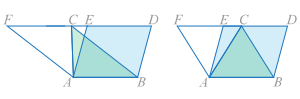
△ABC and parallelogram ABDE lie on the same base AB and between the same parallel lines AB and DE
| Given: | △ABC and parallelogram ABDE lie on the same base AB and between the same parallel lines AB and DE. |
| To prove: | Area of △ABC = × area of parallelogram ABDE. |
| Construction: | Through A, draw a line parallel to BC meeting DE or DE produced at F. |
| Proof: | In quadrilateral ABCF, AB ∥ FC. [Given] |
| and | AF ∥ BC. [By construction] |
| Therefore, | ABCF is a parallelogram. [Both pairs of opposite sides are parallel] |
| Again, | Parallelograms ABCF and ABDE lie on the same base AB and between the same parallel lines. |
| Therefore, | Area of parallelogram ABCF = area of parallelogram ABDE. [By the previous theorem] |
| Now, | Diagonal AC divides parallelogram ABCF into two congruent triangles. |
| Therefore, | Area of △ABC = × area of parallelogram ABCF. |
| But, | Area of parallelogram ABCF = area of parallelogram ABDE. |
| Therefore, | Area of △ABC = × area of parallelogram ABDE. [Proved] |
⭐ Triangles on the same base and between the same parallel lines are equal in area.
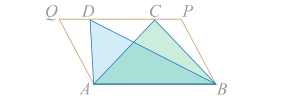
△ABC and △ABD lie on the same base AB and between the same parallel lines AB and CD
| Given: | △ABC and △ABD lie on the same base AB and between the same parallel lines AB and CD. |
| To prove: | Area of △ABC = area of △ABD. |
| Construction: | Construct parallelogram ABPQ on base AB between the same parallel lines AB and CD. |
| Proof: | △ABC and parallelogram ABPQ lie on the same base AB and between the same parallel lines. |
| Therefore, | Area of △ABC = × area of parallelogram ABPQ. |
| Similarly, | Area of △ABD = × area of parallelogram ABPQ. |
| Therefore, | Area of △ABC = area of △ABD. [Proved] |
⭐ If two triangles of equal area lie on the same base and on the same side of it, they lie between the same parallel lines.
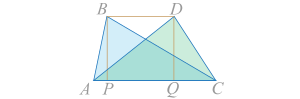
△ABC and △ADC lie on the same base AC and on the same side of AC
| Given: | △ABC and △ADC lie on the same base AC and on the same side of AC. Their areas are equal. Join B and D. |
| To prove: | BD ∥ AC. |
| Construction: | Draw BP and DQ perpendicular to AC from B and D respectively. Let BP and DQ meet AC or AC produced at P and Q respectively. |
| Proof: | Area of △ABC = × AC × BP. |
| and | Area of △ADC = × AC × DQ. |
| Since, | Area of △ABC = area of △ADC. [Given] |
| Therefore, | × AC × BP = × AC × DQ. |
| Therefore, | BP = DQ. |
| Again, | BP ∥ DQ. [Perpendiculars to the same line are parallel] |
| Therefore, | BPQD is a parallelogram. [One pair of opposite sides is equal and parallel] |
| Hence, | BD ∥ PQ. [Opposite sides of a parallelogram are parallel] |
| But, | P and Q lie on AC, so PQ is a part of the same straight line AC. |
| Therefore, | BD ∥ AC. [Proved] |
🧩 Solved Examples
Example 1: Two parallelograms on the same base
Parallelograms ABCD and EBCF are on the same base BC and between the same parallels. If the area of ABCD is 72 cm², find the area of EBCF.
Solution: Parallelograms on the same base and between the same parallels have equal areas.
Area(EBCF) = 72 cm².
Example 2: Triangle and parallelogram on the same base
A triangle and a parallelogram lie on the same base and between the same parallels. If the area of the parallelogram is 96 cm², find the area of the triangle.
Solution:
Area of triangle = 1/2 × 96 = 48 cm².
Example 3: Finding an unknown height
Two triangles have the same base of 12 cm and equal areas. The height of the first triangle is 7 cm. Find the height of the second triangle.
Solution: Since the triangles have the same base and equal areas, their corresponding heights are equal.
Height of second triangle = 7 cm.
✍️ Practice Problems
-
Two parallelograms are on the same base and between the same parallels. The area of one is 135 cm². Find the area of the other.
-
A triangle and a parallelogram are on the same base and between the same parallels. If the triangle has area 42 cm², find the area of the parallelogram.
-
△ABC and △ABD are on the same base AB and between the same parallels. If the area of △ABC is 56 cm², find the area of △ABD.
-
Two triangles on the same base have equal areas. If their third vertices are on the same side of the base, what can you say about the line joining those vertices?
-
A parallelogram and a triangle lie on the same base of 15 cm and have the same height of 8 cm. Find their areas and compare them.
-
Explain why two figures can have equal areas without being congruent. Give a simple example.
✅ Answers
1. 135 cm².
2. 84 cm².
3. 56 cm².
4. The line joining the third vertices is parallel to the common base.
5. Parallelogram = 15 × 8 = 120 cm²; triangle = 1/2 × 15 × 8 = 60 cm². The triangle has half the area of the parallelogram.
6. Equal area means equal surface covered, not equal shape and size. For example, a 6 cm × 4 cm rectangle and an 8 cm × 3 cm rectangle both have area 24 cm² but are not congruent.
📚 Important Points to Remember
👉 Figures lying between the same parallel lines have the same perpendicular height when measured from the same base line.
👉 Parallelograms with the same base and the same height have equal areas.
👉 A triangle on the same base and between the same parallels as a parallelogram has half the area of the parallelogram.
👉 Two triangles on the same base and between the same parallels have equal areas.
👉 A diagonal divides a parallelogram into two congruent triangles. Therefore, each triangle has half the area of the parallelogram.
👉 Equal areas do not necessarily mean that two figures are congruent. They may have different shapes or dimensions.
👉 In proofs, it is clearer to write “area of △ABC = area of △ABD” rather than “△ABC = △ABD”.


