

Polygon Theorems
If the number of sides of a polygon is known, we can easily find the sum of its interior angles, the sum of its exterior angles, and the measure of each angle of a regular polygon. Let us prove and apply these formulas step by step.
⭐ Sum of interior angles of an n-sided convex polygon is 2(n − 2) right angles or (n − 2) × 180°
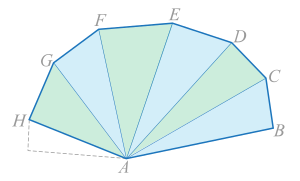
An n-sided convex polygon
Drawing diagonals from one vertex divides the polygon into (n − 2) triangles.
| Given: | Let ABCDEFGH ... be an n-sided convex polygon. |
| To prove: | The sum of its interior angles is 2(n − 2) right angles or (n − 2) × 180°. |
| Construction: | From vertex A, draw diagonals to all non-adjacent vertices. |
| Proof: | An n-sided convex polygon is divided into (n − 2) triangles. |
| ∴ | Sum of the interior angles of the polygon |
| = | sum of the interior angles of (n − 2) triangles |
| = | (n − 2) × 2 right angles [Because the angle sum of a triangle is 2 right angles or 180°] |
| = | 2(n − 2) right angles |
| = | (n − 2) × 180° [Proved] |
⭐ Sum of the exterior angles of a polygon, taken one at each vertex in the same direction, is 360°
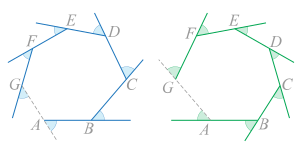
Exterior angles of an n-sided polygon
Take one exterior angle at each vertex in the same direction.
| Given: | Let ABCDEFG ... be an n-sided convex polygon. At each vertex, take one exterior angle in the same direction. |
| To prove: | The sum of these n exterior angles is 360°. |
| Because | At each vertex, an interior angle and its adjacent exterior angle form a linear pair, so their sum is 180°. |
| ∴ | The total of all n interior angles and the corresponding n exterior angles is n × 180°. |
| The sum of the interior angles is (n − 2) × 180°. | |
| ∴ | Sum of the exterior angles |
| = | n × 180° − (n − 2) × 180° |
| = | 2 × 180° |
| = | 360° [Proved] |
⭐ What is a regular polygon?
A polygon in which all sides are equal and all interior angles are equal is called a regular polygon.
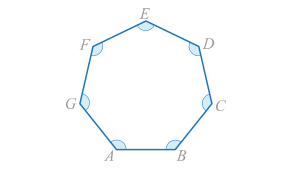
Regular Polygon
All sides and all interior angles are equal.
👉 A regular triangle is an equilateral triangle, and a regular quadrilateral is a square.
⭐ Each interior angle of a regular n-sided polygon
| Because | All interior angles of a regular polygon are equal. |
| The sum of the interior angles of an n-sided polygon is (n − 2) × 180°. | |
| ∴ | Each interior angle |
| = |
⭐ Each exterior angle of a regular n-sided polygon
| Because | All exterior angles of a regular polygon are equal, and their sum is 360°. |
| ∴ | Each exterior angle |
⭐ Solved Example 1: Find the sum of the interior angles of a 12-sided polygon
For an n-sided polygon,
Sum = (n − 2) × 180°Here, n = 12.
= (12 − 2) × 180° = 10 × 180° = 1800°Therefore, the sum of the interior angles is 1800°.
⭐ Solved Example 2: Find each interior and exterior angle of a regular octagon
For a regular octagon, n = 8.
Each exterior angle:
Each interior angle:
180° − 45° = 135°Therefore, each interior angle is 135° and each exterior angle is 45°.
⭐ Solved Example 3: A regular polygon has each exterior angle equal to 30°. Find the number of sides.
For a regular polygon,
Therefore, the polygon has 12 sides.
📝 Practice Problems
- Find the sum of the interior angles of a hexagon.
- Find the sum of the interior angles of a decagon.
- Each exterior angle of a regular polygon is 40°. Find the number of sides.
- Find each interior angle of a regular nonagon.
- The sum of the interior angles of a polygon is 1260°. Find its number of sides.
- Can a regular polygon have each exterior angle equal to 28°? Give a reason.
Show answers
- 720°
- 1440°
- 9 sides
- 140°
- 9 sides
- No. 360 ÷ 28 is not a whole number, so such a regular polygon is not possible.
📚 Important points to remember
👉 Sum of interior angles of an n-sided polygon = (n − 2) × 180°.
👉 Sum of one exterior angle at each vertex, taken in the same direction, is always 360°.
👉 Each interior angle of a regular polygon is .
👉 Each exterior angle of a regular polygon is .
👉 An interior angle and its adjacent exterior angle add up to 180°.
👉 If each exterior angle of a regular polygon is known, then .


