

Basic Concepts of a Circle
Take a pencil compass. Keep the pointed end fixed at one point on your notebook and rotate the pencil end once completely around that point. The pencil tip traces a closed curved line. This familiar shape is a circle.
There is one important feature in this construction. The pointed end of the compass does not move, and the pencil tip always remains at the same distance from that fixed point. The basic idea of a circle comes from this property.
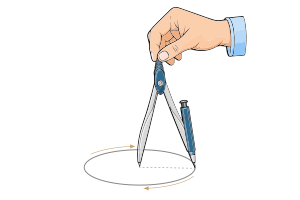
Pencil Compass
Pencil compass drawing a circle
A circle is the set of all points in a plane that are at the same distance from a fixed point.
⭐ Centre and Radius
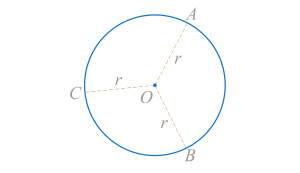
Circle, Centre and Radius
Circle, Centre & Radius
The point at which the pointed end of the compass remains fixed is called the centre of the circle. Let the centre be O.
Now take any three points A, B and C on the circle. From the definition of a circle,
OA = OB = OCThis equal distance from the centre to any point on the circle is called the radius of the circle.
If the radius is represented by r, then
OA = OB = OC = rRemember it simply: The centre remains fixed, and every point on the circle is at the same distance from the centre.
Circle and Circumference
A circle is the set of points at a fixed equal distance from the centre. The total length of this closed curved boundary is called the circumference of the circle.
⭐ Chord
Take two points on the circle, such as A and B. Join them with a line segment to obtain AB.
A line segment joining any two points on a circle is called a chord.
Therefore, AB is a chord.
Many chords of different lengths can be drawn in the same circle.
⭐ Diameter
If a chord passes through the centre of the circle, that chord has a special name. It is called a diameter.
Suppose the chord XY passes through the centre O. Then XY is a diameter.
In this case,
XO = OY = rTherefore,
XY = XO + OY = r + r = 2rHence,
d = 2rHere d is the diameter and r is the radius.
Important facts about chords and diameters
- Joining any two points on a circle gives a chord.
- A chord that passes through the centre is a diameter.
- Every diameter is a chord.
- But every chord is not a diameter.
- The diameter is twice the radius.
- In the same circle, the diameter is the longest chord.
⭐ Arc
Mark two points X and Y on a circle. If you move along the curved boundary from X to Y, there are two different paths.
Each of these curved paths is called an arc of the circle.
Minor Arc
The shorter arc between two endpoints is called the minor arc.
For example, the shorter arc may be represented as XY.
Major Arc
The longer arc between the same two endpoints is called the major arc.
It is usually clearer to use three letters to name a major arc. If a point P lies on the longer arc, the arc can be written as XPY.
Easy way to recognise them: Between the same two endpoints, the shorter curved path is the Minor Arc and the longer curved path is the Major Arc.
⭐ Semicircle
Now suppose X and Y are the endpoints of a diameter. A diameter divides the circle into two equal parts.
Therefore, the two arcs from X to Y are equal. Each arc is half of the complete circumference.
Each of these equal halves is called a semicircle.
So, when the two arcs between the same endpoints are equal, those endpoints are the endpoints of a diameter.
Two important regions inside a circle
The interior of a circle can be divided in different ways. Two commonly used regions are a segment and a sector.
⭐ Segment
A chord usually divides the circular region into two parts.
The region bounded by a chord and one of the arcs joining the endpoints of that chord is called a segment of the circle.
Suppose AB is a chord. The chord AB together with one of the arcs AB forms a segment.
Minor Segment
The smaller region between the chord and the minor arc is called the minor segment.
Major Segment
The larger region between the same chord and the major arc is called the major segment.
To recognise a segment, look for a chord. One chord + one arc = one segment.⭐ Sector
From the centre O, draw two radii to points A and B on the circle. Thus, draw OA and OB.
These two radii and an arc between them enclose a part of the circular region.
The region bounded by two radii and the arc between them is called a sector of the circle.
Minor Sector
The smaller region bounded by OA, OB and the minor arc AB is called the minor sector.
Major Sector
The larger region bounded by the same two radii and the major arc AB is called the major sector.
To recognise a sector, look for the centre. Two radii + one arc = one sector.⭐ Do not confuse a segment with a sector
| Point of comparison | Segment | Sector |
|---|---|---|
| Which straight line is used? | One chord | Two radii |
| What else is used? | One arc | One arc |
| Smaller part | Minor segment | Minor sector |
| Larger part | Major segment | Major sector |
Difference in one line
Segment = Chord + Arc Sector = Two Radii + Arc⭐ Parts of a circle at a glance
| Centre: | The fixed point from which every point on the circle is at the same distance. |
| Radius: | The distance from the centre to any point on the circle. |
| Chord: | A line segment joining two points on the circle. |
| Diameter: | A chord passing through the centre. Its length is 2r. |
| Arc: | A curved part of the circle between two points. |
| Segment: | A region bounded by a chord and an arc. |
| Sector: | A region bounded by two radii and an arc. |
⭐ Short Examples
Example 1: Find the diameter
The radius of a circle is 6.5 cm. Find its diameter.
We know,
d = 2rTherefore,
d = 2 × 6.5 = 13 cm.
Answer: 13 cm.
Example 2: Which one is a segment and which one is a sector?
If a region is bounded by the chord AB and the arc AB, it is a segment.
On the other hand, if a region is bounded by the two radii OA, OB and the arc AB, it is a sector.
⭐ Check Your Understanding
🔸 Can a circle have more than one chord?
Yes. Joining any two points on a circle gives a chord.
🔸 Is every chord a diameter?
No. Only the chord passing through the centre is a diameter.
🔸 Into how many equal parts does a diameter divide a circle?
Two semicircles.
🔸 What forms the boundary of a segment?
One chord and one arc.
🔸 What forms the boundary of a sector?
Two radii and one arc.
⚠️ Common mistakes and how to avoid them
- Do not confuse a chord with an arc. A chord is a straight line segment, while an arc is a curved part of the circle.
- Do not think of a diameter as a completely separate object. A diameter is a special chord that passes through the centre.
- Do not confuse a segment with a sector. A segment contains a chord, while a sector contains two radii.
- It is better to use three letters when naming a major arc. This makes it clear which longer arc is meant.
📚 Important points to remember
🔹 Every point on a circle is at the same distance from the centre.
🔹 The fixed distance from the centre to the circle is the radius.
🔹 A line segment joining two points on a circle is a chord.
🔹 A chord passing through the centre is a diameter.
🔹 d = 2r.
🔹 In the same circle, the diameter is the longest chord.
🔹 Between the same two endpoints, the shorter arc is the minor arc and the longer arc is the major arc.
🔹 The endpoints of a diameter divide the circle into two equal semicircles.
🔹 A chord and an arc form a segment.
🔹 Two radii and an arc form a sector.
Quick Revision
| Diameter | d = 2r |
| Chord | A line segment joining two points on the circle |
| Diameter | A chord passing through the centre |
| Segment | Chord + Arc |
| Sector | Two Radii + Arc |
Learn next: Circle Theorems
Once the basic ideas of a circle are clear, the next step is to learn how a unique circle passes through three non-collinear points and to study the important theorems related to chords.
Next topic: Circle Theorems