

Theorems on Concurrence in a Triangle
In geometry, three or more lines are called concurrent when they pass through the same point. A triangle has four important concurrence results involving its perpendicular bisectors, altitudes, internal angle bisectors and medians.
🔎 Important results at a glance
👉 The three perpendicular bisectors of the sides of a triangle are concurrent. Their common point is the circumcenter.
👉 The three altitudes of a triangle are concurrent. Their common point is the orthocenter.
👉 The three internal angle bisectors of a triangle are concurrent. Their common point is the incenter.
👉 The three medians of a triangle are concurrent. Their common point is the centroid.
⭐ The three perpendicular bisectors of the sides of a triangle are concurrent.
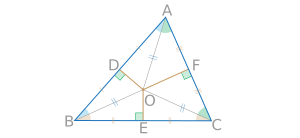
D, E and F are the midpoints of AB, BC and CA respectively in △ABC
| Given: | In △ABC, D, E and F are the midpoints of AB, BC and CA respectively. The perpendiculars to AB at D and to BC at E meet at O. |
| To prove: | The perpendicular bisectors of AB, BC and CA are concurrent. It is enough to prove OF ⟂ AC, showing that O also lies on the perpendicular bisector of AC. |
| Construction: | Join O to A, B and C. |
| Proof: | In △AOD and △BOD, |
| AD = BD [D is the midpoint of AB] | |
| ∠ADO = ∠BDO = 90° [OD ⟂ AB] | |
| OD is common. | |
| Therefore, | △AOD ≅ △BOD [SAS] |
| Hence, | OA = OB [Corresponding sides of congruent triangles] ...(i) |
| Similarly, | △BOE ≅ △COE [SAS] |
| Hence, | OB = OC ...(ii) |
| From (i) and (ii), | OA = OC. |
| Now, | In △AFO and △CFO, |
| OA = OC [Proved above] | |
| AF = CF [F is the midpoint of AC] | |
| OF is common. | |
| Therefore, | △AFO ≅ △CFO [SSS] |
| Hence, | ∠AFO = ∠CFO [Corresponding angles of congruent triangles] |
| But, | ∠AFO and ∠CFO form a linear pair on straight line AC. Since they are equal, each is 90°. |
| Therefore, | OF ⟂ AC. |
| Hence, | The three perpendicular bisectors of the sides of △ABC are concurrent. [Proved] |
The point of concurrence is called the circumcenter. Since it lies on the perpendicular bisectors of all three sides, it is equidistant from the three vertices:
OA = OB = OC.
⭐ The three altitudes of a triangle are concurrent.
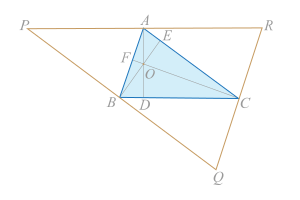
AD, BE and CF are perpendiculars from A, B and C to the opposite sides of △ABC
| Given: | In △ABC, AD, BE and CF are drawn from A, B and C perpendicular to the opposite sides BC, CA and AB respectively. |
| To prove: | AD, BE and CF are concurrent. |
| Construction: | Through A, B and C draw lines parallel to BC, CA and AB respectively. Let these lines meet one another at P, Q and R, forming △PQR. |
| Proof: | By construction, APBC, ABCR and ABQC are parallelograms. |
| From parallelogram APBC, | AP = BC. |
| From parallelogram ABCR, | AR = BC. |
| Therefore, | AP = AR. Hence A is the midpoint of PR. |
| Similarly, | B is the midpoint of PQ and C is the midpoint of QR. |
| Again, | PR ∥ BC [By construction] |
| and | AD ⟂ BC [Given] |
| Therefore, | AD ⟂ PR [Since PR ∥ BC] |
| Thus, | AD is the perpendicular bisector of PR in △PQR. |
| Similarly, | BE is the perpendicular bisector of PQ and CF is the perpendicular bisector of QR. |
| But, | The three perpendicular bisectors of the sides of a triangle are concurrent. |
| Therefore, | AD, BE and CF are concurrent. |
| Hence, | The three altitudes of △ABC are concurrent. [Proved] |
The common point of the three altitudes is called the orthocenter.
⭐ The three internal angle bisectors of a triangle are concurrent.
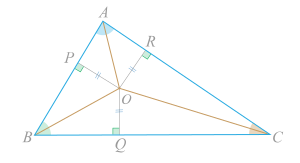
Internal angle bisectors of ∠A, ∠B and ∠C in △ABC
| Given: | In △ABC, the internal bisectors of ∠B and ∠C meet at O. Join A and O. |
| To prove: | The internal bisectors of ∠A, ∠B and ∠C are concurrent. In other words, prove that AO bisects ∠A. |
| Construction: | From O draw OP, OQ and OR perpendicular to AB, BC and AC respectively. |
| Proof: | In △BOQ and △BOP, |
| ∠OBQ = ∠OBP [BO bisects ∠B] | |
| ∠OQB = ∠OPB = 90° [OQ ⟂ BC and OP ⟂ AB] | |
| BO is common. | |
| Therefore, | △BOQ ≅ △BOP [AAS] |
| Hence, | OQ = OP [Corresponding sides of congruent triangles] ...(i) |
| Similarly, | △COQ ≅ △COR [AAS] |
| Hence, | OQ = OR ...(ii) |
| From (i) and (ii), | OP = OR ...(iii) |
| Now, | Consider right triangles △APO and △ARO. |
| ∠OPA = ∠ORA = 90°. | |
| AO is the common hypotenuse. | |
| OP = OR [From (iii)] | |
| Therefore, | △APO ≅ △ARO [RHS] |
| Hence, | ∠PAO = ∠RAO [Corresponding angles of congruent triangles] |
| Therefore, | AO bisects ∠A. |
| Hence, | The three internal angle bisectors of △ABC are concurrent. [Proved] |
The common point is called the incenter. It is equidistant from all three sides of the triangle.
⭐ The three medians of a triangle are concurrent.
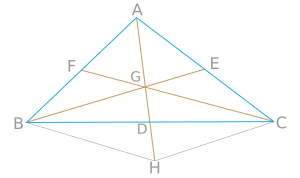
The medians AD, BE and CF of △ABC meet at G
| Given: | In △ABC, medians BE and CF meet at G. Join A to G and produce AG to meet BC at D. |
| To prove: | AD is the third median. That is, prove that D is the midpoint of BC. Then all three medians will be concurrent. |
| Construction: | Produce AD to H so that AG = GH. Join B to H and C to H. |
| Proof: | In △ABH, F is the midpoint of AB [CF is a median]. |
| and | G is the midpoint of AH [AG = GH]. |
| Therefore, | FG ∥ BH [Midpoint theorem] |
| But, | F, G and C are collinear [CF passes through G]. |
| Therefore, | GC ∥ BH. |
| Again, | In △ACH, E is the midpoint of AC [BE is a median]. |
| and | G is the midpoint of AH. |
| Therefore, | GE ∥ HC [Midpoint theorem] |
| But, | B, G and E are collinear [BE passes through G]. |
| Therefore, | BG ∥ HC. |
| Now, | In quadrilateral BGCH, GC ∥ BH and BG ∥ HC. |
| Therefore, | BGCH is a parallelogram. |
| Hence, | The diagonals BC and GH of parallelogram BGCH bisect each other. |
| Therefore, | D is the midpoint of BC. |
| Hence, | AD is the third median of △ABC. |
| Therefore, | The three medians of a triangle are concurrent. [Proved] |
The common point of the medians is called the centroid. The centroid divides every median in the ratio 2:1 from the vertex.
🧩 Solved Examples
Example 1: Circumcenter and equal distances
The perpendicular bisectors of the sides of △ABC meet at O. If OA = 6 cm, find OB and OC.
Solution: O is the circumcenter, so it is equidistant from all three vertices.
OA = OB = OCTherefore, OB = 6 cm and OC = 6 cm.
Example 2: Distance of the incenter from the sides
The internal angle bisectors of a triangle meet at I. The perpendicular distance from I to one side is 4 cm. Find the perpendicular distance from I to each of the other two sides.
Solution: I is the incenter, and the incenter is equidistant from all three sides.
Therefore, each of the other two perpendicular distances is 4 cm.
Example 3: Centroid and a median
In △ABC, G is the centroid and AD is a median. If AD = 12 cm, find AG and GD.
Solution: The centroid divides a median in the ratio 2:1 from the vertex.
AG = 2/3 × 12 = 8 cm GD = 1/3 × 12 = 4 cm✍️ Practice Problems
-
The perpendicular bisectors of the sides of △PQR meet at O. If OP = 7 cm, find OQ and OR.
-
Name the point where the three altitudes of a triangle meet.
-
The internal angle bisectors of △ABC meet at I. Perpendiculars from I to AB, BC and CA have lengths 5 cm, x cm and y cm respectively. Find x and y.
-
In △XYZ, G is the centroid and XM is a median of length 15 cm. Find XG and GM.
-
Which triangle centre is always inside a triangle: circumcenter, orthocenter, incenter or all of them?
-
In an equilateral triangle, what can you say about the circumcenter, orthocenter, incenter and centroid?
✅ Answers
1. OQ = OR = 7 cm.
2. Orthocenter.
3. x = 5 cm and y = 5 cm.
4. XG = 10 cm and GM = 5 cm.
5. The incenter is always inside the triangle.
6. All four centres coincide at the same point.
📚 Important Points to Remember
👉 Three or more lines are called concurrent when they pass through the same point.
👉 The three perpendicular bisectors of a triangle meet at the circumcenter. The circumcenter is equidistant from the three vertices.
👉 The three altitudes meet at the orthocenter.
👉 The three internal angle bisectors meet at the incenter. The incenter is equidistant from the three sides.
👉 The three medians meet at the centroid.
👉 The centroid divides each median in the ratio 2:1 from the vertex.
👉 A perpendicular bisector of a side and an angle bisector are different. A perpendicular bisector is related to a side, while an angle bisector divides an angle into two equal angles.
👉 These four concurrence theorems are true for every triangle, but the four centres are generally different points.
👉 In an equilateral triangle, the circumcenter, orthocenter, incenter and centroid all coincide.
👉 Proofs of concurrence often use congruent triangles, the midpoint theorem, parallel lines and properties of parallelograms.


