

Volume and Surface Area of Cuboid and Cube
Have you noticed the shapes of a brick, a book or a shoebox? These are familiar examples of a Cuboid. The ideal shape of a die used in Ludo is a Cube.
To find how much space these solids occupy, we calculate their Volume. To find how much paper or paint is needed to cover their outer faces, we calculate their Surface Area.
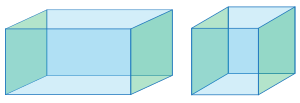
Cuboid and Cube
📚 What Are a Cuboid and a Cube?
Cuboid: A cuboid is a three-dimensional (3D) solid bounded by 6 rectangular faces. Its length, breadth and height need not be equal.
Cube: A cube is a three-dimensional solid bounded by 6 equal square faces. Its length, breadth and height are equal.
Remember: A cube is a special type of cuboid. Every cube is a cuboid, but every cuboid is not a cube.
📚 Important Properties
🔹 Faces: Both have 6 faces. Opposite faces are equal and parallel, and adjacent faces are perpendicular to each other.
🔹 Edges: Both have 12 edges. An edge is the line segment where 2 adjacent faces meet.
🔹 Vertices: Both have 8 vertices. At each vertex, 3 edges meet.
🔹 Space Diagonals: Both have 4 space diagonals. These join opposite vertices through the interior of the solid.
🔹 Face Diagonals: Each face has 2 diagonals, giving 12 face diagonals in all. Each joins opposite vertices of the same face.
👉 Volume and Surface Area of a Cuboid
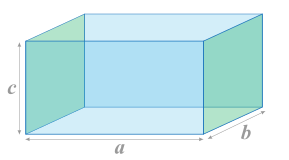
Cuboid
l = Length, b = Breadth, h = Height
Let the length, breadth and height of a cuboid be l, b and h, respectively.
⭐ Volume
Volume = Base area × Height
The base of a cuboid is a rectangle, so its area is l × b.
Therefore, Volume = l × b × h cubic units.
⭐ Total Surface Area
Among the 6 faces of a cuboid:
- Each of the top and bottom faces has area lb.
- Each of the front and back faces has area lh.
- Each of the remaining 2 faces has area bh.
Therefore, total surface area = 2lb + 2lh + 2bh.
Thus, Total surface area = 2(lb + bh + hl) square units.
⭐ Lateral Surface Area
The lateral surface area is the sum of the areas of the 4 side faces, excluding the top and bottom faces.
Lateral surface area = Perimeter of base × Height
Therefore, Lateral surface area = 2(l + b) × h = 2h(l + b) square units.
This formula also gives the total area of the 4 walls of a cuboidal room. Use the internal length, breadth and height of the room.
Note: To paint the walls excluding doors and windows, subtract the areas of the doors and windows from the total wall area.
⭐ Length of a Space Diagonal
The length of a space diagonal of a cuboid is:
This length is expressed in linear units, such as centimetres or metres.
⭐ Sum of the Lengths of All Edges
A cuboid has 4 edges along its length, 4 along its breadth and 4 along its height.
Therefore, Sum of all edge lengths = 4(l + b + h) units.
👉 Volume and Surface Area of a Cube
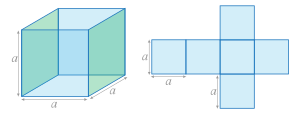
Cube
Length = Breadth = Height = a
Let the length of each edge of a cube be a.
We can obtain the formulas for a cube by substituting l = b = h = a into the formulas for a cuboid.
⭐ Volume of a Cube
Volume = Length × Breadth × Height
Therefore, Volume of a cube = a × a × a = a³ cubic units.
⭐ Total Surface Area
Each face of a cube is a square, so the area of one face is a².
There are 6 such equal faces.
Therefore, Total surface area of a cube = 6a² square units.
⭐ Lateral Surface Area
Excluding the top and bottom faces leaves 4 square faces.
Therefore, Lateral surface area of a cube = 4a² square units.
⭐ Length of a Space Diagonal
The length of a space diagonal of a cube is:
Thus, Space diagonal = units.
The diagonal of one square face, or Face diagonal = units.
⭐ Sum of the Lengths of All Edges
Each of the 12 edges of a cube has length a.
Therefore, Sum of all edge lengths = 12a units.
The phrase “sum of all edge lengths” is clearer here than “perimeter of a cube”.
👉 Simple Solved Examples
✏️ Example 1: Volume and Surface Area of a Cuboid
A cuboidal box is 5 cm long, 3 cm wide and 2 cm high. Find its volume, total surface area and lateral surface area.
Solution:
Here, l = 5 cm, b = 3 cm and h = 2 cm.
Volume
lbh = 5 × 3 × 2 = 30 cm³.
Total surface area
2(lb + bh + hl) = 2(5 × 3 + 3 × 2 + 2 × 5)= 2(15 + 6 + 10) = 62 cm².
Lateral surface area
2h(l + b) = 2 × 2 × (5 + 3) = 32 cm².
Answer: Volume = 30 cm³, total surface area = 62 cm², and lateral surface area = 32 cm².
✏️ Example 2: Volume and Surface Area of a Cube
Each edge of a cube is 4 cm long. Find its volume, total surface area and lateral surface area.
Solution:
Here, a = 4 cm.
Volume = a³ = 4 × 4 × 4 = 64 cm³.
Total surface area = 6a² = 6 × 4² = 6 × 16 = 96 cm².
Lateral surface area = 4a² = 4 × 4² = 4 × 16 = 64 cm².
Answer: Volume = 64 cm³, total surface area = 96 cm², and lateral surface area = 64 cm².
Notice: The volume and lateral surface area have the same numerical value here, but they represent different quantities and have different units.
✏️ Example 3: Area of the 4 Walls of a Room
A cuboidal room has an internal length of 6 m, breadth of 4 m and height of 3 m. Find the total area of its 4 walls without subtracting doors and windows.
Solution:
Total area of the 4 walls = 2h(l + b)
= 2 × 3 × (6 + 4)= 6 × 10 = 60 m².
Answer: The total area of the 4 walls is 60 m².
This does not include the floor or ceiling.
✏️ Example 4: Space Diagonal of a Cuboid
A cuboid is 3 cm long, 4 cm wide and 12 cm high. Find the length of a space diagonal.
Solution:
Answer: The space diagonal is 13 cm long.
✏️ Example 5: Finding Height from Volume
A cuboid has a volume of 120 cm³, length of 6 cm and breadth of 4 cm. What is its height?
Solution:
We know that Volume = Length × Breadth × Height.
Therefore, Height = Volume ÷ (Length × Breadth).
Answer: The height of the cuboid is 5 cm.
🧠 Important Points to Remember
- Use the same units: Express length, breadth and height in the same unit before substituting into a formula.
- Volume: Express it in cubic units, such as cm³ or m³.
- Area: Express it in square units, such as cm² or m².
- Diagonal length: Express it in linear units, such as cm or m.
- Total surface area: Include all 6 faces of the cuboid or cube.
- Lateral surface area: Include the 4 side faces, excluding the top and bottom.
- Open-top box: It does not have all 6 faces. Identify the faces present before calculating the area instead of directly using the total surface area formula.
- Capacity: Use internal dimensions to find how much a box or container can hold.
✍️ Try It Yourself
🔹 1. A cuboid is 8 cm long, 5 cm wide and 2 cm high. What is its volume?
🔹 2. Each edge of a cube is 3 cm long. What is its total surface area?
🔹 3. A cuboidal room has an internal length of 5 m, breadth of 4 m and height of 3 m. What is the total area of its 4 walls without subtracting doors and windows?
🔹 4. Each edge of a cube is 2 cm long. What is the length of a space diagonal?
Check Your Answers:
🔹 1. 80 cm³.
🔹 2. 54 cm².
🔹 3. 54 m².
🔹 4. cm.
💡 Quick Revision
Here, l, b and h are the length, breadth and height of the cuboid, and a is the length of each edge of the cube.
| Measurement | Cuboid | Cube |
|---|---|---|
| Volume | lbh | a³ |
| Total surface area | 2(lb + bh + hl) | 6a² |
| Lateral surface area | 2h(l + b) | 4a² |
| Space diagonal length | ||
| Sum of all edge lengths | 4(l + b + h) | 12a |
⭐ Both have: 6 faces, 12 edges, 8 vertices and 4 space diagonals.
⭐ Remember the units: Length → units; Area → square units; Volume → cubic units.


