

Curved Surface Area, Total Surface Area and Volume of a Cone
🎯 What will you learn in this lesson?
👉 Recognize the structure and parts of a right circular cone.
👉 Distinguish perpendicular height from slant height.
👉 Use the formulas for curved surface area, total surface area and volume.
👉 Explain the curved surface area formula using a sector.
👉 Solve simple problems involving hats, tents and containers.
How much paper is needed for a conical party hat? How much water can a conical container hold? The first question requires curved surface area; the second requires the volume of the interior.
👉 What Is a Cone?
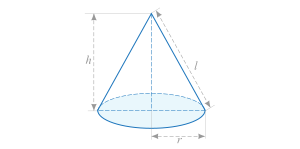
Cone
A cone has a circular base and a curved surface that meets at a point called the vertex.
This lesson covers a right circular cone. The perpendicular from its vertex to its base passes through the base centre. The slant height and curved surface area formulas here apply to this type of cone.
Forming a Cone by Rotating a Right Triangle
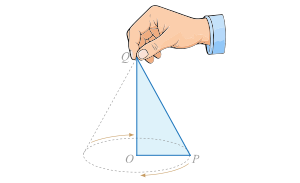
Forming a cone by rotating a right triangle
Rotating a right triangle through one full turn about either side adjoining its right angle forms a right circular cone. Then:
- The fixed side becomes the cone's height.
- The other perpendicular side becomes the base radius.
- The hypotenuse becomes the slant height.
Rotating about the hypotenuse produces a different solid, so the choice of axis matters.
👉 Measurements and Symbols
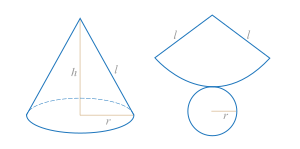
Measurements of a cone
🔹 Base radius, r: The distance from the centre of the circular base to any point on its circumference.
🔹 Perpendicular height, h: The perpendicular distance from the vertex to the centre of the base.
🔹 Slant height, l: The length of a straight segment from the vertex to a point on the base circumference. It is the same in every direction for a right circular cone.
🔹 Base diameter, d: Twice the radius, so d = 2r.
Here, r > 0 and h > 0. The symbol l is a lowercase letter l, not the number 1.
👉 Slant Height Formula and Proof
Let the vertex be A, the base centre O and a point on the base circumference B. Then:
AO = h, OB = r, AB = l and ∠AOB = 90°.
By Pythagoras' theorem in right triangle AOB:
⭐ l2 = r2 + h2
Therefore:
⭐
Rearranging the same relationship also gives:
⭐
Remember: The slant height is the hypotenuse, so l > h and l > r. You cannot find it by simply adding the height and radius.
👉 Curved Surface Area of a Cone
⭐ CSA = πrl
Use the slant height l, not the perpendicular height h. This area covers only the curved surface, excluding the circular base.
💡 Proving the formula by unfolding the curved surface
🔹 Cut the curved surface along a slant line and unfold it onto a plane. It forms a sector of a circle.
🔹 Sector radius = cone's slant height = l.
🔹 Sector arc length = circumference of the cone's base = 2πr.
🔹 A full circle of the same radius l has circumference 2πl and area πl².
🔹 For a fixed radius, sector area is proportional to arc length. Therefore, the curved surface area is:
🔹
🔹 We are comparing sectors of a circle with a fixed radius. We are not assuming that areas of circles with different radii are proportional to their circumferences.
Extra Relationship: Central Angle of the Unfolded Sector
If the sector's central angle has degree measure θ:
⭐
Thus, the central angle is . This helps in designing the paper pattern for a conical hat. No extra allowance for joining is included.
👉 Base Area and Total Surface Area
Area of the circular base:
⭐ B = πr2
Adding the curved surface and base:
⭐ TSA = πrl + πr2 = πr(l + r)
Hat or tent without a floor: Curved surface only, πrl.
Entire outer surface, including the base: πr(l + r).
For fabric or paper problems, account for door openings, seams, thickness and wastage as specified. These are ignored when only the ideal geometric area is required.
👉 Volume of a Cone
⭐ V = 13 πr2h
Thus, volume = 13 × base area × perpendicular height.
A cylinder with the same base radius and height has volume πr2h. The cone's volume is one-third of this.
⭐
For conical and cylindrical containers with the same internal radius and height, 3 brimful cone measures fill the cylinder, provided no water is spilled or retained. This demonstrates the relationship experimentally; it is not a complete mathematical proof.
Caution: Use h in the volume formula, not l. If the slant height is given, find the perpendicular height first.
In terms of diameter d:
⭐
🔎 Advanced: Proving the volume formula with calculus
🔹 This section is optional. Calculus is not needed to solve the basic problems.
🔹 Let x be the distance along the axis from the vertex towards the base. At the vertex, x = 0; at the base, x = h.
🔹 If the circular cross-section parallel to the base at that position has radius ρ, similar triangles give:
🔹 ।
🔹 Hence, the cross-sectional area is .
🔹 Integrating the volumes of infinitesimally thin discs:
🔹
🔹
🔹 Here, x is measured from the vertex. If measured from the base, the expression for the cross-sectional radius must change accordingly.
👉 Volume, Material and Capacity
⭐ Solid cone: 13 πr2h is the volume of material in the object.
⭐ Conical container: Apply the same formula using the radius and perpendicular height of its interior to find capacity.
⭐ Thick-walled hollow object: Subtract the interior volume from the outer volume to find the volume of material. Both sets of dimensions are needed.
1 cm³ = 1 mL and 1000 cm³ = 1 litre.
👉 Simple Worked Examples
Using π: Leave π in an exact answer. 3.14 and 227 are only approximations. Use the value specified in the question.
✏️ Example 1: Slant Height
A cone has radius 3 cm and perpendicular height 4 cm. Find its slant height.
Solution:
cm.
Answer: 5 cm. Simply calculating 3 + 4 does not give the correct answer.
✏️ Example 2: Curved and Total Surface Areas
A cone has radius 3 cm and slant height 5 cm. Find its curved and total surface areas.
Solution: Curved surface area = π × 3 × 5 = 15π cm².
Base area = π × 3² = 9π cm².
Total surface area = 15π + 9π = 24π cm².
Answer: 15π cm² and 24π cm², respectively.
✏️ Example 3: Volume of a Cone
A cone has radius 3 cm and perpendicular height 4 cm. Find its volume.
Solution:
cm³.
Answer: 12π cm³. A cylinder with the same base and height has volume 36π cm³.
✏️ Example 4: Given the Diameter
A cone has base diameter 10 cm and perpendicular height 12 cm. Find its slant height and total surface area.
Solution: Radius r = 10 ÷ 2 = 5 cm.
cm.
Total surface area = π × 5 × (13 + 5) = 90π cm².
Answer: Slant height 13 cm; total surface area 90π cm².
✏️ Example 5: Volume from Slant Height
A cone has radius 5 cm and slant height 13 cm. Find its volume.
Solution: First find the perpendicular height.
cm.
cm³.
Answer: 100π cm³. Do not substitute 13 as the height in the volume formula.
✏️ Example 6: Fabric for a Tent
A conical tent has base radius 7 m and slant height 10 m. How much fabric is needed without a floor? Ignore the door opening, seams and wastage. Use .
Solution: Include only the curved surface.
m².
Answer: Approximately 220 m² of fabric.
✏️ Example 7: Capacity of a Container
A container has a conical interior of radius 3 cm and perpendicular height 10 cm. How many millilitres of water will fill it to the brim? Use π ≈ 3.14.
Solution:
cm³.
Answer: Approximately 94.2 mL.
✏️ Example 8: Height from Volume
A cone has volume 48π cm³ and radius 4 cm. Find its perpendicular height.
Solution: Rearranging the volume formula:
cm.
Answer: Perpendicular height 9 cm.
✍️ Try These Yourself
Give exact answers in terms of π where appropriate.
🔹 1. A cone has radius 6 cm and height 8 cm. Find its slant height.
🔹 2. A cone has radius 4 cm and slant height 5 cm. Find its curved and total surface areas.
🔹 3. A cone has radius 2 cm and perpendicular height 9 cm. Find its volume.
🔹 4. A cone has base diameter 12 cm and slant height 10 cm. Find its perpendicular height and volume.
🔹 5. A cone unfolds into a sector of radius 10 cm. If its base radius is 5 cm, find the sector's central angle.
🔹 6. A conical container has internal radius 6 cm and perpendicular height 10 cm. Find its capacity in millilitres. Use π ≈ 3.14.
✅ Answers and Short Calculations
🔸 1. cm.
🔸 2. Curved surface area 20π cm²; total surface area π × 4 × (5 + 4) = 36π cm².
🔸 3. Volume cm³.
🔸 4. Radius 6 cm; height cm; volume 96π cm³.
🔸 5. Central angle .
🔸 6. Capacity 120π cm³, or approximately 376.8 mL.
🧠 Important Points to Remember
⭐ Type of cone: The slant height and curved surface area formulas discussed apply to right circular cones.
⭐ Slant height for curved area: πrl uses l.
⭐ Perpendicular height for volume: The volume formula uses h and includes division by 3.
⭐ Diameter and radius: Divide the diameter by 2 to get the radius.
⭐ Include the base? Exclude it for a hat or floorless tent; include it for total surface area.
⭐ Sector dimensions: The unfolded sector has radius l, not the cone's base radius r.
⭐ Units: Use square units for area and cubic units for volume. Convert all lengths to the same unit first.
⭐ Capacity: Use the internal dimensions of the container.
⭐ Scaling: For similar cones, multiplying all lengths by k multiplies surface area by k² and volume by k³.
💡 Quick Revision
| Quantity | Formula |
|---|---|
| Slant height | |
| Perpendicular height | |
| Curved surface area | πrl |
| Base area | πr² |
| Total surface area | πr(l + r) |
| Volume |
⭐ Here, r is the base radius, h the perpendicular height and l the slant height.


