

Surface Area and Volume of Spheres and Hemispheres
🎯 What will you learn in this lesson?
👉 Recognize spheres, solid hemispheres and hollow hemispheres.
👉 Choose the correct formulas for curved surface area, total surface area and volume.
👉 Distinguish a bowl's capacity from the volume of material used to make it.
👉 Solve problems using outer radius, inner radius and thickness.
👉 Solve simple everyday problems using correct units.
To paint a spherical ball, you need its surface area. To measure the space occupied by a solid spherical object, you need its volume. The amount of liquid a bowl can hold is its capacity. These 3 ideas have different uses.
👉 What Is a Sphere?

Sphere
A sphere is a perfectly round three-dimensional shape. Every point on its surface is the same distance from a fixed centre. A marble or smooth round ball is an approximate real-life example.
In this lesson, volume of a sphere means the volume enclosed by its surface. For a solid object, this equals the volume of material; for a hollow object, they differ.
Main Parts of a Sphere
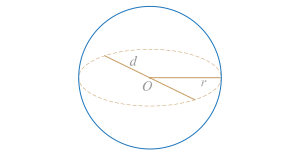
Sphere, centre, radius and diameter
⭐ Centre: The point equidistant from all points on the sphere's surface.
⭐ Radius: The distance from the centre to any point on the surface, denoted by r.
⭐ Diameter: A line segment through the centre with both endpoints on the surface. Its length is d = 2r.
If the diameter is known, first find the radius:
Example: A diameter of 10 cm gives radius 10 ÷ 2 = 5 cm.
👉 Surface Area of a Sphere
A sphere has no flat face, so its curved surface is its entire surface.
Here, S is surface area and r is radius. In terms of diameter:
📚 Memory aid: A circle of the same radius has area πr². The sphere's surface area is 4 times this. This relationship helps you remember the formula; it is not a complete geometric proof.
Units: cm², m² and other square units.
👉 Volume of a Sphere
In terms of diameter:
⭐
Units: cm³, m³ and other cubic units. Volume measures the three-dimensional space occupied by an object wherever it is located, not just in air or outer space.
💡 Relationship between sphere and cylinder volumes
🔹 A sphere of radius r fits exactly inside a right circular cylinder of radius r and height 2r.
🔹 Cylinder volume = πr² × 2r = 2πr³.
🔹 An established geometric result states that the sphere's volume is of this cylinder's volume.
🔹 Therefore, sphere volume = .
🔹 This explains the formula using the relationship. A full proof of that relationship is beyond this introductory discussion.
👉 Solid Hemisphere
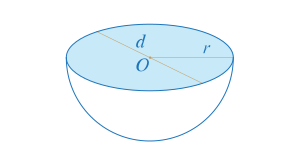
Solid hemisphere
Cutting a sphere with a plane through its centre produces 2 equal hemispheres. A solid hemisphere is filled inside and has one curved surface and one flat circular face.
Half of a solid marble is an example. An ordinary bowl is hollow and should not be described as a solid hemisphere.
1. Curved Surface Area
Half the sphere's curved surface area:
⭐
2. Total Surface Area
Add the flat circular base to the curved surface:
⭐
Notice: Total surface area is not half the sphere's surface area. Cutting creates a new flat face.
3. Volume
⭐
For a solid hemisphere, this is the object's volume. With no hollow interior, it has no container capacity like a bowl.
👉 Hollow Hemisphere
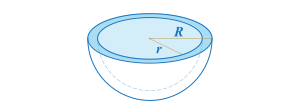
Hollow hemisphere
A thick-walled hemispherical bowl has different outer and inner measurements.
Let:
- Outer radius R.
- Inner radius r.
- Wall thickness t = R − r.
📚 Conditions: The outer and inner surfaces are concentric hemispheres whose rims lie in the same plane. Here, R > r > 0. Real bowls with different shapes may not follow these formulas directly.
1. Volume of Material
Subtract the empty interior from the outer solid hemisphere's volume:
⭐
This gives the volume of metal, glass or other material needed for the bowl. To find mass, you also need the material's density.
2. Capacity of the Bowl
The amount of liquid filling the bowl to its brim equals the volume of the hemispherical interior:
⭐
Use the inner radius here.
1 cm³ = 1 mL
1000 cm³ = 1 litre
3. Which Curved Surface Area Is Required?
First check which surface the question specifies.
📚 Outer curved surface only: 2πR2.
📚 Inner curved surface only: 2πr2.
📚 Both curved surfaces: 2π(R2 + r2).
Do not automatically add both areas whenever a question says curved surface area. Use its description or diagram to identify the required surfaces.
4. Total Surface Area
An open thick-walled bowl has 3 surface parts:
🔹 Outer curved surface: 2πR².
🔹 Inner curved surface: 2πr².
🔹 Flat annular rim: π(R² − r²).
Therefore:
⭐
Caution: The empty circle in the opening is not part of the bowl's surface. Add only the surrounding annular rim. A separate lid is not included in this formula.
👉 Hollow Sphere versus Hollow Hemisphere
A hollow sphere is a complete spherical shell. For concentric inner and outer spheres:
Volume of material:
⭐
Outer surface only: 4πR².
Combined inner and outer surfaces: 4π(R² + r²).
A completely closed shell has no annular rim like a hemispherical bowl. A hollow hemisphere with the same radii contains half as much material by volume.
👉 Simple Worked Examples
Calculation rule: Exact answers are given in terms of π where appropriate. For decimals, use the approximation specified in the question. π ≈ 3.14 and are approximations, not exact values of π.
✏️ Example 1: Sphere Area and Volume
A sphere has radius 3 cm. Find its surface area and volume.
Solution:
Surface area = 4π × 3² = 36π cm².
Volume cm³.
Answer: Area 36π cm²; volume 36π cm³. Their numerical values match here, but their units and meanings differ.
✏️ Example 2: Sphere Measurements from Diameter
A sphere has diameter 12 cm. Find its surface area and volume.
Solution: Radius r = 12 ÷ 2 = 6 cm.
Area = 4π × 6² = 144π cm².
Volume cm³.
Answer: 144π cm² and 288π cm³.
✏️ Example 3: Solid Hemisphere
Find the curved surface area, total surface area and volume of a solid hemisphere of radius 3 cm.
Solution:
Curved surface area = 2π × 3² = 18π cm².
Total surface area = 3π × 3² = 27π cm².
Volume cm³.
Answer: 18π cm², 27π cm² and 18π cm³, respectively.
✏️ Example 4: How Much Water Can the Bowl Hold?
A bowl has a hemispherical interior of radius 3 cm. Find its brimful capacity. Use π ≈ 3.14.
Solution:
cm³.
Answer: Approximately 56.52 mL. The outer radius is not needed.
✏️ Example 5: Material Used to Make a Bowl
A hollow hemispherical bowl has outer radius 6 cm and inner radius 3 cm. Find its volume of material and wall thickness.
Solution:
cm³.
Thickness t = 6 − 3 = 3 cm.
Answer: Material volume 126π cm³; thickness 3 cm.
✏️ Example 6: Surfaces of a Hollow Bowl
A hollow hemisphere has outer radius 5 cm and inner radius 4 cm. Find the combined curved area and the total surface area including the rim.
Solution: Outer curved area = 2π × 5² = 50π cm².
Inner curved area = 2π × 4² = 32π cm².
Combined curved area = 50π + 32π = 82π cm².
Annular rim = π(5² − 4²) = 9π cm².
Total surface area = 82π + 9π = 91π cm².
Answer: Combined curved area 82π cm²; total including the rim 91π cm².
✏️ Example 7: Painting Only the Outside
A hemispherical bowl has outer radius 7 cm. Only its outer curved surface is painted. Find the area to be painted. Use .
Solution:
cm².
Answer: Approximately 308 cm². Exclude the inner surface and rim.
✏️ Example 8: Doubling the Radius
A sphere's radius increases from 2 cm to 4 cm. By what factors do its area and volume change?
Solution: The new radius is 2 times the original. Area is proportional to the square of the radius and volume to its cube.
Answer: Area becomes 4 times and volume 8 times the original.
✍️ Try These Yourself
Express your answers in terms of π.
🔹 1. Find the surface area and volume of a sphere of radius 2 cm.
🔹 2. Find the total surface area and volume of a solid hemisphere of diameter 6 cm.
🔹 3. A hemispherical bowl has inner radius 6 cm. Find its capacity in millilitres.
🔹 4. A hollow hemisphere has outer radius 4 cm and inner radius 3 cm. Find its thickness and volume of material.
🔹 5. A hollow hemisphere has outer radius 3 cm and inner radius 2 cm. Find the combined curved area and total surface area.
🔹 6. A concentric spherical shell has outer radius 3 cm and inner radius 2 cm. Find the volume of material and outer surface area.
✅ Check Your Answers
🔸 1. Area 16π cm²; volume cm³.
🔸 2. Radius 3 cm; total surface area 27π cm²; volume 18π cm³.
🔸 3. Capacity 144π mL.
🔸 4. Thickness 1 cm; material volume cm³.
🔸 5. Combined curved area 26π cm²; total surface area 31π cm².
🔸 6. Material volume cm³; outer surface area 36π cm².
🧠 Important Points to Remember
Diameter and radius: Divide the diameter by 2 to obtain the radius.
Correct units: Use square units for area and cubic units for volume. Convert all lengths to the same unit before calculating.
Solid hemisphere: Include the flat circular base for total surface area.
Hollow bowl: Subtract the empty interior from the outer volume to find material volume. For capacity, use only the inner radius.
Difference of cubes: R³ − r³ and (R − r)³ are not equal in general. Thickness alone does not determine the volume of material.
Painting or polishing: Choose the formula according to whether the outer, inner or all surfaces are required.
Approximation: Leave π in an exact answer. Use the specified approximation when a decimal answer is required.
Scaling: Multiplying all lengths by k multiplies surface area by k² and volume by k³.
💡 Quick Revision
| Shape | Surface area | Volume |
|---|---|---|
| Sphere; radius r | 4πr² | |
| Solid hemisphere; radius r | Curved surface 2πr²; total surface 3πr² | |
| Hollow hemisphere; radii R and r | Both curved surfaces 2π(R² + r²); total including rim π(3R² + r²) | Material: |
| Hollow sphere; radii R and r | Outer only 4πR²; inner and outer combined 4π(R² + r²) | Material: |
⭐ Remember the capacity of a hollow hemispherical bowl separately: , where r is the inner radius.


