

Surface Area and Volume of Solid and Hollow Cylinders
🎯 What will you learn in this lesson?
👉 Recognize solid and hollow cylinders.
👉 Distinguish curved surface area from total surface area.
👉 Explain how the formulas are obtained.
👉 Calculate the volume of material in a pipe and the capacity of a container.
👉 Choose the correct surfaces, measurements and units for each problem.
How much paper is needed to label a can? How much metal is needed to make a pipe? How many litres will fill a container to the brim? These questions use area, volume of material and capacity, respectively.
👉 What Is a Cylinder?
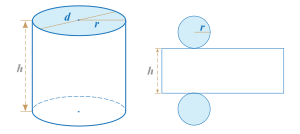
Cylinder
Here, cylinder means a right circular cylinder. It has 2 equal, parallel circular faces. The axis joining their centres is perpendicular to both faces. The perpendicular distance between them is the height.
The curved surface area formulas here apply to right circular cylinders, not directly to oblique cylinders. A solid cylinder is completely filled, like an ideal cylindrical metal rod. A hollow cylinder has an empty interior, like a straight pipe.
👉 Main Dimensions of a Solid Cylinder
⭐ Base radius = r
⭐ Base diameter = d = 2r
⭐ Perpendicular height = h
Here, r and h are positive. If the diameter is given, use r = d2.
Value of π: π is irrational. You may use π ≈ 3.14 or π ≈ 227 as approximations, not exact values. Follow the value specified in the question, or leave π in an exact answer.
👉 Solid Cylinder Formulas and Explanations
1. Area of One Base
The base is a circle, so:
⭐ B = πr2
Here, B is the area of one circular face. The combined area of both faces is 2πr2.
2. Lateral or Curved Surface Area
⭐ CSA = 2πrh
This includes only the curved side surface, excluding the top and bottom circular faces.
💡 Understanding the formula
🔹 Cut a can's label along its height and lay it flat. Assuming no extra overlap for joining, it forms a rectangle.
🔹 Rectangle length = base circumference = 2πr.
🔹 Rectangle width = cylinder height = h.
🔹 Curved surface area = length × width = 2πr × h = 2πrh.
3. Total Surface Area
For a complete solid cylinder, add both circular faces to the curved surface:
⭐ TSA = 2πrh + 2πr2 = 2πr(h + r)
📚 Remember: Curved surface + top face + bottom face = total surface.
4. Volume
⭐ V = πr2h
Every cross-section parallel to the base has the same area, πr². Imagine stacking very thin circular layers of the same size up to height h. This explains the volume formula:
Volume = base area × height.
This is a simple geometric explanation. The rule does not apply to every 3D solid. In cones and pyramids, for example, cross-sectional size changes with height.
If the diameter is d:
⭐
👉 Which Area Should You Use for an Open Container?
For a container made from thin sheet, ignoring wall thickness, joining allowance and wastage:
🔹 Closed container with both circular faces: 2πrh + 2πr²
🔹 Open top with one bottom face: 2πrh + πr²
🔹 Side sheet or label only: 2πrh
These are areas of one side of the sheet. For painting both inside and outside, count both surfaces as required. Thick walls or a thick bottom need additional measurements.
👉 Structure of a Hollow Cylinder
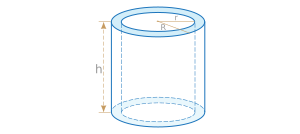
Hollow cylinder
Here, a hollow cylinder is a straight pipe of uniform thickness, open at both ends. The outer and inner cylinders share an axis and have equal heights.
Let:
🔹 Outer radius R
🔹 Inner radius r
🔹 Height or length h
🔹 Wall thickness t = R − r
Here, R > r > 0 and h > 0. If the outer diameter is D and inner diameter d:
Caution: Subtracting the diameters alone does not give wall thickness; divide that difference by 2.
👉 Surface Area of a Hollow Cylinder
1. Outer and Inner Curved Surfaces
The outer radius is R, so the outer curved surface area is:
⭐
The inner radius is r, so the inner curved surface area is:
⭐
For both curved surfaces together:
⭐
If only the outside is painted, do not add the inner area. Check which surface the question means by curved surface area.
2. Area of the Two Annular Ends
Each end is a flat ring. Its area = larger circle area − inner empty circle area.
⭐
Therefore, the combined area of both ends is:
⭐
The empty opening is not part of the pipe's surface and must not be added.
3. Total Surface Area
Add the inner and outer curved surfaces and both annular ends:
⭐
⭐
💡 Obtaining the formula by factorisation
🔹 We know R² − r² = (R + r)(R − r).
🔹 Therefore, total surface area = 2πh(R + r) + 2π(R + r)(R − r).
🔹 Taking out the common factor 2π(R + r) gives:
🔹 ।
This formula includes no lid or closed bottom. For a thick container closed at one end, the bottom's shape and thickness are also needed.
👉 Volume of Material in a Hollow Cylinder
Subtract the empty interior from the volume of the complete outer cylinder:
⭐
Equivalently, multiply the area of an annular cross-section by the length.
This gives the volume of metal, plastic or other material in the pipe, not its mass. To find mass, you also need density:
Mass = volume of material × density, using compatible units.
👉 Interior Volume and Container Capacity
Volume of the pipe's empty interior:
⭐
A pipe open at both ends cannot hold water on its own. For a cylindrical container's capacity, use its internal radius and usable internal height in the same formula.
Unit conversions:
🔹 1 cm³ = 1 mL
🔹 1000 cm³ = 1 litre
🔹 1 m³ = 1000 litres
You may need to subtract bottom thickness from the external height. Do not assume that external and internal dimensions are equal.
👉 Simple Worked Examples
✏️ Example 1: Solid Cylinder Area and Volume
A solid cylinder has radius 3 cm and height 5 cm. Find its curved surface area, total surface area and volume.
Solution:
Curved surface area = 2π × 3 × 5 = 30π cm².
Total surface area = 2π × 3 × (3 + 5) = 48π cm².
Volume = π × 3² × 5 = 45π cm³.
Answer: 30π cm², 48π cm² and 45π cm³, respectively.
✏️ Example 2: Volume from Diameter
A cylinder has diameter 10 cm and height 4 cm. Find its volume.
Solution: Radius r = 10 ÷ 2 = 5 cm.
Volume = π × 5² × 4 = 100π cm³.
Answer: 100π cm³, or approximately 314 cm³ using π ≈ 3.14.
✏️ Example 3: Area of a Can's Label
A can has radius 7 cm and height 10 cm. How much paper covers only its curved surface? Ignore overlap for joining and use .
Solution:
cm².
Answer: Approximately 440 cm² of paper. The top and bottom are not covered.
✏️ Example 4: Sheet for an Open-Top Container
An open-top cylindrical container has radius 3 cm and height 4 cm. What sheet area is needed, ignoring thickness, joints and wastage?
Solution: Include one curved surface and one circular base.
A = 2π × 3 × 4 + π × 3² = 24π + 9π = 33π cm².
Answer: 33π cm² of sheet.
✏️ Example 5: Water Container Capacity
A cylindrical container has internal radius 10 cm and internal height 20 cm. How many litres fill it to the brim? Use π ≈ 3.14.
Solution:
Capacity = π × 10² × 20 = 2000π cm³.
In litres = 2000π ÷ 1000 = 2π ≈ 6.28 litres.
Answer: Approximately 6.28 litres.
✏️ Example 6: Pipe Material and Empty Interior
A pipe has outer radius 5 cm, inner radius 4 cm and length 10 cm. Find its thickness, volume of material and interior volume.
Solution: Thickness = 5 − 4 = 1 cm.
Volume of material = π × 10 × (5² − 4²) = 90π cm³.
Interior volume = π × 4² × 10 = 160π cm³.
Answer: 1 cm, 90π cm³ and 160π cm³. Adding the two volumes gives the complete outer cylinder's volume, 250π cm³.
✏️ Example 7: Total Surface Area of a Pipe
A pipe open at both ends has outer radius 3 cm, inner radius 2 cm and length 5 cm. Find its total area, including both curved surfaces and the ends.
Solution: Outer curved surface area = 2π × 3 × 5 = 30π cm².
Inner curved surface area = 2π × 2 × 5 = 20π cm².
Both annular ends = 2π(3² − 2²) = 10π cm².
Total surface area = 30π + 20π + 10π = 60π cm².
Answer: 60π cm². The compact formula also gives 2π(3 + 2)(5 + 3 − 2) = 60π.
✏️ Example 8: Height from Volume
A cylinder has volume 72π cm³ and radius 3 cm. Find its height.
Solution: From V = πr²h:
cm.
Answer: Height 8 cm.
✍️ Try These Yourself
Leave answers in terms of π where appropriate.
🔹 1. A solid cylinder has radius 2 cm and height 5 cm. Find its curved surface area, total surface area and volume.
🔹 2. A cylinder has diameter 6 cm and height 4 cm. Find its volume.
🔹 3. A thin open-top container has radius 2 cm and height 3 cm. Find the sheet area, ignoring thickness and joints.
🔹 4. A pipe has outer diameter 10 cm, inner diameter 6 cm and length 7 cm. Find its thickness and volume of material.
🔹 5. A pipe open at both ends has outer radius 4 cm, inner radius 3 cm and length 6 cm. Find the combined curved surface area and total surface area.
🔹 6. A cylindrical container has internal radius 5 cm and internal height 20 cm. Find its capacity in litres. Use π ≈ 3.14.
✅ Answers and Short Calculations
🔸 1. Curved surface area 20π cm²; total surface area 28π cm²; volume
20π cm³.
🔸 2. Radius 3 cm; volume π × 3² × 4 = 36π cm³.
🔸 3. Sheet area 2π × 2 × 3 + π × 2² = 16π cm².
🔸 4. Radii 5 cm and 3 cm; thickness 2 cm; volume of material
π × 7 × (25 − 9) = 112π cm³.
🔸 5. Combined curved area 2π × 6 × (4 + 3) = 84π cm²; total surface area
2π × 7 × (6 + 1) = 98π cm².
🔸 6. Capacity π × 5² × 20 = 500π cm³ = 0.5π litres, or approximately 1.57 litres.
🧠 Important Points to Remember
🔹 Shape: These curved surface area formulas apply to right circular cylinders.
🔹 Radius: Divide a given diameter by 2 first.
🔹 Required surfaces: Labels, painting, open containers and closed containers may involve different surfaces.
🔹 Pipe open at both ends: The ends are 2 rings, not 2 complete circles.
🔹 Material versus empty space: Material volume uses R² − r²; the empty interior uses only r².
🔹 Difference of squares: R² − r² and (R − r)² are not equal in general.
🔹 Units: Use square units for area and cubic units for volume. Convert all lengths to the same unit first.
🔹 Capacity: Use the internal radius and internal height.
🔹 Scaling: Doubling the radius with height unchanged multiplies volume by 4. Doubling both radius and height multiplies volume by 8.
💡 Quick Revision
| Shape | Surface area | Volume |
|---|---|---|
| Solid cylinder; radius r, height h | Curved surface 2πrh; total surface 2πr(r + h) | πr²h |
| Hollow cylinder open at both ends; radii R and r, height h | Both curved surfaces 2πh(R + r); total surface 2π(R + r)(h + R − r) | Material: πh(R² − r²) |
⭐ The empty interior has volume πr²h. For container capacity, r and h must be internal measurements.


