

General Rules for Writing and Naming Chemical Formulas
🎯 What will you learn in this chapter?
👉 The difference between a chemical symbol and a chemical formula
👉 What valency is and why it is important
👉 The correct order of writing metals and non-metals in a formula
👉 How to use the valency cross method to form chemical formulas
👉 Naming compounds containing metals with variable valency
👉 Using prefixes such as mono, di, tri, and tetra in naming compounds
👉 How electronegativity affects the order of elements in formulas
👉 How to write formulas of compounds containing metals and radicals, or two radicals
🔹 While writing the formula of a compound, the symbol or formula of the metal or metal-like positive radical is generally written first. The symbol or formula of the non-metal or non-metal-like negative radical is written after it.
Suppose the symbol of a metal atom or metal-like radical is M and its valency is x. Similarly, suppose the symbol of a non-metal atom or non-metal-like radical is N and its valency is y.
Then the formula of the compound formed by M and N will be MyNx.
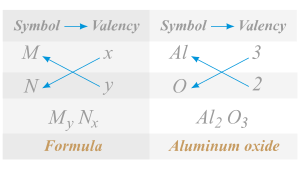
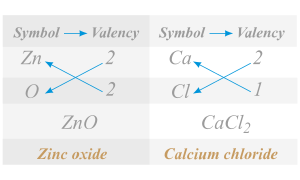
Formation of Al2O3, ZnO, and CaCl2 using the valency cross method.
⭐ When a metal shows more than one valency, traditional names may use the suffix -ous for the lower valency and -ic for the higher valency.
For example —
Cu: cuprous - 1, cupric - 2
Hg: mercurous - 1, mercuric - 2
Cr: chromous - 2, chromic - 3
Fe: ferrous - 2, ferric - 3
Sn: stannous - 2, stannic - 4
As: arsenous - 3, arsenic - 5
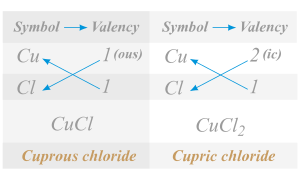
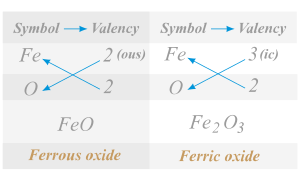
⭐ For compounds formed between non-metals, prefixes such as mono for 1, di for 2, tri for 3, tetra for 4, and penta for 5 are commonly used to indicate the number of atoms.
For example — nitrous oxide (N2O), nitrogen monoxide (NO), dinitrogen trioxide (N2O3), dinitrogen tetroxide (N2O4), and dinitrogen pentoxide (N2O5).
⭐ In many binary compounds of two non-metals, the less electronegative element is written first and the more electronegative element is written second.
For example, carbon dioxide is written as CO2 and silicon dioxide as SiO2.
⭐ When a compound contains two non-metals, the more electronegative element is generally written later in the formula.
For example, oxygen is more electronegative than nitrogen, so oxygen is written after nitrogen. Therefore, nitric oxide is written as NO. Similarly, sulfur dioxide is SO2 and phosphorus pentachloride is PCl5.
⭐ When writing the formula of a compound formed by a metal and a polyatomic ion, write the metal symbol first and the radical formula after it, then use their valencies to obtain the simplest whole-number ratio.
⭐ When a compound is formed from two radicals or ions, write the positive ion first and the negative ion second, then use their charges or valencies to form an electrically neutral formula.
Why is the formula of water written as H2O instead of OH2?
✅ Quick Revision
🔹 A chemical symbol is the short form used to represent an element.
🔹 A chemical formula represents the composition of an element or compound using chemical symbols.
🔹 Valency is the combining capacity of an atom or ion.
🔹 In ionic formulas, the positive ion is generally written first and the negative ion second.
🔹 The cross method uses valencies or ionic charges to obtain the simplest ratio of the combining particles.
🔹 Traditional names of some metals use -ous for the lower valency and -ic for the higher valency, such as ferrous and ferric.
🔹 Prefixes such as mono, di, tri, and tetra are used in the names of many covalent compounds.
🔹 In many binary compounds, the more electronegative element is written second.


