

Chemical Symbols, Formulas, Valency, and Radicals
🎯 What will you learn in this chapter?
👉 What a chemical symbol is and how it is written
👉 The meaning of chemical formulas of elements and compounds
👉 How to interpret formulas such as NaCl, H₂O, and CO₂
👉 What radicals or polyatomic ions are, along with their formulas and valencies
👉 Rules for distinguishing symbols of elements that begin with the same letter
👉 Examples of symbols derived from Latin names
👉 What valency means and why it is important
👉 Common monovalent, divalent, and trivalent radicals
Chemical Symbol
A chemical symbol is the short form used to represent an element. In other words, it represents one atom of an element in a concise form.
⭐ Some common rules for writing chemical symbols ⭐
Using the first letter of the English name of the element —
Hydrogen (Hydrogen) = H
Oxygen (Oxygen) = O
Carbon (Carbon) = C
Nitrogen (Nitrogen) = N
Sulfur (Sulfur) = S
Boron (Boron) = B
When several elements begin with the same letter, a second letter from the name is added to distinguish their symbols. The first letter is uppercase and the second letter is lowercase —
Calcium (Calcium) = Ca
Chromium (Chromium) = Cr
Chlorine (Chlorine) = Cl
Cadmium (Cadmium) = Cd
Cesium (Cesium) = Cs
Bromine (Bromine) = Br
Bismuth (Bismuth) = Bi
Barium (Barium) = Ba
Beryllium (Beryllium) = Be
Some symbols are derived from the Latin names of elements —
Sodium (Natrium) = Na
Potassium (Kalium) = K
Iron (Ferrum) = Fe
Lead (Plumbum) = Pb
Silver (Argentum) = Ag
Gold (Aurum) = Au
Copper (Cuprum) = Cu
Mercury (Hydrargyrum) = Hg
Match the left column with the right one
👉 Significance of Chemical Symbols
⭐ A symbol represents the name of an element in a short form.
⭐ A chemical symbol can represent one atom of an element.
⭐ A symbol may also represent an amount of the element equal to its relative atomic mass in atomic mass units when discussing particles at the atomic scale.
⭐ For monatomic elements such as calcium (Ca), sodium (Na), potassium (K), and iron (Fe), the same symbol is used to represent the element and an individual atom of that element.
Chemical Formula
A chemical formula is a concise way of representing the composition of an element or compound using chemical symbols.
⭐ In molecular elements containing more than one atom, the number of atoms is written as a subscript to the right of the symbol.
Hydrogen (H) – H2, oxygen (O) – O2, ozone (O) – O3
To understand chemical formulas properly, we also need to understand two important ideas: valency and radicals or polyatomic ions.
Valency
Valency is the combining capacity of an atom when it joins with other atoms.
Traditionally, valency may be understood by comparing how many hydrogen atoms an atom can combine with, or how many hydrogen atoms it can replace in a compound.
Taking the valency of hydrogen as 1, we can estimate the valency of other elements from simple compounds:
🔹 HCl → 1 H atom is combined with 1 Cl atom, so the valency of chlorine is 1.
🔹 H2O → 2 H atoms are combined with 1 O atom, so the valency of oxygen is 2.
🔹 NH3 → 3 H atoms are combined with 1 N atom, so the valency of nitrogen is 3.
Writing Chemical Formulas Using Valency
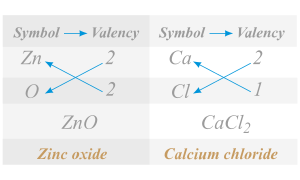
Formation of ZnO and CaCl2 using the valency cross method.
This method is discussed in more detail in the next chapter.⭐ Valency is normally expressed as a whole number in elementary chemistry.
⭐ An element may show more than one valency. This is called variable valency.
Example — Iron (Fe)
Fe²⁺ → valency 2
Fe³⁺ → valency 3
Therefore,
🔹 FeO → here Fe has valency 2
🔹 Fe2O3 → here Fe has valency 3
The same element can form different compounds when it shows different valencies or oxidation states.
Radicals or Polyatomic Ions
A group of two or more atoms can remain bonded together and take part in chemical reactions as a single unit. Such a charged group is called a polyatomic ion. In traditional school chemistry, such groups are often called radicals.
⭐ Each radical or polyatomic ion has a definite charge or combining capacity.
⭐ Polyatomic ions usually occur as parts of compounds or in solution rather than as neutral, independent substances.
⭐ They may be positively or negatively charged.
⭐ Positively charged radicals behave like cations, for example the ammonium ion (NH4+).
⭐ Some single-atom ions are also traditionally grouped with radicals in school chemistry. For example, chloride (Cl‒), fluoride (F‒), and bromide (Br‒).
Some Common Radicals and Their Valencies
🔹 Monovalent radicals or ions:
Nitrate (NO3‒), nitrite (NO2‒), hydroxide (OH‒), chlorate (ClO3‒), bicarbonate (HCO3‒), permanganate (MnO4‒), aluminate (AlO2‒), bisulfate (HSO4‒), chloride (Cl‒), fluoride (F‒), bromide (Br‒), iodide (I‒).
🔹 Divalent radicals or ions:
Oxide (O2‒), sulfide (S2‒), sulfite (SO32‒), sulfate (SO42‒), carbonate (CO32‒), zincate (ZnO32‒), dichromate (Cr2O72‒).
🔹 Trivalent radicals or ions:
Phosphide (P3‒), phosphate (PO43‒), nitride (N3‒).
Match the left column with the right one
🧠 Pure Thinking Questions
💡 If an element has valency 2, will it always form the same kind of compound? Think of examples and explain your reasoning.
💡 Sodium (Na) and potassium (K) are both monovalent. Should NaCl and KCl have exactly the same properties? Why or why not?
💡 Why are polyatomic ions usually found as parts of compounds or in solution rather than as neutral, independent substances?
💡 If an element has more than one valency, such as iron, how will the formulas of its compounds change? Think of real examples.
💡 Why is the valency cross method useful while writing chemical formulas? What kinds of mistakes could occur if the valencies are ignored?
✅ Quick Revision
🔹 A chemical symbol is the short form used to represent an element.
🔹 Symbols are usually derived from the first one or two letters of the English or Latin name of an element.
🔹 A chemical formula represents the composition of an element or compound using chemical symbols.
🔹 Valency is the combining capacity of an atom or ion.
🔹 The valency cross method is often used to obtain the simplest ratio of ions while writing formulas.
🔹 A group of atoms that behaves as a single charged unit is called a polyatomic ion or, in traditional school chemistry, a radical.


